
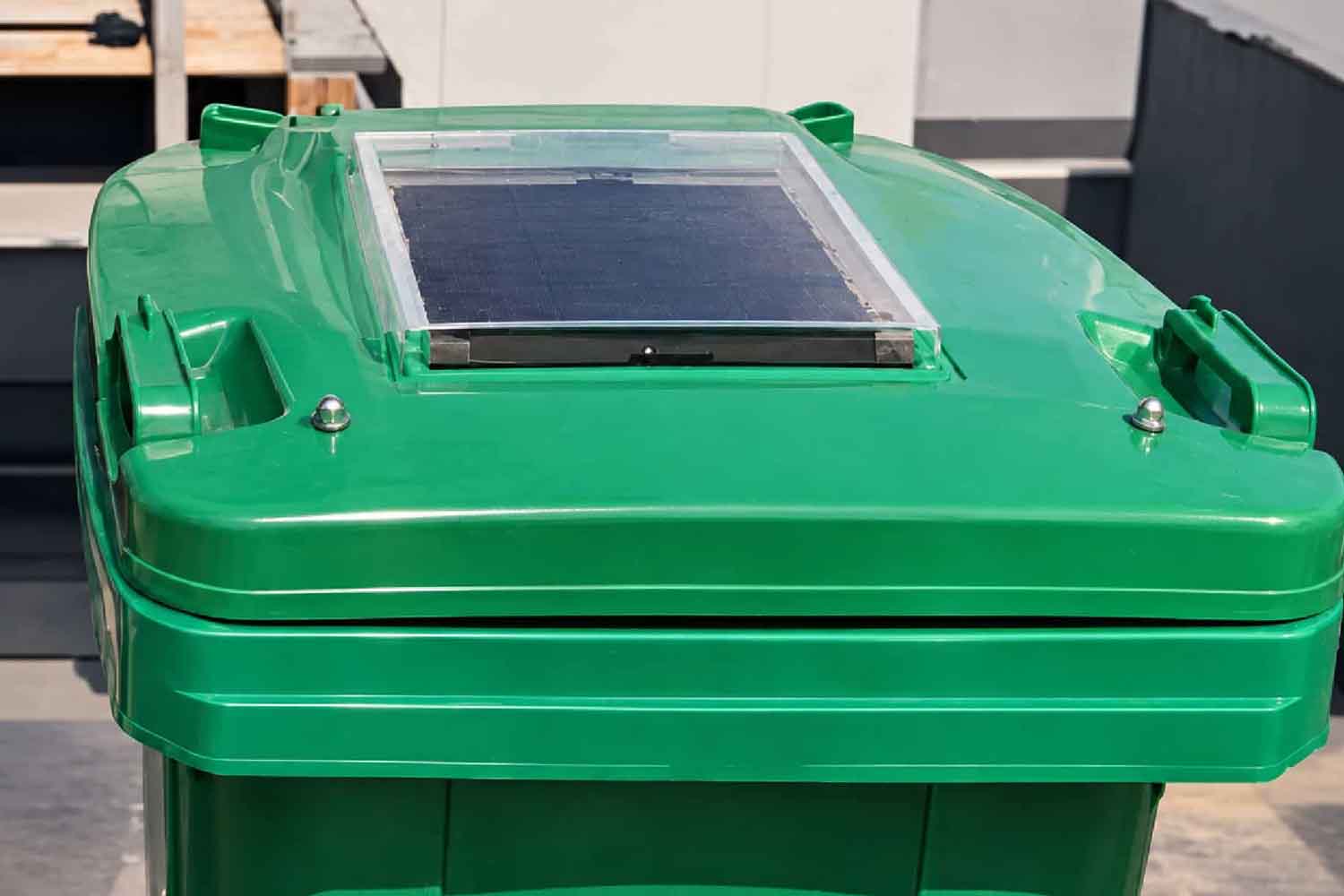
For more than 1,000 hours, inside a bin with rotting fruit, bread and wine, a small module mounted on the lid continued to degrade the acetic acid released from the waste. No socket, battery or photovoltaic panel: the energy is directly supplied by sunlight, concentrated on a catalyst.
The device was developed by a group of Chinese researchers and described in the study published on Environmental Science & Technology. The work is authored by Tongzhou Xu and colleagues, with researchers from the Beijing Academy of Science and Technology, the Central China Normal University and the Huazhong University of Science and Technology.
The idea starts from one of the less noble problems of organic waste management: opening the lid when it’s hot outside. During decomposition, various volatile compounds are produced; the researchers focused on acetic acid, one of the volatile fatty acids associated with the pungent odor of food waste. The experimental device then tries to degrade the molecules directly inside the container, before they disperse into the air.
Inside the lid is a lithium manganese catalyst
The material chosen is a lithium-modified manganese dioxide, referred to in the study as Li–MnO₂. The addition of lithium changes the distribution of electrons within the material and makes the reaction that leads to the degradation of acetic acid more effective when light arrives.
In the prototype, the catalyst is enclosed in a removable, gas-permeable module. A lens concentrates solar radiation on the material: the light is transformed into heat on the surface and, at the same time, promotes the electronic processes necessary for the reaction. In the laboratory, Li–MnO₂ degraded acetic acid more effectively than simple MnO₂ and activated carbon under the simulated light conditions used by the researchers, maintaining good performance even in the presence of humidity.
Activated carbon, also used in odor filters, works primarily by retaining molecules. Here the goal is different: to make the acetic acid react and degrade it. For Jinlong Wang, one of the corresponding authors, the motivation was very practical: to intervene on the odor at the source, inside the bin, as explained in the American Chemical Society press release.
Rotten fruit, bread and wine for over 40 days
After testing the material, the group moved on to something much more similar to the garbage can at home. The module was installed on the lid of a normal wheeled bin and subjected to natural sunlight, while fruit, bread and wine decomposed inside.
The system continued to degrade acetic acid for more than 40 days, exceeding the 1,000 hours of operation reported in the study. The authors consider the result as proof of the stability of the device in a representative municipal waste scenario. The energy advantage is quite obvious: catalytic odor abatement systems may require electrical heating, whereas here that job is entrusted to light.
However, there is an important boundary. The study mainly measures the removal of acetic acid, defined by the authors as a key compound among the volatile fatty acids produced by waste. A dustbin contains a much more complex mixture of odorous substances, so more than 1,000 hours of operation do not prove that the lid eliminates every possible bad smell.
For now it remains a prototype
The work shows that the principle can also work outside the small laboratory reactor: a real module exists, it can be mounted on a common bin and has worked for weeks with real food waste. From here to finding it above the waste bin, however, there is still a long way to go.
The study does not establish how well the system would maintain performance during long periods of low light or document a durability of months or years through rain, dirt, grease, shocks and repeated washing. In fact, the authors speak of a possible future application in the management of waste odors, not of a product already ready for the market. For now it remains a prototype with a very concrete merit: for over forty days he used something that already comes free on the lid of an outdoor dustbin. The sun.
