
In Italy radioactive waste continues to grow. And they don’t just come from old nuclear power plants, now inactive: hospitals, research laboratories and industrial activities also produce them. At the end of 2025, 34,606 cubic meters of radioactive waste were stored on the national territory, almost 840 more than the previous year. An increase of 2.49%, which shows how long and complex the process is to treat and dispose of them adequately.
The numbers are provided by the National Inventory of Radioactive Waste of ISIN, the National Inspectorate for Nuclear Safety and Radiation Protection, updated to 31 December 2025 and released today. The interesting fact is that, while the volume of materials to be managed increases, the overall radioactivity decreases by 2.51%. A result that might seem reassuring, but which requires some explanation: less radioactivity, in fact, does not necessarily mean less waste, nor that the problem of its management is close to a solution.
Why does this waste continue to increase?
The increase in these particular wastes does not affect all categories in the same way. In 2025, waste with very low activity (characterised by low levels of radioactivity) grew above all, with an increase of 580 cubic metres, and waste with a very short average lifespan (which loses its radioactivity relatively quickly), increased by 286 cubic metres. The increase in medium-level waste (waste that requires greater precautions for radiation protection) is more limited, equal to approximately 35 cubic metres. On the other hand, low activity waste (i.e. waste with higher radioactivity, which requires particular protection and isolation measures) decreased by almost 62 cubic metres.
Overall, the national volume is divided as follows:
Classification is fundamental because different materials require different management methods and times. Not all radioactive waste presents the same risks and, above all, not all of it can be disposed of with the same solutions.
Lazio is the Italian region with the most radioactive waste
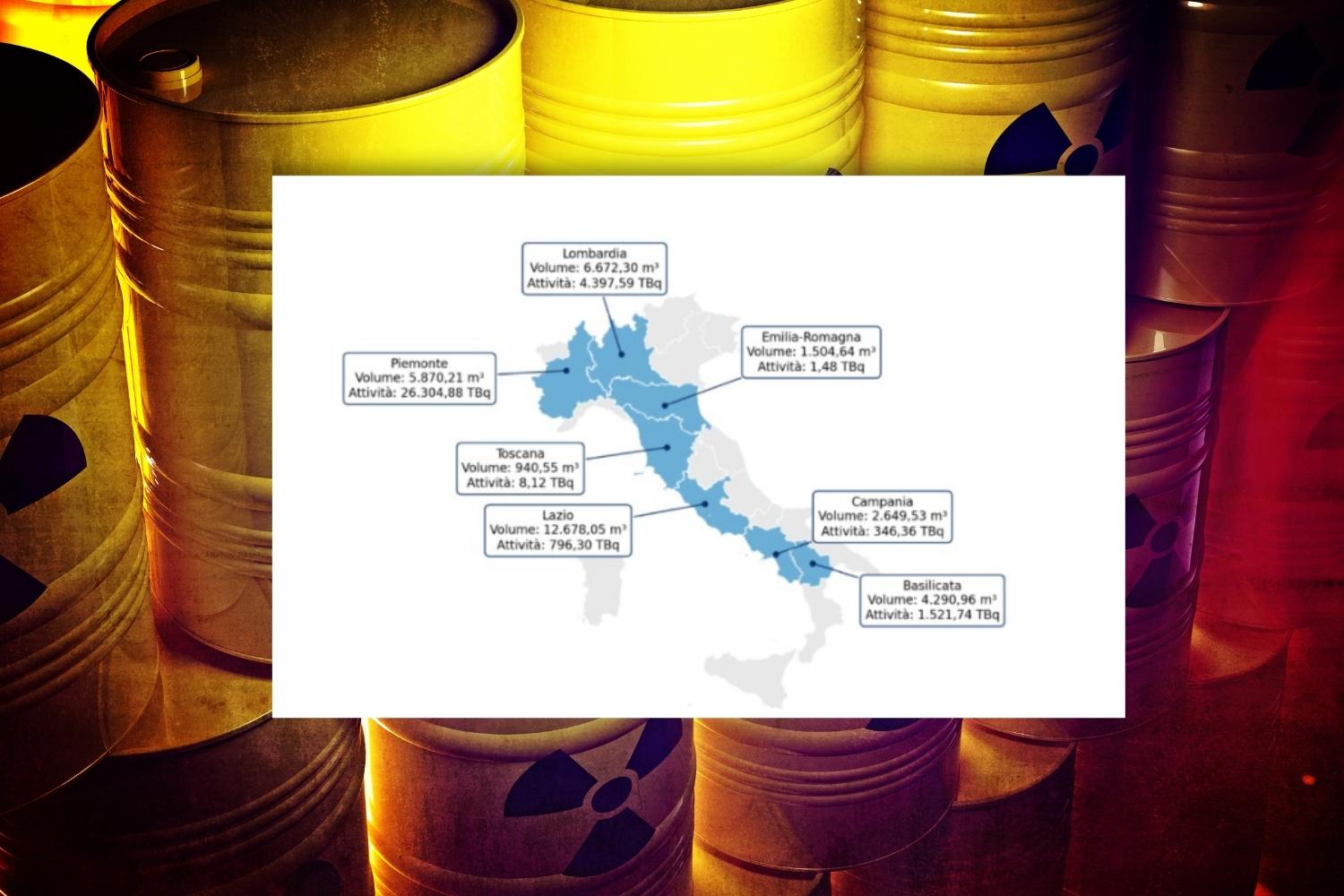
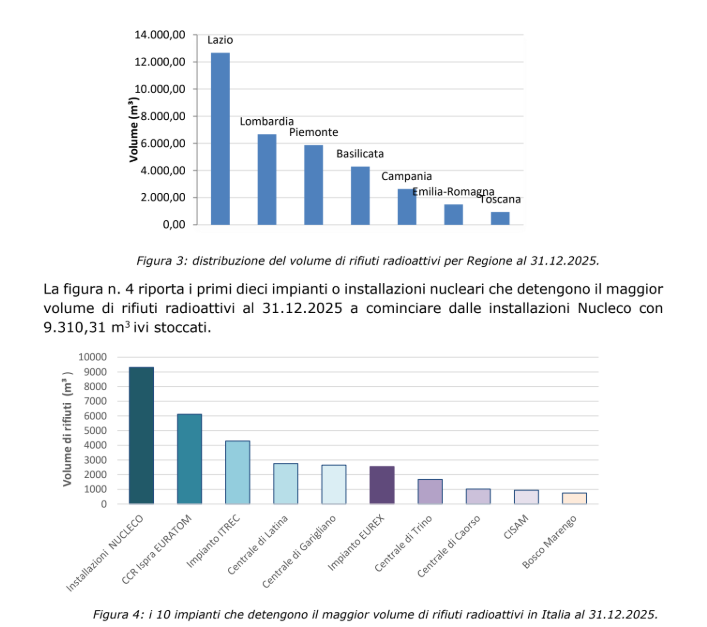
The territorial distribution reveals another peculiarity: radioactive waste is not distributed uniformly throughout the country, but is concentrated above all in some regions. In first place we find Lazio, with 12,678 cubic meters, equal to 36.64% of all radioactive waste present in Italy. It alone holds more than a third of them.
Followed by Lombardy (6,672 m3 and 19.28% of the total), Piedmont (5,870 m3, 16.96%), Basilicata (4,291 m3, 12.40%), Campania (2,650 m3, 7.66%), Emilia-Romagna (1,505 m3, 4.35%) and Tuscany (941 m3, 2.72%). The concentration depends on the presence of old power plants, plants linked to the nuclear fuel cycle and structures dedicated to the treatment and management of radioactive materials.
@ISIN
It is no coincidence that the installations of Nucleco, a company that operates in the management of radioactive waste, represent the site with the largest volume recorded by the inventory: over 9,310 cubic meters. But it is important to clarify that the region that stores the most waste in terms of volume is not necessarily the one that has the greatest radioactivity.
Radioactivity decreases
According to ISIN, at the end of 2025 the overall activity of radionuclides contained in radioactive waste, decommissioned sources and spent nuclear fuel amounted to 33,376.47 terabecquerels (TBq), 861 less than the previous year. The becquerel is the unit of measurement of radioactive activity and indicates the number of nuclear decays per second. It does not directly measure the risk to people, which also depends on the type of radiation, exposure and characteristics of the materials. The recorded decrease is mainly due to natural radioactive decay: as time passes, unstable atoms transform and the activity of certain substances is reduced.
This, however, does not mean that all materials quickly become harmless. Some radionuclides decay quickly, while others require extremely long periods. Piedmont holds the highest share of radioactive activity, with approximately 26,305 TBq, a quantity significantly higher than that of the other regions. The data also includes irradiated nuclear fuel. Among the plants considered, the one with the greatest activity associated with radioactive waste and abandoned sources is the EUREX in Saluggia, in the province of Vercelli.
It is precisely this distinction between volume and activity that is important: a thousand cubic meters of very low radioactive materials are not comparable, in terms of radiological characteristics and management needs, to much smaller quantities of highly radioactive materials.
@ISIN
The return of nuclear power plants to Italy and the unsolved problem of waste
These numbers arrive at a particularly delicate moment. The Meloni Government has decided to reopen the path to nuclear energy, focusing on new technologies, including small modular reactors (SMR). On 23 September 2026, Parliament definitively approved the enabling law on so-called sustainable nuclear energy, which became law no. 169 of 29 September 2026. The provision, which will come into force on 15 October, entrusts the Government with the task of defining the new regulatory framework for the sector through subsequent legislative decrees. It does not mean, therefore, that the construction of new power plants has already been decided, but it represents an important political and legislative step towards a possible return of the atom to the national energy mix.
The point, however, is that Italy has not yet solved the problem of waste produced by its previous nuclear program. The National Repository, the infrastructure intended to collect radioactive waste currently distributed across numerous sites in a single place, remains a project without a definitive location. After years of studies, maps of suitable areas and consultations, the search for the site continues. According to Sogin’s project, the deposit should permanently accommodate approximately 84 thousand cubic meters of very low and low activity waste, as well as temporarily hosting approximately 14 thousand cubic meters of medium and high activity waste. For the latter, in fact, a different definitive disposal solution will be necessary, suited to their characteristics and decay times.
And this is where the contradiction emerges. On the one hand, new nuclear power plants are being discussed as a possible response to the need to decarbonise the energy system. On the other hand, we have not yet managed to identify a place where we can centrally manage an important part of the radioactive waste that we already possess in a centralized and long-term manner. Nuclear has the advantage of producing electricity with low greenhouse gas emissions during operation, but it leaves open questions that cannot be dismissed as technical details: costs, implementation times, safety, spent fuel management and responsibilities towards future generations.
