
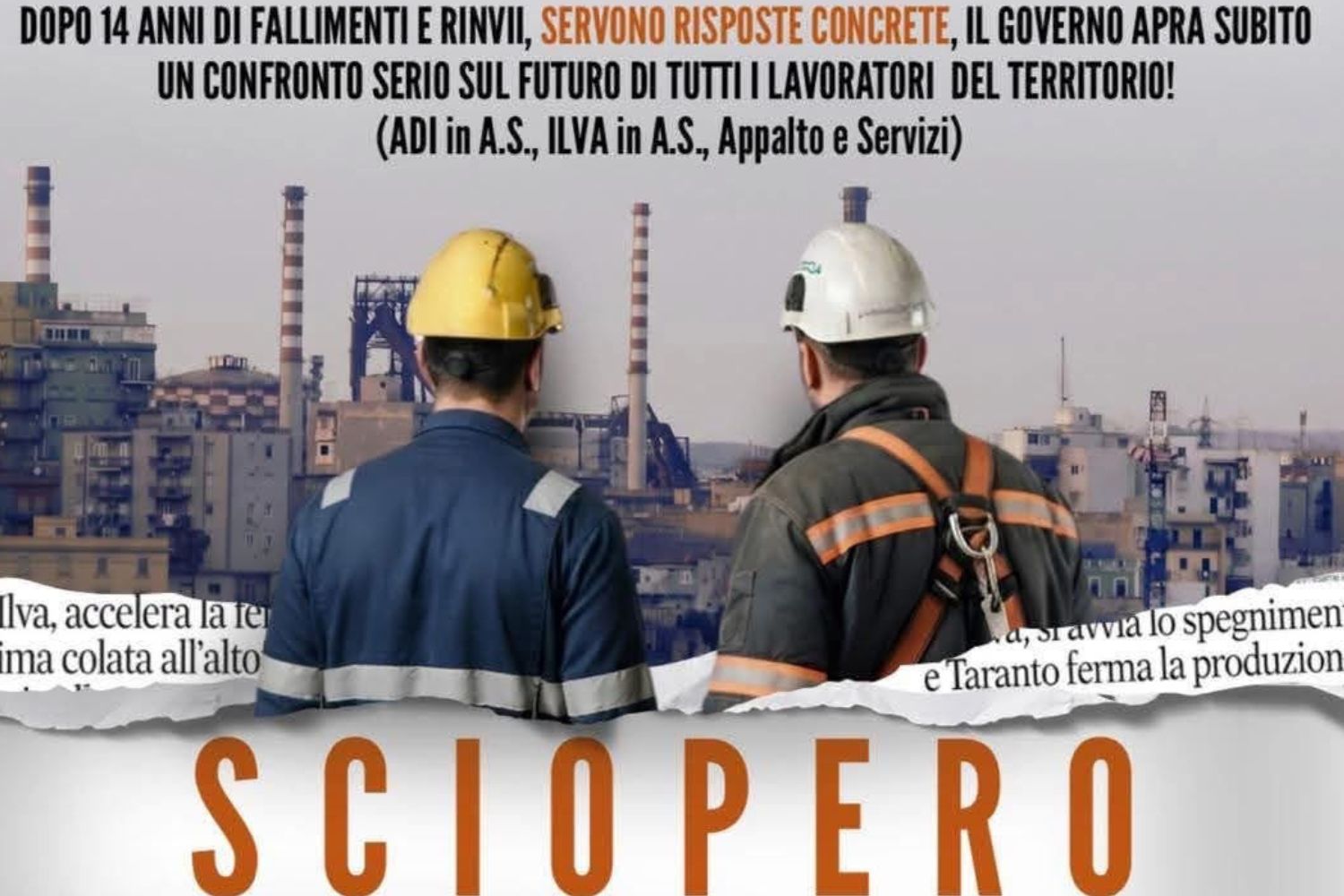
The Italian government has launched a 187 million euro measure to deal with the emergency of the former Ilva steel group, focusing on maintaining the plants in pre-heating mode and on employment incentives. The response from the blue suits, however, was not long in coming. The national trade unions Fim, Fiom and Uilm have proclaimed another forty-eight hours of strike in all Italian factories, judging the measures insufficient to guarantee concrete prospects for the industrial and employment future of the supply chain.
The Council of Ministers structured the intervention along three main lines: the safeguarding of employment levels, the physical protection of steel plants and the relaunch of productive investments. As specified by the Minister of Labor Marina Calderone, the regulatory and economic system “will exert its effects during 2027 and in the years to come”. At the center of the strategy is the decision to keep the blast furnaces in a preheating phase without direct production, a technical measure designed to sterilize the risk of a definitive shutdown. This option serves to freeze the scenario pending the ruling of the Court of Cassation, set for October 20th, on the appeals relating to the ruling of the Court of Appeal of Milan.
The legislative text also introduces a preferential lane for development contracts, binding new industrial entities to the priority hiring of staff from Acciaierie d’Italia and Ilva in Extraordinary Administration, accompanied by social security contributions relief for employers. On the territorial resources front, the package includes a final loan tranche of 40.5 million euros for the company, one million euros per year allocated to the Taranto technopole and the creation of the Brindisi-Taranto industrial district to accelerate the transition towards zero-emission technologies through simplified administrative procedures.
The consequences on the Apulian energy supply chain
Despite the financial coverage, the workers’ mobilization shows no sign of subsiding. In Taranto, the permanent garrison and road blocks set up along state roads 7 and 106 paralyzed the movement of goods, extending to the entrance of the nearby Eni refinery and blocking the transit of tankers. The persistence of this logistical block prevents the supply of technical gases and chemical reagents essential for the refining cycle, forcing the company to evaluate a scheduled shutdown of the plants.
The impact on the territory quickly translated into a chain reaction affecting primary services. Several fuel stations in the region have remained dry, urban public transport is experiencing severe slowdowns due to the shortage of diesel and the authorities are carefully monitoring the critical issues at the airports of Bari and Brindisi, where there are reports of difficulties in refueling aircraft. Faced with this scenario, the unions maintain an intransigent line, demanding targeted social safety nets, the recognition of the qualification of strenuous jobs and pension support formulas for older workers. The dispute will move in the next few hours to Bari, where an institutional summit is planned with the president of the Puglia Region Antonio Decaro.
The dispute in the Northern factories
The crisis front extends well beyond the Apulian hub, directly involving the plants in Northern Italy. In Genoa the workers demonstrated in front of the Prefecture in conjunction with the meeting with the Minister of the Interior Matteo Piantedosi. The request made by the Genoese workers concerns the purchase on the international market of hot coils, the rolls of semi-finished steel necessary to feed the production lines in the factories of Genoa, Novi Ligure and Racconigi. The immediate objective is to avoid the start of layoffs for 985 employees starting from mid-November.
Faced with the hypothesis of a fragmentation of territorial negotiations that distinguishes the situation of the northern sites from that of Taranto, the trade union organizations have reiterated a position of rigorous geographical and contractual cohesion. The official line establishes that the entire production chain must remain united, rejecting any distinction between workers and subordinating any solution to the overall stability of the steel group.
