
From today, 15 October 2026, radiators can be turned back on in much of Northern Italy, but not everywhere. Several cities have decided to postpone the start-up of heating systems, taking advantage of the still mild temperatures to reduce energy consumption, reduce bills and limit polluting emissions. The green light mainly concerns climate zone E, which includes around 4,000 Italian municipalities, including Milan, Turin and Aosta. Not everyone, however, will follow the national calendar: from Bergamo to Bologna, there are various administrations that have chosen to postpone the switch-on.
Heating from 15 October: where you can turn it on
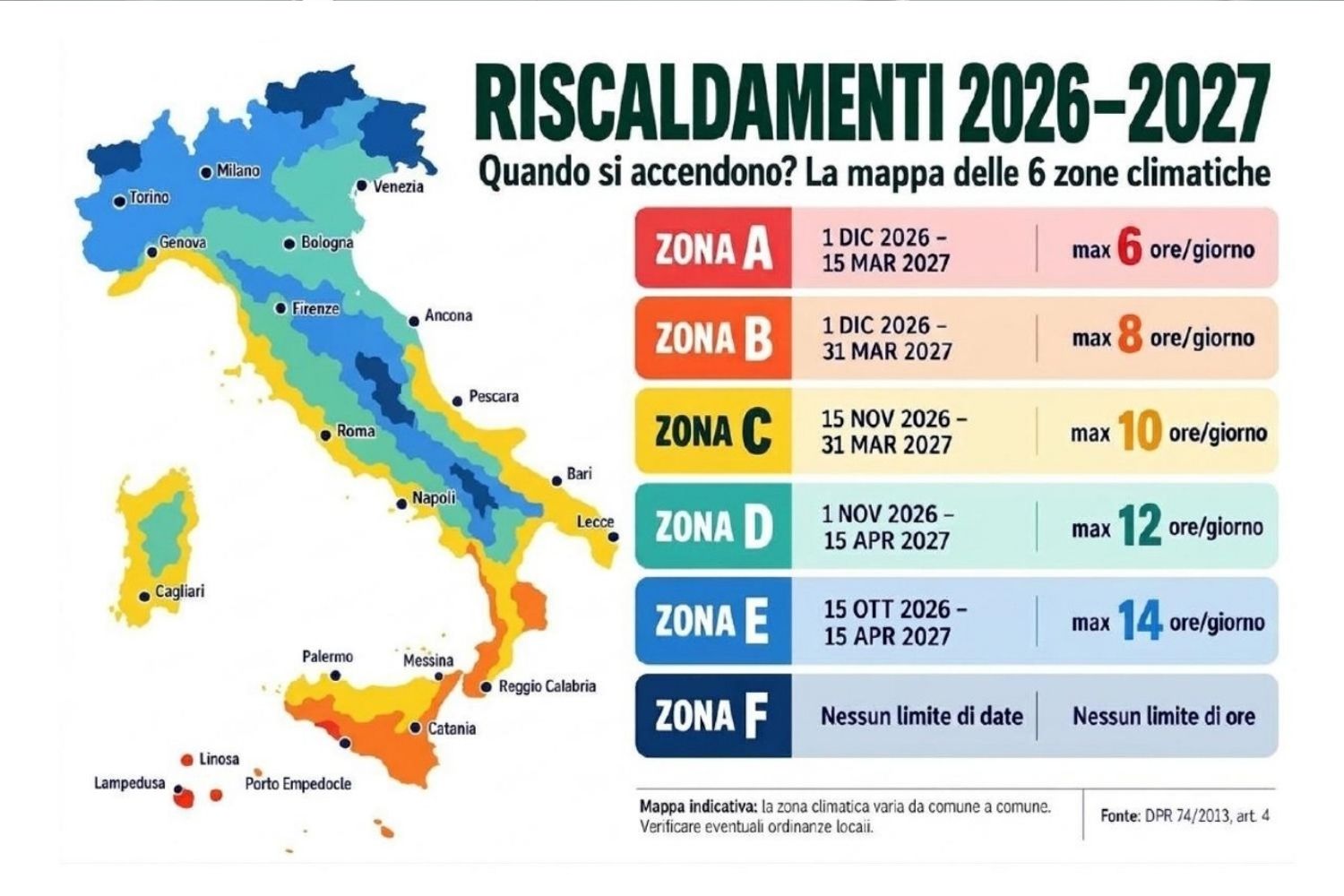
In Italy, the switch-on dates of heating systems depend on the climate zone they belong to. The national territory is in fact divided into six bands, from A to F, based on local climatic conditions.
From 15 October, heating can start in zone E, which affects most of the northern cities and numerous inland municipalities. National legislation allows systems to be kept running for a maximum of 14 hours a day, generally between 5am and 11pm. In Milan, however, more restrictive rules have been introduced: until 30 October radiators can remain on for no more than 8 hours a day. From October 31st until April 15th 2027, the limit will increase to 13 hours per day.
The cities that postpone turning on the radiators
Despite the national green light, several Municipalities have chosen to wait a few more days before turning on the systems. In Monza, Bergamo and Brescia the date has been moved to October 22nd. Same decision for Corsico and Buccinasco, two municipalities in the province of Milan. The postponement will instead be longer in Bologna and in the lowland areas of Emilia-Romagna, where the switch-on has been postponed to November 1st. Venice has also chosen to intervene on the calendar, postponing the start of heating in public buildings, offices, shops and commercial activities to November 1st.
The objective is to avoid unnecessary consumption in a period in which temperatures still allow us to do without radiators. However, administrations will be able to provide exemptions should a cold wave arrive.
The lighting calendar in other climate zones
For the other areas of the country we will have to wait for the next few weeks. Zone D, which includes cities such as Rome and Florence, will be able to turn on the heating from November 1st, for a maximum of 12 hours a day. From November 15th it will be the turn of zone C, in which the systems will be able to operate for up to 10 hours a day.
Zones A and B, characterized by a generally milder climate, will instead have to wait until December 1st. In zone A, up to 6 hours per day are allowed, while in B the limit is 8 hours. No ordinary calendar restrictions, however, for zone F, which includes the coldest places in the country, especially the mountainous ones.
However, the dates represent the general calendar established by national legislation: municipal ordinances and local provisions may introduce changes.
What is the maximum temperature allowed in the house?
In addition to days and times, there are also limits for indoor temperatures. National legislation establishes a maximum temperature of 20°C for homes, with a tolerance of 2 degrees. In Lombardy, however, the limit has been lowered to 19 °C, still with a tolerance of 2 degrees. For buildings intended for industrial and artisanal activities the reference limit is 18 °C, with the same tolerance. There are specific exemptions for facilities such as hospitals, retirement homes, nurseries and nursery schools.
Switch on later to save energy and reduce emissions
Postponing turning on the heating is not just an economic issue. Plants powered by fossil fuels contribute to emissions of greenhouse gases and, depending on the technology used, substances that worsen air quality. Reducing operating hours and maintaining adequate internal temperatures allows you to limit energy waste without necessarily giving up domestic comfort.
It is also important to remember that the calendar establishes when it is possible to turn on the heating, not when it becomes mandatory to do so. If external temperatures remain mild and domestic environments are sufficiently warm, waiting a few days before reactivating the radiators can be an advantageous choice for the wallet and the environment.
