
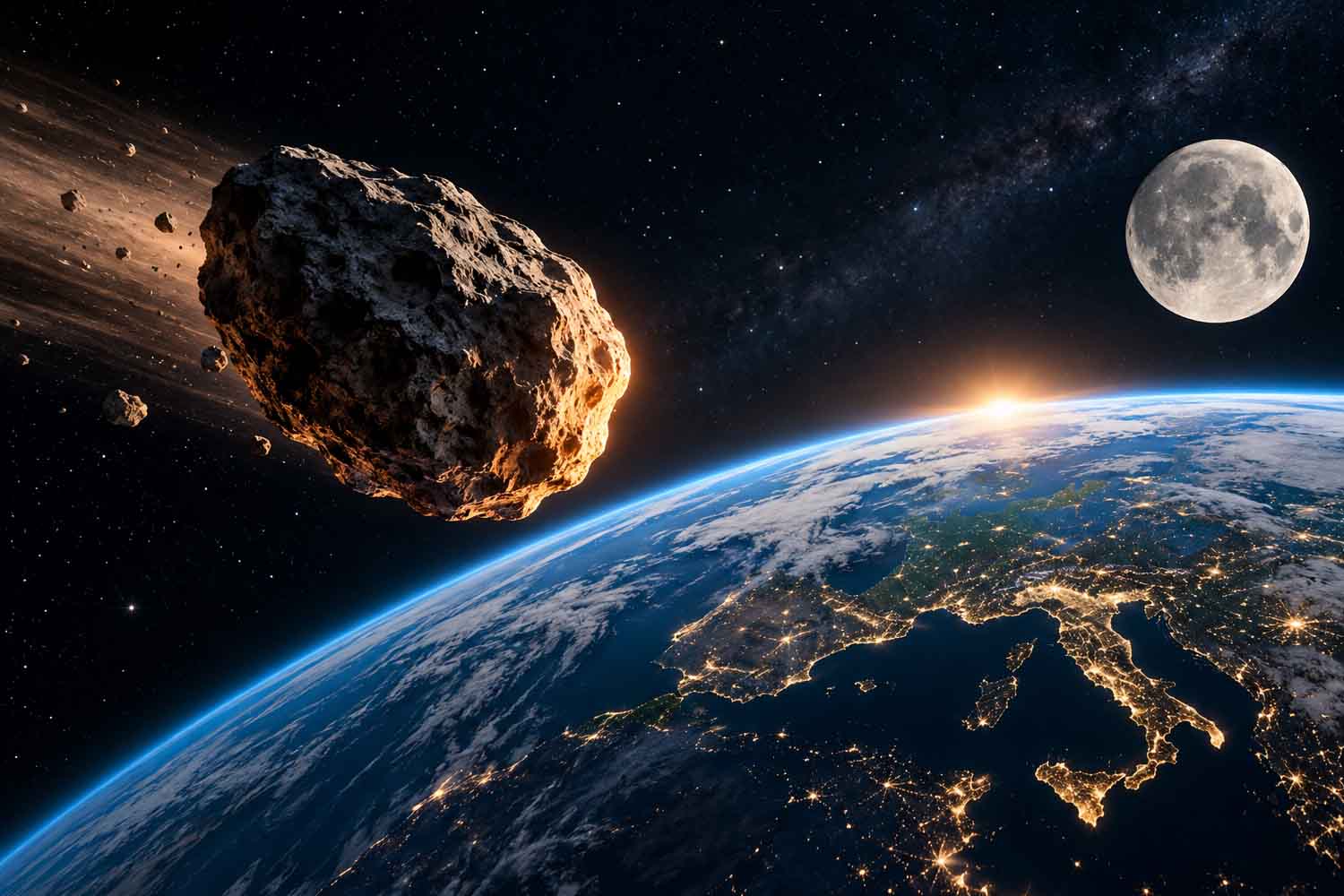
An asteroid will pass near the Earth on Halloween night, arriving, according to current estimates, at a distance closer than that of the Moon. Is called 2025 UK9 and on Saturday, October 31, 2026, at around 3:35 a.m., it will reach an estimated minimum distance of about 315,000 kilometers from the center of our planet. For reference, the Moon is located on average at 384,400 kilometers. An appointment with a rather apt calendar, even if the little visitor doesn’t seem intent on playing pranks.
And he won’t be the only one. A second, much larger asteroid, known as., will arrive on Monday 2 November Zoozvewhich can also be photographed from Italy with amateur tools. Two close encounters that astronomers will be able to follow through observations and data from NASA’s Center for Near-Earth Object Studies.
The Halloween asteroid will pass closer than the Moon
2025 UK9 is a small rocky body with an estimated diameter of between 3 and 7 meters. It was discovered on October 28, 2025 by the Mt. Lemmon Survey program, as part of the University of Arizona’s Catalina Sky Survey, and will return to Earth’s vicinity almost exactly one year later. According to NASA forecasts, the asteroid will travel at approx 28,000 kilometers per hour relative to Earth, reaching its point of closest approach in the early hours of October 31st.
The distance of 315,000 kilometers is still an estimate. As explained by astrophysicist Gianluca Masi, scientific director of the Virtual Telescope Project, the asteroid was only observed for a couple of days after its discovery. A rather short interval to reconstruct its position with great precision after a year.
For this reason, the time and actual distance of the passage could be updated with new observations. The dimensions of the object are however very modest and there are no indications of an emergency for the Earth. No spectacular appearance to the naked eye, therefore: 2025 UK9 is too small and dim to provide a trail in the Halloween sky.
Zoozve, the curious quasi-moon of Venus, arrives on November 2nd
The second appointment is scheduled for Monday 2 November, around 8.10pm, when 524522 Zoozve, previously known as 2002 VE68will reach the minimum distance from Earth.
This asteroid has decidedly larger dimensions: its diameter is estimated between 200 and 500 meters. According to data from the European Space Agency, it will pass about 6 million kilometers from our planet, almost sixteen times the average distance of the Moon. Zoozve, however, has a peculiarity that makes it much more interesting than its distance from Earth: it is one quasi-moon of Venus.
Discovered on November 11, 2002 by astronomer Brian Skiff, it was the first identified quasi-satellite of a major planet. As NASA explains, these objects orbit the Sun, but their motion relative to a planet can make them appear to be its companions. Zoozve therefore follows its own solar orbit, maintaining a particular orbital relationship with Venus, which continues to have no known true moons.
The name also has an unusual history. In 2024 the International Astronomical Union officially approved “Zoozve”, born from a misreading by illustrator Alex Foster: while preparing a poster of the Solar System, he interpreted the acronym 2002 VE68 as if it were the name of a celestial body. A typo that ended up directly in the astronomy registers.
How to observe the November 2 asteroid from Italy
The passage of Zoozve will also offer an interesting opportunity to Italian astronomy enthusiasts. According to experts, the asteroid will be found in the hours close to its closest approach very high in the sky, in the constellation Andromedaa favorable position for those observing from our latitudes.
However, there is a difficulty: the object will not be very bright. To locate it, you will need an amateur telescope and photographic shots, capable of collecting the weak light of the asteroid and distinguishing its movement compared to the stars. It will therefore not be enough to raise your eyes to the sky, even away from the city lights. Those who have the right equipment, however, will be able to try to photograph it during the passage on November 2nd.
For everyone else, what remains are the observations of astronomers and the images that may arrive from telescopes. Halloween will have its asteroid, while on November 2nd it will be the turn of the one which, due to an error on a poster, ended up with one of the most curious names in the solar system.
