
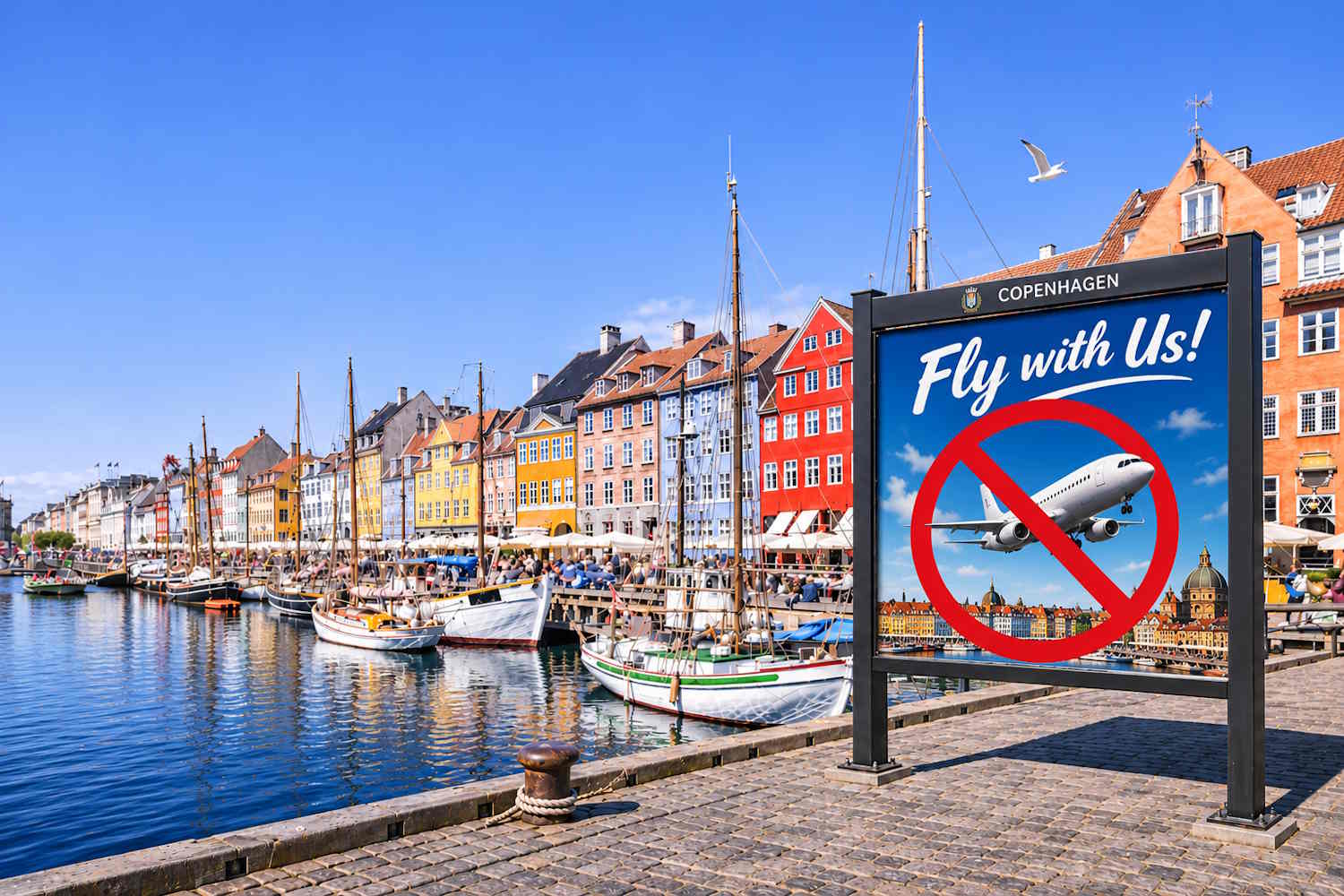
No more advertising of airline flights, cruises and new petrol cars on municipal billboards. Copenhagen has decided to limit the promotion of fossil fuel-related products and services in its public spaces, becoming the first Danish city to approve such restrictions.
The decision came on November 5th, with 39 votes in favor and 14 against in the City Council. The objective is to eliminate an increasingly evident contradiction: on the one hand cities invest to reduce emissions, on the other they continue to host advertisements that encourage consumption with a high climate impact.
Every day we are bombarded with advertisements that try to sell us air travel, cruises and new gas-powered cars as symbols of freedom, adventure and the good life. But the flip side of the coin is climate change, air pollution and a bill that we will all have to pay, said Karoline Lindgaard, a member of Alternativet and one of the promoters of the proposal.
What does the Copenhagen ban include?
The restrictions will affect advertising spaces on buildings, land and infrastructure owned by the Municipality or under its control. In particular, advertisements for air travel, cruises and new petrol or diesel powered cars, including hybrids, will be affected. The measure does not prohibit the purchase of these products or travel, but it prevents the Municipality from making its spaces available for their promotion.
The application, however, will not be immediate across the entire advertising network: the administration, in fact, will have to deal with the concessionaires and work with the bus company and the one that manages the subway, to extend the restrictions to the respective spaces as well. New municipal contracts will already have to take the ban into account.
The decision was also supported by a mobilization of citizens and associations. Two days before the vote, 255 people and 15 organizations had signed an open letter calling for a stop to fossil ads.
Our public space should not be used to increase demand for fossil fuels that are harmful to health and put our collective security at risk, commented Esther Michelsen Kjeldahl, activist for Fossilfri Fremtid and Fossil Free Advertising.
From Amsterdam to Helsinki: the European cities that say enough to fossil advertising
In Europe, an increasing number of administrations are choosing to limit the advertising of products and services with high emissions, albeit with different rules and times.
Amsterdam has introduced restrictions on advertising fossil fuels, flights, cruises and even meat products in public spaces from May 2026. In the Netherlands, The Hague has also adopted a ban covering air travel, cruises and cars powered by fossil fuels, while Utrecht and other cities have taken similar steps.
In the UK, Edinburgh has banned the promotion of high-emitting products on municipal advertising spaces in 2024, including some forms of sponsorship. Bristol has also extended its restrictions to fast fashion and SUVs.
In Scandinavia, Stockholm introduced restrictions on municipal spaces in 2026, while Helsinki approved a path to the ban in October 2026, but implementation could take years due to existing advertising contracts.
The Valdagno case
The Danish decision comes a few days after a similar measure adopted in Italy. The Municipality of Valdagno, in the province of Vicenza, has in fact approved a modification to the Advertising and Public Billboard Plan, introducing restrictions on the promotion of fossil fuels and products powered exclusively by these sources within 150 meters of sensitive places, including schools, hospitals, parks and public transport stops.
The Italian measure is more limited than that of Copenhagen and excludes, for example, hybrid cars, but follows the same logic.
We talk about it here: Valdagno makes history: it is the first municipality in Italy to ban the advertising of fossil fuels
In Copenhagen the debate is not only about the climate, but also about the responsibility of institutions in commercial communication. And this is the central point of a choice that is spreading in Europe: a product can be legal without a public administration necessarily having to promote it. Moreover, there are already limitations on tobacco, alcohol and gambling advertising.
Now several cities are extending the same reasoning to products with a high climate impact and it is logical: if we really want to change our consumption habits, perhaps we should also start from what is proposed to us every day as desirable, normal and indispensable.
