
Stand with your back against the wall and your knees bent, maintaining the position as your leg muscles begin to feel themselves. Or support your body weight on your forearms, trying not to give in after the first thirty seconds. They are two rather common exercises, yet they hide an interesting feature: they can train muscle strength and, in some modalities studied, help reduce blood pressure, even without involving any movement.
It’s called isometric training and in recent years it has attracted the attention of researchers especially for its possible cardiovascular benefits. A scientific review published on Frontiers in Public Healthwhich analyzed 40 randomized clinical trials, found an average reduction in systolic blood pressure of approximately 6.6 mmHg and diastolic blood pressure of 2.6 mmHg compared to control groups. Results obtained through training programs repeated over time, with different effects depending on the participants and the exercises practiced.
The research adds to a series of studies that are giving new attention to a form of physical activity that is rather simple to perform, at least on paper. Because maintaining a position, when the muscles begin to tremble, can be decidedly more tiring than it seems.
Because training without moving can lower your blood pressure
In isometric training, the muscles contract and develop tension while the joints remain essentially still. It happens when we hold a plank, squat against a wall, or hold an object with constant force. This working method produces a muscular stimulus different from that of dynamic exercises, in which the movement alternates contraction and lengthening of the muscles.
Regarding blood pressure, one of the most significant findings came in 2023, when a meta-analysis published on British Journal of Sports Medicine compared 270 randomized trials, for a total of 15,827 participants. The researchers looked at different forms of training, from running and weight training to combined aerobic and strength training and isometric exercises.
All categories showed favorable effects on resting blood pressure, but isometric training recorded the largest average reduction: 8.24 mmHg for systolic blood pressure and 4 mmHg for diastolic blood pressure. In the statistical comparison between the individual activities, the wall squat was among the exercises most likely to reduce systolic blood pressure.
The physiological reasons are still being studied. One of the hypotheses concerns the adaptations of blood vessels to repeated contractions: during effort the blood flow is temporarily modified and, when the muscle relaxes, it increases again. Over time, these stimuli could help improve vascular function and blood pressure regulation.
From plank to wall squat: the best-known isometric exercises
One of the practical advantages of this type of training is the possibility of using your own body weight, without necessarily having to buy equipment or go to a gym.
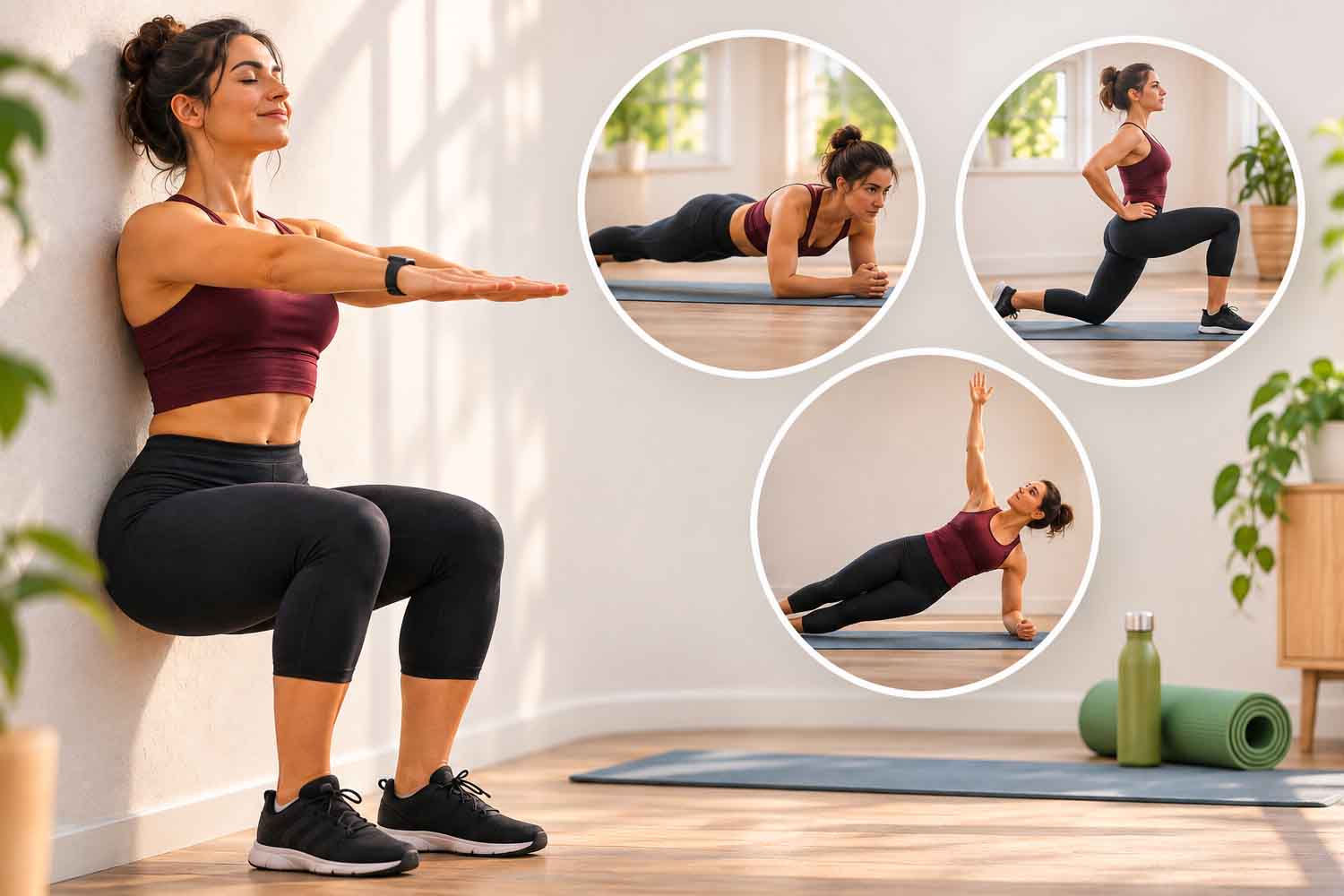
The wall squat, also called wall sitconsists of leaning your back against a wall and gradually going down by bending your knees, as if you were sitting on an invisible chair. Once you have reached a position suited to your abilities, you maintain it by contracting the quadriceps and glutes in particular.
It is one of the exercises most studied for its possible effects on blood pressure. In the 2026 review, the most favorable results were seen in subgroups doing wall squats three times a week for over eight weeks, especially among people with hypertension. However, the differences between the protocols remain exploratory and require further verification.
The plank, on the other hand, mainly tests the trunk muscles. Your forearms and toes support your body weight while your abs, glutes, and stabilizing muscles work to maintain alignment. It is an exercise particularly used to train body control and stability.
A variant is the side plank, which consists of supporting the body on one forearm and on the side of the foot, keeping the pelvis raised. The work focuses mainly on the oblique muscles of the abdomen and the stabilizers of the trunk. It may seem like a simple rotation of the traditional plank, at least until you try to hold the position.
Those who want to involve their legs more can try the static lunge: you bring one foot forward and one back, bend both knees and maintain the position without going up or down. Quadriceps and glutes remain under tension, while the body must maintain balance.
For the abdominal muscles there is also the hollow body hold, particularly used in gymnastics. It is performed by lying on your back, slightly lifting your shoulders and legs off the floor and keeping your lumbar area flat on the ground. The goal is to maintain the position without arching your back, possibly bending your knees to reduce difficulty.
Yoga also includes several positions that require isometric contraction. An example is Utkatasana, the chair position: you bend your knees as if to sit, keeping your torso stable and your arms raised. The muscles of the thighs and buttocks work to support the body, while those of the trunk contribute to stability.
Then there is the isometric handgrip, which consists of squeezing a device with a controlled force maintained for a certain interval. A meta-analysis published in Journal of Clinical Hypertensionbased on 31 studies and 905 participants, found average reductions in systolic blood pressure of 5.38 mmHg and diastolic blood pressure of 2.71 mmHg.
You don’t necessarily need specific equipment to perform other isometric exercises. Holding the glute bridge with your pelvis raised, standing on your toes to train your calves, or holding a dumbbell with your elbow bent without moving your arm are also examples of static contractions.
These are exercises that involve different muscle groups and can be included in a more complete workout. The results obtained on pressure control through wall squats and handgrips, however, cannot be automatically attributed to any static position.
The benefits for muscle strength
The scientific interest in isometric training goes beyond blood pressure. Maintaining a contraction against resistance also represents a training stimulus for the muscles, with effects on the ability to develop strength. A review with meta-analysis published in Journal of Science and Medicine in Sport examined 32 studies, involving a total of 621 adults between 18 and 45 years old, comparing isometric training with dynamic training.
The results showed significant improvements in muscle strength through isometric exercises. The latter proved to be particularly effective in increasing the strength measured during static contractions, while for the strength developed during the movement the differences compared to dynamic training were not statistically significant. This explains why isometric exercises can find space alongside traditional training with weights and repetitions: they train a specific ability, that of producing and maintaining muscle tension.
There is also a practical aspect. The plank essentially requires floor space, while the wall squat only requires a wall. The intensity, however, depends on the position, duration and physical condition of the person training. The ease with which an exercise is prepared does not necessarily coincide with its lightness.
How much isometric training is needed to get benefits?
In studies dedicated to blood pressure, protocols with three weekly sessions have often been used, each consisting of four contractions of approximately two minutes, interspersed with recovery periods. Duration and intensity are adapted to the type of exercise and the characteristics of the participants. Regularity seems to play an important role, but there is no single one-size-fits-all program. And above all, the reduction in pressure measured at rest must be distinguished from what happens while the muscles are actually under stress.
In fact, during an intense isometric contraction, the pressure can temporarily increase. A study published in Journal of Hypertension monitored 62 apparently healthy adults during planks and wall sits, recording considerable increases in diastolic blood pressure. No adverse events were observed, but the researchers highlighted the need to better study the safety of these exercises in people with a higher cardiovascular risk.
For this reason it is important to avoid holding your breath during the effort and choose an intensity compatible with your preparation. Anyone suffering from uncontrolled hypertension or cardiovascular disease should discuss the program with a healthcare professional. The American Heart Association includes isometric exercises among the forms of resistance training that can help control blood pressure, along with aerobic activity and dynamic exercises.
Walking, cycling, running and weight training therefore retain their role. Planks and wall squats can add a different stimulus, also useful for those who want to vary their routine. After all, anyone who has tried to maintain a wall squat for more than a few seconds already knows the least surprising part of this research: to make the muscles work, sometimes, you just need to stand still.
