
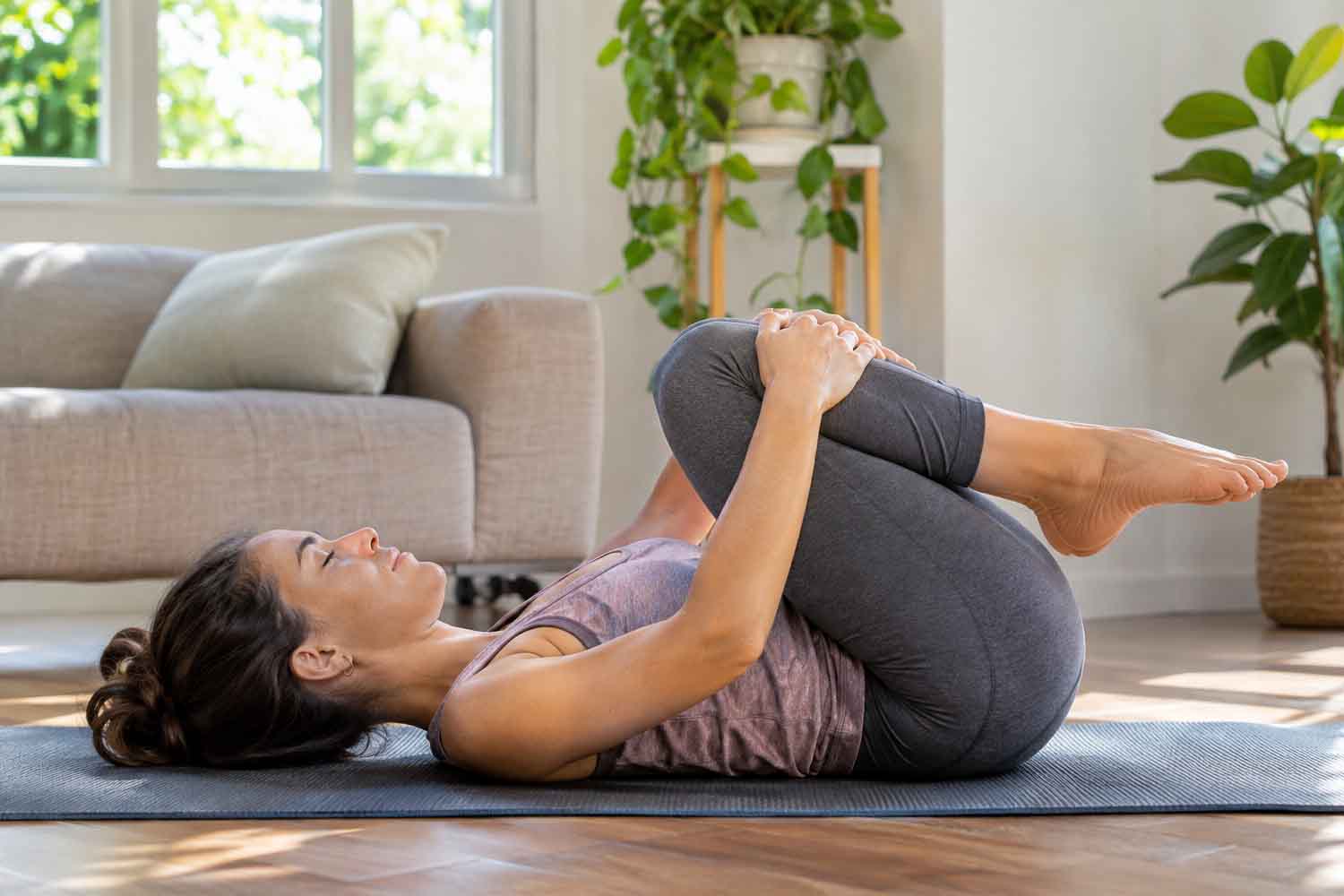
Not just a healthy diet, keeping the digestive system healthy is also a question of… stretching! Eleven exercises, eleven minutes and a mat. We start with the cobra position, move on to the knees drawn up to the chest and finish on all fours, slowly rotating the torso. It is a short stretching routine designed to involve the abdomen, back and pelvis, with movements that alternate muscle stretching, breathing and spinal mobility.
The sequence is inspired by traditional Chinese medicine, which connects digestive well-being to the stomach and spleen meridians, two energy pathways which, according to this tradition, also cross the abdominal region. From this interpretation comes the choice to combine stretching, twisting and activation of the trunk muscles.
Western medicine also recognizes the importance of movement for gut health. The National Institute of Diabetes and Digestive and Kidney Diseases, the US institute specializing in digestive diseases, indicates regular physical activity among the habits that can help relieve constipation. The routine can be performed at home, without special tools. All you need is a mat, a little space and the desire to get up from the chair. The latter, after a day spent in front of the computer, could be the most difficult part.
The first three exercises: cobra, Superman and leg raises
The first exercise is the cobra stretch, a position well known also by those who practice yoga. You lie on your stomach, with your hands resting on the sides of your chest. As you exhale, gently push up into your arms to lift your upper torso, keeping your pelvis close to the floor. After a few seconds you slowly return to the initial position and repeat the movement. The stretching mainly involves the front part of the trunk and the spine. The goal is to stretch your body, without trying to turn into an acrobat on the first repetition.
We continue with the Superman with his arms folded. Always on your stomach, keep your legs extended and your arms bent at the sides of your torso, forming a W. From this position, raise your arms and legs slightly, contracting the buttocks, abdomen and back muscles. The sequence involves holding the position for approximately 40 seconds. The movement requires some muscle activation, especially in the lower back.
The third exercise is the prone leg raise. You remain lying on your stomach, with your forehead resting on your hands or with your arms stretched forward. Inhaling, slowly lift both legs off the floor, activating the glutes and posterior trunk muscles. Also in this case the position is maintained for approximately 40 seconds. These first movements involve the back and the muscles that help stabilize the torso. The execution must remain controlled, avoiding forcing the lumbar area.
@AI generated
Knees to chest and twists: four exercises to do on the back
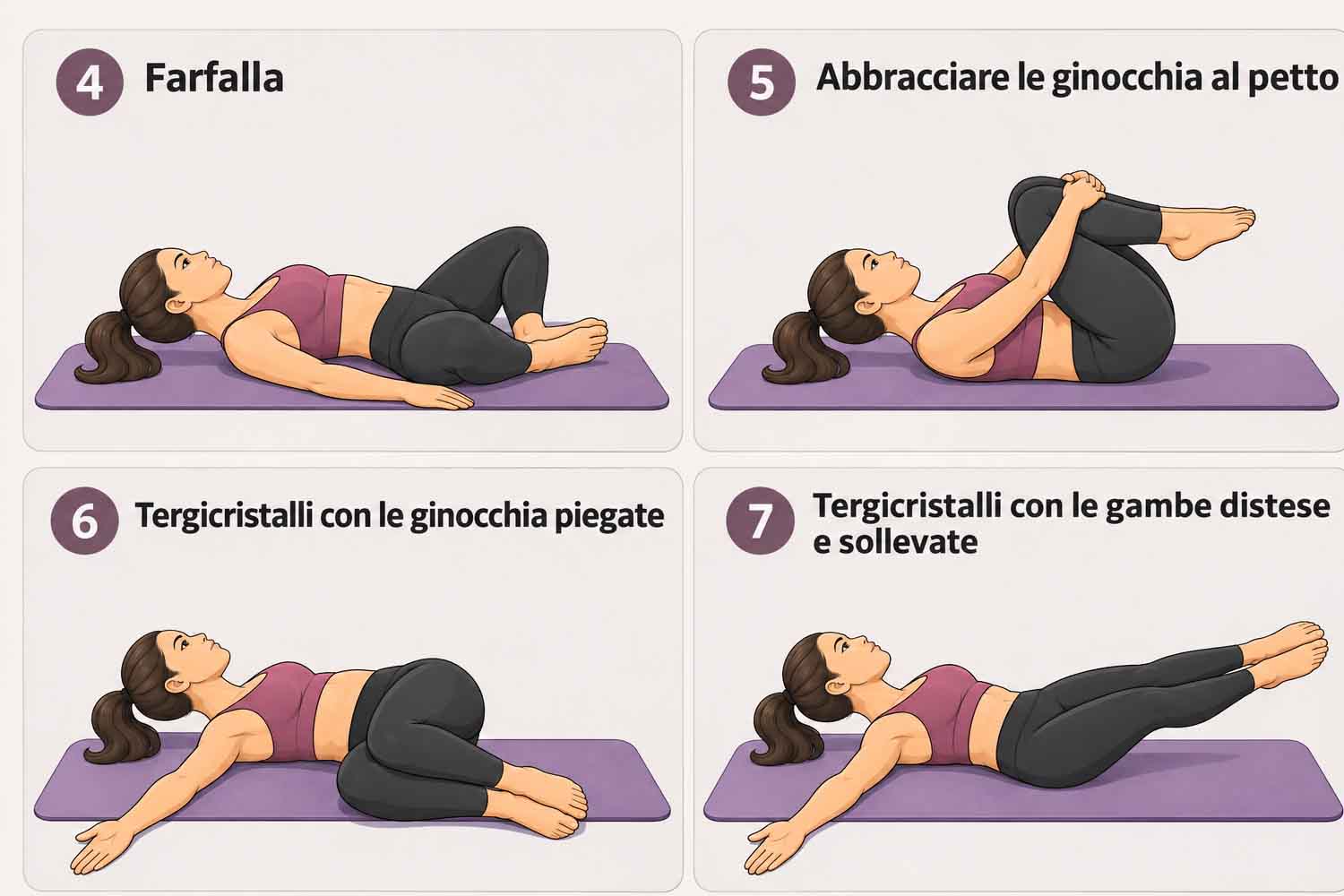
For the second part of the routine you have to turn over on your stomach. We start with the butterfly while lying down. While sitting, bend your knees until the soles of your feet touch, then slowly lie down on your back. Inhaling, try to lengthen the spine and open the knees outwards, bringing them closer to the floor. Then they bring themselves back together, repeating the movement fluidly.
The fifth exercise is probably the most immediate: hug your knees to your chest. Simply lie down on your back, bend both legs and gently bring them towards your torso, using your hands. It is a position that allows you to flex the hips and lower back, giving a sensation of elongation in the lumbar region.
We then move on to the so-called bent-knee wipers. The name is quite eloquent. Lying on your back, open your arms laterally and raise your legs, keeping your knees and hips bent. From this position, slowly rotate both knees first to the left and then to the right. The movement involves the trunk and allows you to work on the rotation of the spine.
The seventh exercise resumes the same principle, this time with the legs extended and raised. The arms remain open at the sides of the body, while the legs slowly move from side to side. It is a more challenging variant, because it requires greater control of the abdominal muscles. To perform it you can reduce the amplitude of the twist and keep the knees slightly bent.
@AI generated
The last four positions to mobilize the hips and spine
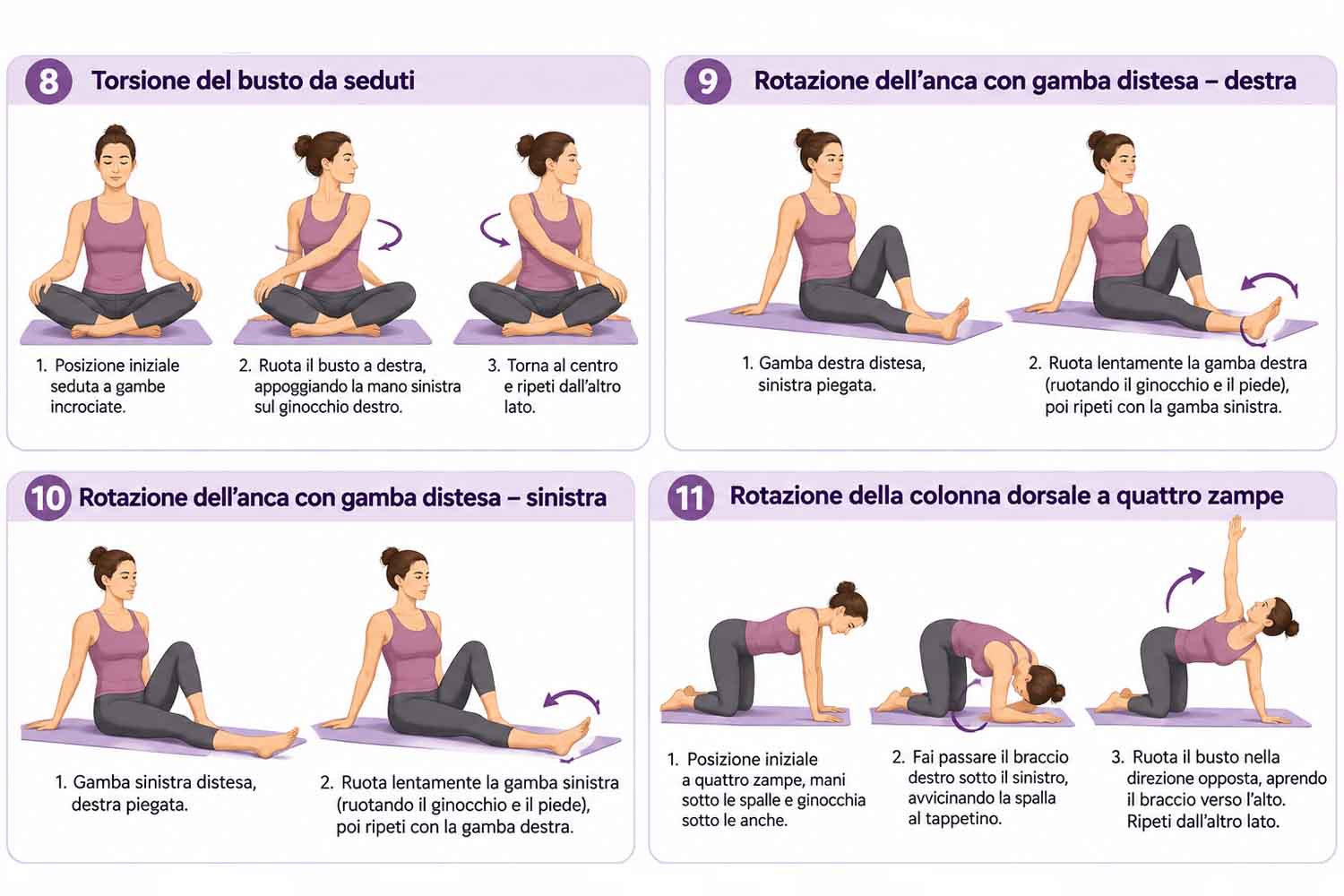
The eighth exercise is performed while sitting, with legs crossed. Place your left hand on your right knee and slowly rotate your torso to the right, accompanying the movement with your gaze over your shoulder. You hold the position for a few seconds, then return to the center and repeat on the other side. The twisting of the torso while sitting involves the back muscles and promotes the mobility of the upper part of the trunk, often stiffened by the many hours spent in front of a screen. The next two exercises are dedicated to the hips.
For the ninth movement, extend the right leg in front of the body, keeping the left leg bent. The extended leg is slowly rotated, changing the orientation of the knee through the movement of the hip. After a few repetitions, change sides, extending the left leg and bending the right. The sequence ends with a rotation of the dorsal column on all fours.
Place your hands and knees on the floor, keeping your hands under your shoulders and your knees aligned with your hips. From this position, pass the right arm under the left one, bringing the shoulder closer to the mat. Then you rotate your torso in the opposite direction, opening your arm upwards. The pelvis remains as stable as possible, while the upper back accompanies the twist. After a few repetitions you change arms.
@AI generated
Because movement can also help the intestines
Digestion is a complex process, influenced by nutrition, daily habits and even the level of physical activity. Spending many hours sitting, moving little during the day, is one of the factors that can contribute to constipation. The British health service NHS also reminds us of this, which suggests increasing daily movement to promote greater intestinal regularity.
Stretching exercises engage different muscle groups, help maintain joint mobility, and provide an opportunity to focus on breathing. Twists allow you to move the trunk, while lying positions alternate stretching and contracting the abdominal muscles.
The eleven-minute sequence can therefore find space in the day as a short activity dedicated to movement and relaxation. You can adapt the intensity to your abilities, avoiding insisting on movements that cause pain. All you need is a mat and a few free minutes. Your back, especially after eight hours in front of the computer, might appreciate the change of program.
