
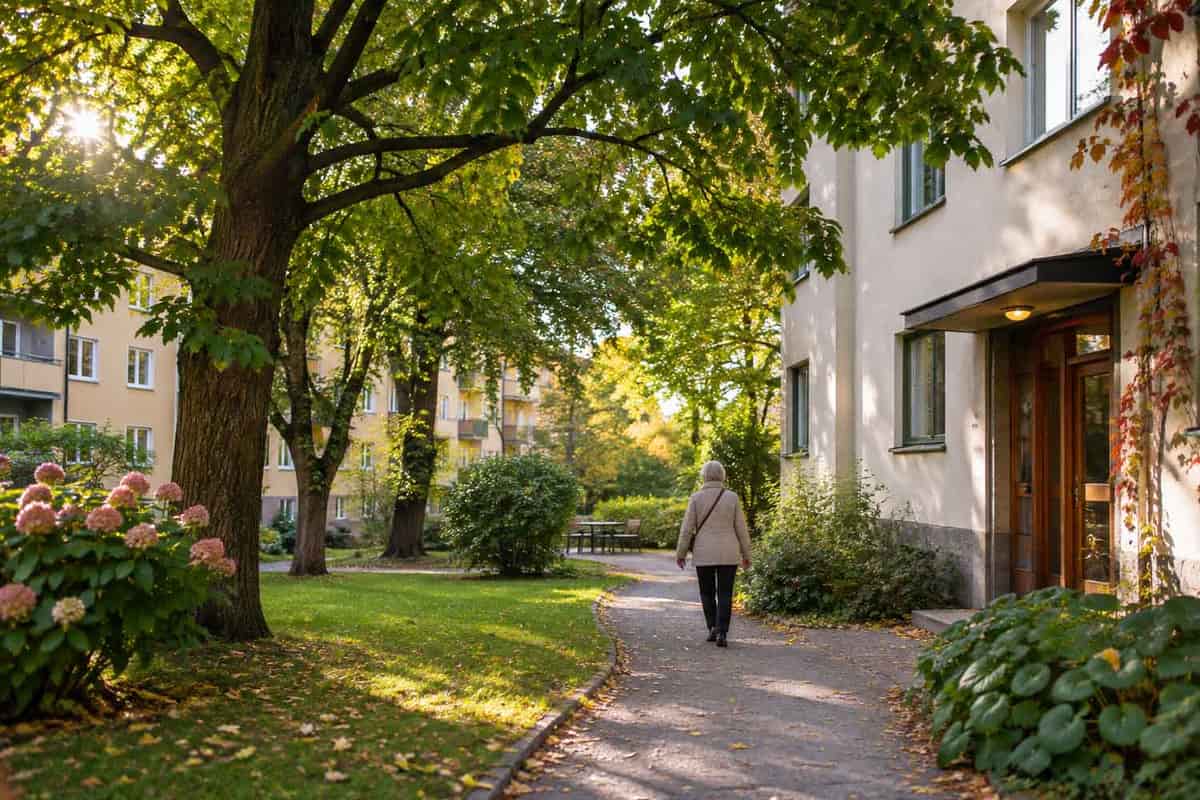
A tree in front of the door, a courtyard with some lawns, a shaded road. In the study conducted in Sweden, more greenery within 100 meters of home was associated with a 21% lower risk of dementia. This data emerged following 2,993 people aged at least 60 over a period of 16 years. And distance appears to play an important role: When the researchers widened the observation range to 250 and 500 meters, the association became weaker.
The research, published on September 28, 2026 in the journal Alzheimer’s & Dementiawas conducted by Stockholm University and Karolinska Institutet. During the observation period, 477 participants received a diagnosis of dementia. The researchers compared the evolution of their cognitive health with the amount of vegetation present around their homes, also taking into account pollution, noise and socioeconomic conditions.
The result suggests that even the most ordinary greenery, the one we encounter when going out to buy bread or simply looking out the window, could play a role in brain health. An interesting detail, especially for those who live in the city, where a tree surviving the concrete is already a good achievement.
The greenery closest to home is the one associated with the best results
To measure vegetation, the researchers used satellite images and an indicator called NDVI, which allows them to estimate how much greenery is present in a given area. They analyzed three radii around the participants’ homes: 100, 250 and 500 meters. The survey covered the vegetation present in the residential environment, including trees, lawns and gardens. So even one that is part of the daily landscape without requiring an organized walk or a trip to a large park.
Considering the average amount of greenery in the five years preceding the observed events, the strongest association appeared within the first 100 meters. An increase in vegetation equal to the difference between the 25th and 75th percentile of the measured values corresponded to a relative reduction in the risk of dementia of 21%.
At 250 meters the estimated reduction dropped to 12%, while at 500 meters it reached 6%, with statistically less solid results. This makes the vegetation present in the immediate vicinity of the homes particularly interesting. It is the one that accompanies our days even when we don’t have the time, desire or possibility to go to a park.
In women the association is even stronger
Another result concerns the differences between men and women. Among participants, more vegetation within 100 meters was associated with a 31% lower relative risk of dementia. In men, the estimated reduction was 7%, without an equally solid association from a statistical point of view.
Researchers have not yet identified a definitive explanation for this difference. Daily habits, time spent near the home and the different ways in which men and women come into contact with natural environments could contribute. The investigation also considered the APOE-ε4 genetic variant, associated with a greater risk of developing Alzheimer’s disease.
Among people who did not have this variant, greater greenness was associated with a 28% relative reduction in dementia risk. Among carriers of the genetic variant, however, the association was less evident, although the difference between the groups was not statistically confirmed. Another element that deserves to be explored further, because it suggests how complex the relationship between environment, genetics and aging can be.
Trees do good even when no one stops to admire them
Trees along a road perform several functions simultaneously. They offer shade, help reduce temperatures in the warmer months, mitigate some of the effects of pollution and make outdoor spaces more pleasant to visit.
Vegetation could also influence cognitive health through other mechanisms, such as stress reduction, better sleep quality, physical activity and social relationships. Cecilia Stenfors, researcher at Stockholm University and first author of the study together with Jing Wu, explained in the official presentation of the research that natural environments can promote psychological recovery, reduce stress and improve mental well-being.
Other work by his group has associated more vegetation near the home with better sleep, greater personal satisfaction and less use of antidepressant drugs. The World Health Organization has also long recognized the value of urban green spaces for physical and mental health, underlining their contribution to stress reduction, sociality and the mitigation of noise, pollution and excessive heat.
In the new Swedish study, the association between vegetation and lower incidence of dementia remained even after accounting for factors such as fine particulate matter, traffic noise, the presence of nearby water, and individual and socioeconomic conditions. In short, green also deserves attention as a possible resource for cognitive health. The research is observational and does not establish a direct causal relationship, but adds an important result to a scientific literature that has been studying the relationship between nature and health for years.
Green is not distributed equally. And this is also a social issue
Another interesting fact appears in the same Swedish study. People who lived in areas with less vegetation tended to have less favorable socioeconomic conditions, lower levels of education, and greater exposure to air pollution and traffic noise. A combination that deserves attention, because unfavorable environmental conditions can accumulate in the same neighborhoods. The problem, moreover, goes beyond the borders of Sweden.
According to the European Environment Agency, in many European cities, neighborhoods with lower incomes generally have less green space than affluent areas. And when greenery exists, it often presents worse conditions: fewer services, insufficient maintenance, less diverse vegetation and greater accessibility problems.
The difference is easily seen in everyday life. There are those who come out of the door and find trees, benches and shaded sidewalks. And those who have to cross busy streets to reach the first public garden, perhaps small, neglected or without services.
For a young and healthy person, traveling a few hundred meters more can be a nuisance. For an elderly person with mobility difficulties, that distance can become a real obstacle. This is why simply inviting people to spend more time in nature risks ignoring part of the problem: the possibility of living surrounded by greenery also depends on the neighborhood in which you live and the resources you have.
In Italy we have 33.7 square meters of greenery per inhabitant. But where?
Even in Italy the urban green numbers tell an interesting story. According to Istat’s Urban Environment 2024 report, published in September 2026, in the capital municipalities the overall surface area of urban green areas exceeds 590 square kilometers, equal to an average of 33.7 square meters per inhabitant. A growing figure compared to the past, which however only represents 3% of the municipal territory.
Above all, an average does not tell us how close the greenery is to the houses. A city can boast large parks and a good number of square meters per inhabitant, leaving entire blocks without trees. It is enough to concentrate a large part of the vegetation in a few areas to obtain a respectable statistical result and a distribution that is anything but homogeneous. The Swedish research therefore adds an interesting consideration: measuring how much greenery a city has is not enough to understand how much greenery really accompanies the lives of its inhabitants.
The issue also concerns urban planning choices. Every new building, car park or road intervention changes the space available for trees and gardens. And when vegetation is eliminated, recreating an equally shaded environment takes years, especially if it involves mature trees.
The elderly, then, are among the people who can depend most on the quality of the environment near their home. A passable road, a bit of shade, a bench and a garden within walking distance make a real difference in the possibility of going out and maintaining social relationships.
Brain health also depends on the decisions of Municipalities
The authors of the study invite us to preserve existing vegetation and create new green spaces near homes, also thinking about the needs of elderly people and those with mobility difficulties. The research was conducted in an urban area of Stockholm, with specific social and environmental characteristics. To understand how applicable the results are to other populations, further studies will be needed, including in more polluted cities and with greater inequalities. In the meantime, however, the data adds a concrete argument to a discussion that is too often reduced to an aesthetic question.
We continue to talk about healthy aging through individual advice: walking, eating well, staying active, cultivating social relationships. All sensible recommendations. Yet, for them to be followed, neighborhoods are also needed in which a person can leave the house without facing an obstacle course between cars, rough sidewalks and expanses of asphalt. Public health also depends on the material conditions in which we live. And those conditions are built, maintained or neglected through collective decisions.
The Swedish study gives us one more reason to consider trees a part of urban infrastructure, with possible benefits that go far beyond shade on summer days. The researchers found the strongest association within 100 meters of homes. Very often, urban planning decisions made years before decide how much vegetation there is in that space. And whoever lives in that neighborhood inherits the consequences, more tree, less tree.
