
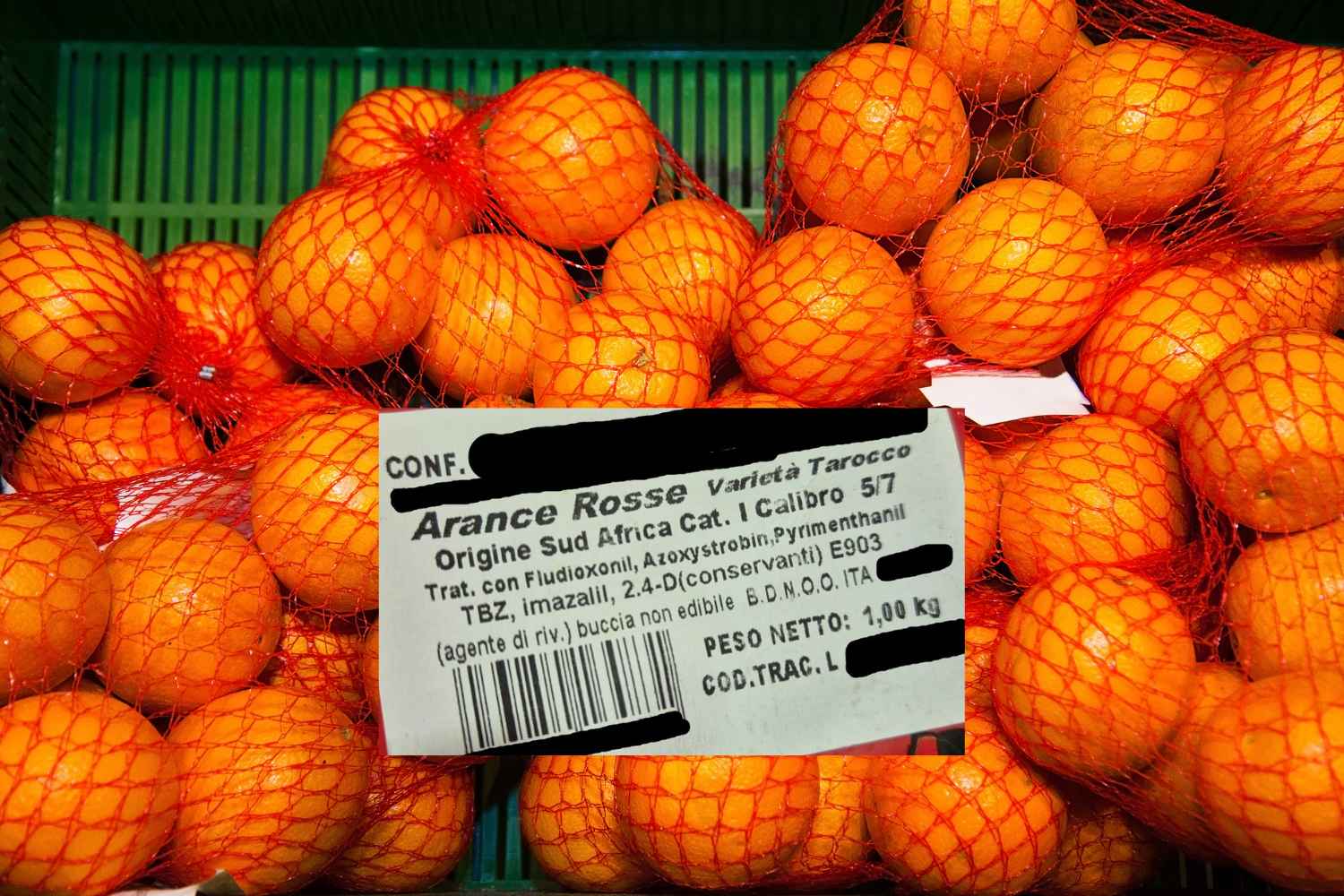
Blood oranges from South Africa and Australia have already arrived on the Italian market, but how are they presented to consumers? And above all, what treatments did they receive after harvesting? The Consortium for the Protection of Sicilian Blood Orange PGI has decided to address the Ministers of Agriculture and Health directly, requesting urgent checks on these products. Among the concerns there is also the risk that imported oranges will be confused with Sicilian ones with a protected geographical indication, with possible consequences for Italian consumers and producers.
The issue had already been raised in October, when the Consortium reported the presence of blood oranges from the southern hemisphere in Italian supermarkets, ahead of the start of the new Sicilian campaign. Now President Gerardo Diana has decided to formalize the requests with a letter addressed to Francesco Lollobrigida, Minister of Agriculture, Food Sovereignty and Forestry, and Orazio Schillaci, Minister of Health.
The objective is to obtain coordinated intervention from the competent authorities, not only to verify the safety of imported oranges, but also to ensure that the information provided on the packages is correct and that their commercial presentation does not create misunderstandings with an Italian production with a precise territorial identity.
Oranges from South Africa and Australia, what has been reported
At the center of the report are oranges coming mainly from South Africa, identified in various Italian supermarkets, and Australian products whose presence has been detected in wholesale markets.
A detail caught the Consortium’s attention: some packages online indicate the Tarocco variety, one of the best known of Sicilian blood oranges. On the back of the packages, as reported in the letter, there is also two important information: the words “non-edible peel” and the indication of some treatments carried out after harvesting.
There are three declared active ingredients: fludioxonil, azoxystrobin and pyrimethanil, substances used with a fungicidal function to combat the development of mold and preserve products for longer.
It is precisely on these treatments that the Consortium asks for clarification. In fact, knowing the name of a substance is not enough to establish whether its use is regular: it is necessary to check whether it is authorized for that specific crop and for that specific use, as well as ensuring that the residues present in the product comply with the maximum limits established by European legislation.
The request is therefore to verify the admissibility of the substances and the methods with which they were used, ascertaining any unauthorized uses and the conformity of the oranges marketed in Italy.
The risk of confusing imported oranges with Sicilian PGI oranges
Then there is an aspect that directly concerns those who purchase. The Consortium fears that the commercial presentation of imported blood oranges could generate confusion with Arancia Rossa di Sicilia PGI, a product linked to a specific territory and protected by a European quality brand.
This is not just a question of geographical origin. When we choose a product with a protected geographical indication, we purchase a food that must comply with precise production regulations and which is linked to the characteristics and tradition of a specific territory.
The presence on the market of foreign pigmented oranges, even with the varietal indication Tarocco, therefore makes it particularly important that the origin is immediately recognizable and that the presentation of the packaging does not mislead.
In the letter to the ministers, the Consortium includes a very precise and solicitous request “checks on the commercial presentation, so that imported oranges are not confused with the PGI Sicilian Blood Orange“.
It is a significant step, which places the issue of food safety alongside that of protecting the identity of Italian production. The consumer must be able to clearly distinguish what he is purchasing, without being led to believe that a product has an origin or characteristics different from the actual ones.
Among other things, the problem does not only concern blood oranges but also other types of oranges and citrus fruits such as limes.
Inedible peel and pesticides
Another element that worries the Consortium is the “inedible peel” warning, shown on the packages together with the indications of post-harvest treatments.
The issue is not secondary. Citrus peels are used very often in cooking, to flavor desserts and preparations, but also to garnish cocktails and other drinks. Precisely this last use is recalled in the letter, with a particular consideration: some substances present on the peel could come into contact with alcohol and thus be ingested.
Hence the request to verify that the information on the packaging is correct, legible and sufficiently clear. According to the Consortium, it is not enough that a treatment is simply declared but it is also necessary to enable those who purchase to understand what they are taking home and what limitations on use concern the product.
The presence of treatments declared on the label then requires specific checks. As President Gerardo Diana specifies in the letter:
The sole declaration of a treatment on the label does not allow us to conclude that the product is irregular or dangerous: checks on the applicable conditions, analysis of residues and a health assessment of the affected batches are required.
In other words, we need laboratory data and official controls, not assumptions. It is necessary to understand which substances have actually been used, under what conditions, in what quantity they are present in the fruit and whether the residues comply with the applicable limits.
What does the Consortium ask of ministers Lollobrigida and Schillaci
In the letter the Consortium does not limit itself to reporting the problem, but also indicates the interventions it would like to be activated through the competent bodies.
First of all, it requests that sampling and laboratory analyzes be carried out on imported oranges, both at the points of entry into Italy and in wholesale markets and large-scale retail trade, to verify the presence of pesticide residues, compliance with the maximum permitted limits and the safety of the products. It also requests checks on the treatments declared on the label, to ensure that the substances used and the relative methods of use are permitted by Italian and European regulations.
The checks should also concern the origin and traceability of individual batches, as well as the correctness and legibility of the information reported on the packaging. A further request concerns the commercial presentation of oranges, which must be controlled so that imported products are not confused with Sicilian Blood Orange PGI.
The Consortium also requests that, should the investigations highlight irregularities or health risks, the measures required by law be promptly adopted. These include, when necessary, the blocking of marketing, the withdrawal or recall of products and adequate information to consumers.
Not just health, also a problem of unfair competition
Behind this story there is also an economic question that concerns the future of Italian productions. The Consortium does not question the possibility of importing fruit from other countries, but asks that all operators are subject to clear rules and rigorous controls.
The fear is that any differences in production conditions and permitted treatments could translate into a competitive disadvantage for Italian companies, which must comply with European rules. If non-compliant uses were found, the problem would therefore not only concern food safety, but also the fairness of competition on the market.
President Gerardo Diana clarifies this in the final part of the letter:
The Consortium I represent does not contest international trade, but demands clear rules, rigorous controls and fair competitive conditions.
A request that therefore concerns two closely linked aspects: on the one hand the need to protect those who purchase, on the other that of protecting companies that invest in the quality and identity of Italian productions.
Now the ball passes to the two ministries and the bodies in charge of controls. Any sampling and official analyzes will establish whether the reported oranges actually comply with the regulations and whether there are problems related to residues or their marketing.
A problem that is also talked about abroad
The issue of post-harvest treatments of citrus fruits and the term “non-edible peel” does not only concern the Italian market. The topic is also arousing a lot of interest abroad and is fueling a real buzz on social media, especially on Instagram, where numerous posts and videos are circulating dedicated to the substances used to preserve oranges and limes and the possible residues on the peels.
In particular, images of packages bearing the warning “peel not suitable for consumption” are shared, accompanied by reflections on the opportunity to use these citrus fruits to prepare desserts, cocktails or drinks.
In short, it is a hot topic that is attracting the attention of consumers all over the world and which brings a very concrete question back to the center: do we really know how the citrus fruits we bring to the table are treated?
View this post on Instagram
