
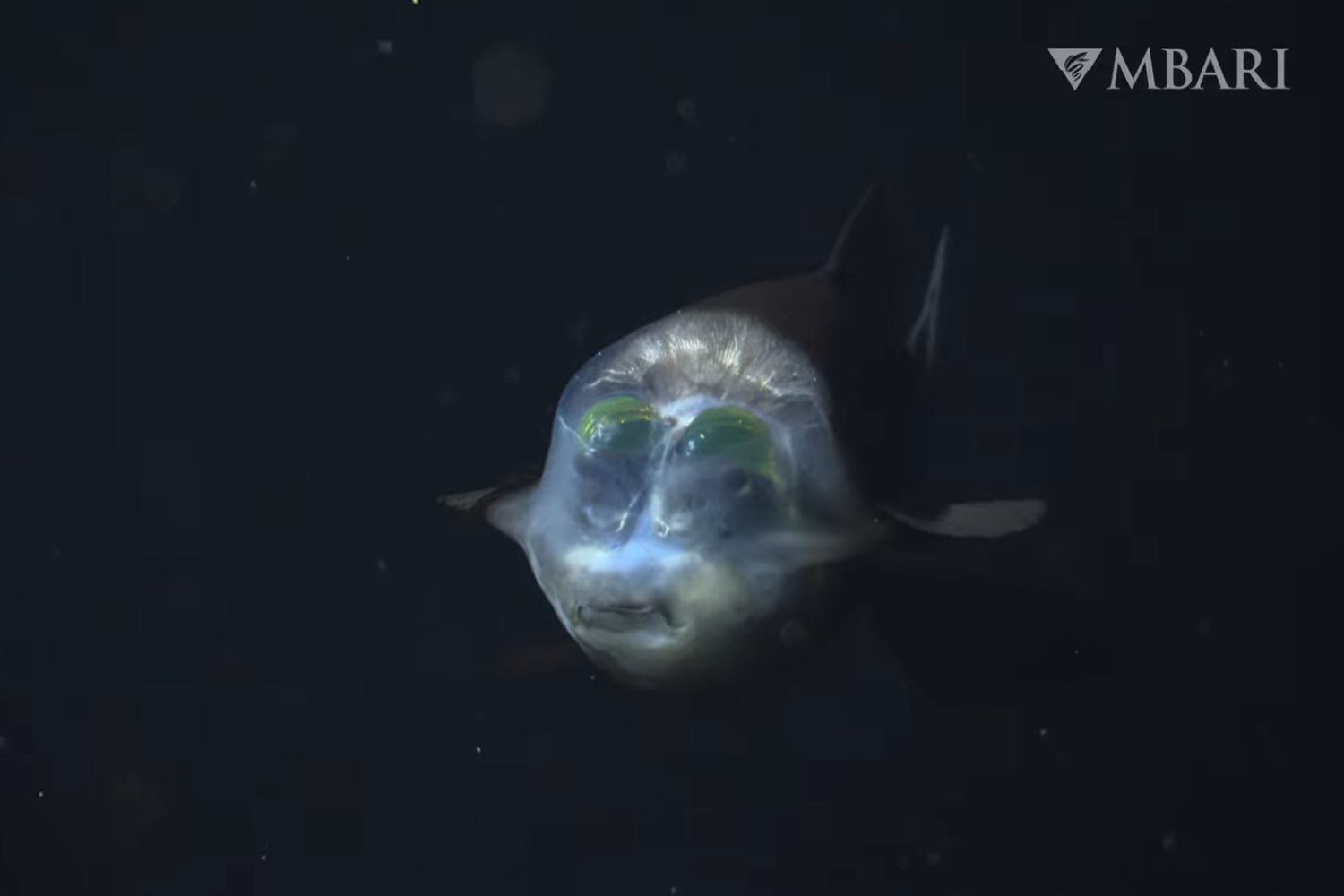
Deep in the oceanic twilight zone, life adopts forms that defy the imagination. About 90 kilometers off the coast of California, the scientific team at the Monterey Bay Aquarium Research Institute recorded a biological event of rare majesty. During the scientific expedition called Diving Deep for Delicate Drifters, conducted aboard the R/V David Packard, senior scientist Steven Haddock and his research team came across a barreleye fish specimen (Macropinna microstoma). The animal was swimming at a depth of 600 meters and was spotted by research specialist Shannon Johnson while the remote-controlled robotic vehicle ROV Doc Ricketts was rising towards the surface.
This is the 11th observation documented by the center in approximately 40 years of marine explorations, spread over over 7000 dives and 41,000 hours of recorded footage. The last meeting took place in 2021. The animal, just 15 centimeters long (i.e. the size of the palm of a hand), was observed for about 20 minutes. The pilot of the submarine Cameron Law operated the on-board systems, capturing 4K video sequences and 3D three-dimensional surveys for the first time ever, varying the lighting sources to study the optical responses of the animal’s brain tissue without proceeding with its capture.
@MBARI (Monterey Bay Aquarium Research Institute)/YouTube
The biological characteristics and the transparent dome of Macropinna
The scientific name Macropinna microstoma reveals the anatomical peculiarities of the species, literally translating into the expression large fins and small mouth. The distinctive feature lies in the entirely transparent skullcap, a dome of gelatinous tissue that protects two enormous green tubular ocular structures. These visual organs constantly scan the body of water above in search of the silhouettes projected by their prey. When the fish spots a crustacean or small prey, the eyes rotate vertically inside the protected head so as not to lose visual contact, allowing the animal to spring upwards and swallow the morsel.
The gelatinous shield also performs a fundamental protective function against the toxins emitted by the tentacles of the siphonophores, from which the fish extracts nourishment. Studies conducted in the past by researchers Bruce Robison and Kim Reisenbichler have highlighted how the pigments present in the lenses serve to filter residual sunlight to identify the bioluminescent camouflage of abyssal organisms. The analysis conducted in the field will enrich the understanding of evolutionary vision systems in light-free environments, confirming the importance of research supported by the David and Lucile Packard Foundation in the deep waters of the Pacific Ocean.
