
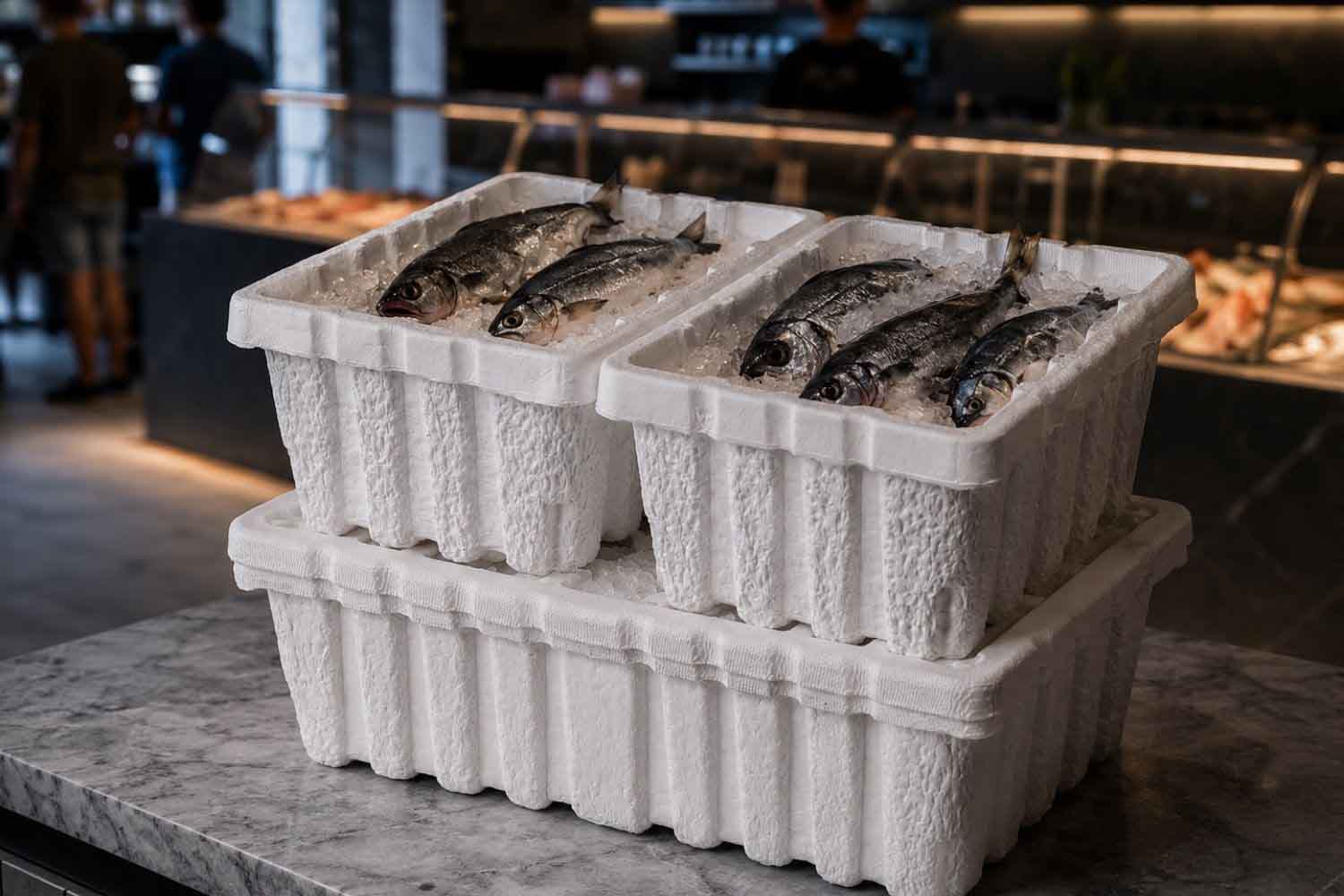
Fresh fish, ice and a box made with paper fibers and industrial hemp. In Bremerhaven, in the north of Germanythe wholesaler Transgourmet Seafood is already using these containers in the daily distribution of seafood products. A rather unusual choice for a sector accustomed to expanded polystyrene boxes, where water is everywhere and keeping the fish at the right temperature is a necessity, even before a health obligation.
The container is called Fiber Boxwas developed by the German company PAPACKS and on November 3, 2026 received the Seafood Star 2027, an award awarded by the trade magazine FischMagazin during the Hamburg seafood industry summit. The award concerns the commitment to sustainability, but the interesting part of the story is above all another: the cassettes have already entered a real commercial chainafter a series of tests conducted together with sector operators.
On the other hand, building vegetable fiber packaging is relatively simple. Convincing that same packaging to withstand fish, ice, melt water and refrigerated transport requires a few more precautions.
A paper box that resists ice
@FiberBox
The Fiber Box is produced through the molding of virgin paper and industrial hemp fibres, a process reminiscent of the one used for common egg containers. The difference lies in the formulation and density of the fibres, designed to resist humidity and contact with ice.
According to technical data published by the manufacturer, during a practical test conducted in February 2026 the boxes maintained their shape and functionality for up to ten days, completely filled with fish and ice, at temperatures between 0 and 2 °C and with a relative humidity of 90-95%.
The containers were moved to the warehouses, loaded onto pallets and also used for truck delivery. However, the information on duration comes from the operational tests communicated by the company: .
Then there is a detail that deserves attention. The Fiber Box, by the manufacturer’s own admission, does not offer independent thermal insulation comparable to that of polystyrene. It must be used within a continuous cold chain, where the temperature is maintained by ice and refrigerated environments. It can therefore replace the container in certain operating conditions, without replacing the insulating function of the traditional material. A difference that is anything but negligible when it comes to food transport.
Styrofoam works well. The problem comes when it becomes waste
Expanded polystyrene boxes, also known as EPS, are widespread in the fish supply chain for very concrete reasons: they are light, resistant to humidity and offer good thermal insulation. However, they also have some flaws. They take up space during storage, can break and disperse fragments into the environment and, when contaminated with food residues, collection and recycling become more complicated.
The German solution intervenes on some of these aspects. The empty boxes can be inserted one inside the other, reducing the space occupied during transport and storage. Once used, according to the manufacturer, they can be sent for paper collection, as long as they are empty and clean.
An evaluation by the cyclos-HTP institute, reported in the Fiber Box documentation, indicates a potential fiber recovery yield of 85%. The value concerns the material in the conditions examined, without labels or other additions, and does not mean that 85% of the cassettes used are actually recycled. After all, even a paper box can become problematic to recover if it arrives at the collection dirty with fish residues, adhesives or other materials. And above all, using vegetable fibers does not automatically guarantee a better environmental balance.
The most important test has already begun in the German warehouses
The collaboration between PAPACKS and Transgourmet Seafood was born precisely to adapt the new container to the needs of fish distribution. Tahsin Dag, founder of the manufacturing company, said during the Seafood Star awards ceremony that his technicians had to familiarize themselves with a sector in which activities begin as early as three in the morning. And where, as he himself recalled, you have to deal with ice inside the boxes, ice outside and very high humidity.
To develop the container, the group worked directly with operators in Bremerhaven, gathering information on actual conditions in the supply chain. The result is packaging available in two sizes and already used by a German wholesaler, although not enough data has been communicated to know how many polystyrene boxes have actually been replaced.
The news comes as Europe is changing its rules on packaging. EU Regulation 2025/40, applicable from 12 August 2026, provides progressively stricter requirements on recyclability, with new provisions starting from 2030 according to the deadlines set by the legislation.
For the Fiber Box there is already a technical evaluation on the possibility of recovering the fibres, but there is no complete public comparison of its life cycle with that of traditional boxes. There is also a lack of data on the actual costs in distribution and the percentage of containers that are recovered after use.
The German experiment shows that packaging made with paper and hemp can find a place in the logistics of fresh fish, at least in the conditions documented so far. It’s an interesting result for an industry that uses huge quantities of single-use containers. To understand whether it is also a better environmental choice, however, we will need to follow those boxes beyond the delivery of the fish. Up to the waste container, where the promises of recycling often meet reality.
