
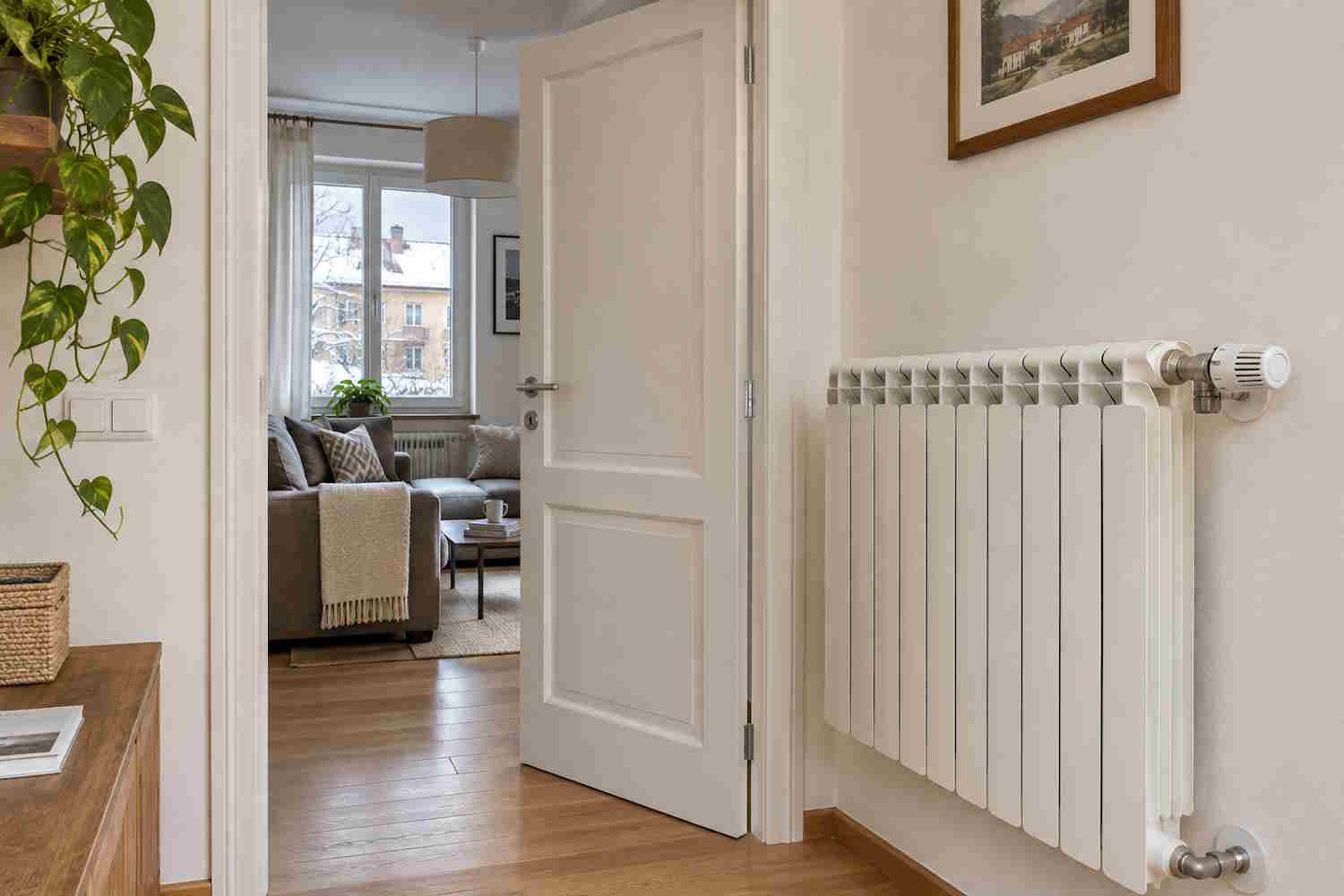
When the cold weather arrives we find ourselves at the same domestic crossroads: close the doors and isolate the rooms or let the house breathe like a large open space. The dilemma becomes even more pressing when the system has a single thermostat and the heat, at least in theory, should be distributed everywhere in the same way.
With water heaters, closing doors between rooms kept at different temperatures can help limit heat exchange. But a closed door, alone, does not lower the radiator setting and does not guarantee savings on the bill: coherent management of the heating is needed. The indications of the German Federal Environment Agency, for example, recommend separating less heated environments from warmer ones.
In reality, what happens between a door that is ajar and one that is left wide open goes much further than simply “it lets heat out” or “it lets cold in”. The behavior of the air comes into play, which has the stubbornness of old habits: if it finds an opening, it runs; if he finds a limit, he stops and changes pace.
The result is that we often find ourselves heating more than necessary. Close the doors or leave everything open with the radiators on? The ultimate strategy for those who don’t have zoned heating is to know exactly why. And it is precisely by observing how we live in environments that we can understand which of the two strategies really works in a house not divided into thermal zones.
Without zone heating does not mean without regulation
A system can have a single thermostat that controls the heating of the entire house and still be equipped with thermostatic valves on the radiators. These regulate the passage of water based on the temperature detected near the valve, allowing, for example, to keep a bedroom less warm than the living room.
Traditional valves, however, are not equivalent to independent thermostats: normally they cannot request the boiler to be turned on when the main thermostat has already interrupted the heat request. This distinction is essential to understand why some rooms can remain cold while elsewhere the temperature is already comfortable
When is it best to close the doors
If a room is rarely used and the radiator is set to a lower temperature, keeping the door closed helps separate it from warmer environments. By leaving it open, some of the heat from nearby rooms will help warm it up, attenuating the difference you wanted to achieve.
The cooler room still receives heat through the walls and other internal surfaces: a door does not create a completely insulated thermal zone. The benefit depends on the building, temperatures and system management. It is therefore not possible to attribute to this gesture a saving percentage valid for all homes.
However, if you close the door but leave the radiator set as before, you are not necessarily reducing the heating of that room. To limit the heat supplied, it is necessary to adjust the radiator regulation, when available.
When leaving it open can be helpful
Between rooms used and heated to similar temperatures, leaving the doors open can promote air exchange and mitigate some temperature differences. This may improve comfort, but does not demonstrate that the system consumes less.
It is not correct to argue that closing the doors always forces the boiler to make “extra effort”. In water radiators, the heat reaches the individual radiators through the pipes: it does not have to pass through the doors.
If one room remains cold while the others are already warm, it is best to check the regulation and operation of the system, rather than immediately raising the general temperature.
The crucial detail: where the thermostat is located
The thermostat measures the temperature where it is installed. It does not automatically know that of all the rooms: when it detects the set value, it interrupts the heating request according to the operation of the system.
Two practical situations arise from this operation. If the thermostat is in the living room, closing the door may allow the room to reach the desired temperature before colder rooms. However, if it is in a poorly heated corridor, it may continue to require heat while elsewhere it is already quite hot.
These are examples, not inevitable effects: the result depends on the house and the system. Opening a door can change the heat distribution, but does not necessarily correct an inadequate setting. If some rooms overheat and others remain cold, it is useful to have the position of the thermostat and balance of the radiators checked.
Don’t let unused rooms freeze
Lowering the temperature of a room doesn’t mean leaving it in the cold all winter. The German Federal Environment Agency recommends heating even rarely used rooms moderately. Keeping the doors to these rooms closed also serves to limit the passage of humidity: the air coming from the warmest rooms can transport water vapor towards cold surfaces, favoring conditions suitable for the formation of mould.
A thermohygrometer helps you observe temperature and humidity together. However, there is no value that alone guarantees the absence of problems: insulation, thermal bridges and wall temperature also count.
Opening the doors does not replace air exchange
Leaving the internal doors open moves the air between the rooms, but does not renew the air in the home. This is why exchange with the outside is needed. ENEA recommends opening windows for a few minutes, avoiding prolonged openings which cause unnecessary heat loss. It also recommends not obstructing radiators with furniture or curtains, which limit the diffusion of heat into the room.
The ultimate strategy: observe the house, not the weather
These indications mainly concern houses with water radiators. If a single split needs to heat multiple rooms through open doors, closing them directly changes the ability of the heat to reach them.
Even with a heat pump, the habits adopted with a boiler must not be automatically transferred: closing many radiators can change the flow rate and functioning of the system. The adjustment must respect the characteristics of the system and the installer’s instructions.
For a house with radiators, the practical criterion is to separate the rooms kept cooler, adjust the radiators accordingly and check that the other rooms reach a comfortable temperature. Between rooms heated in the same way, the choice can follow daily needs.
In short, there is no one-size-fits-all answer, but there is a criterion that always works: the house must be listened to. When all rooms are used throughout the day, closing the doors can create uncomfortable temperature differences, with the system working harder than necessary. However, when some environments remain uninhabited for hours or days – isolating them is a smart choice. The heat stays where it is needed, comfort increases and waste decreases.
The rest is done by attention to detail: good ventilation, curtains that protect the night, small measures to reduce dispersion. We don’t need revolutions, just the ability to read what is happening around us. After all, the house never lies: it always tells us whether it needs an open door or a closed door. We just have to learn to translate it.
