
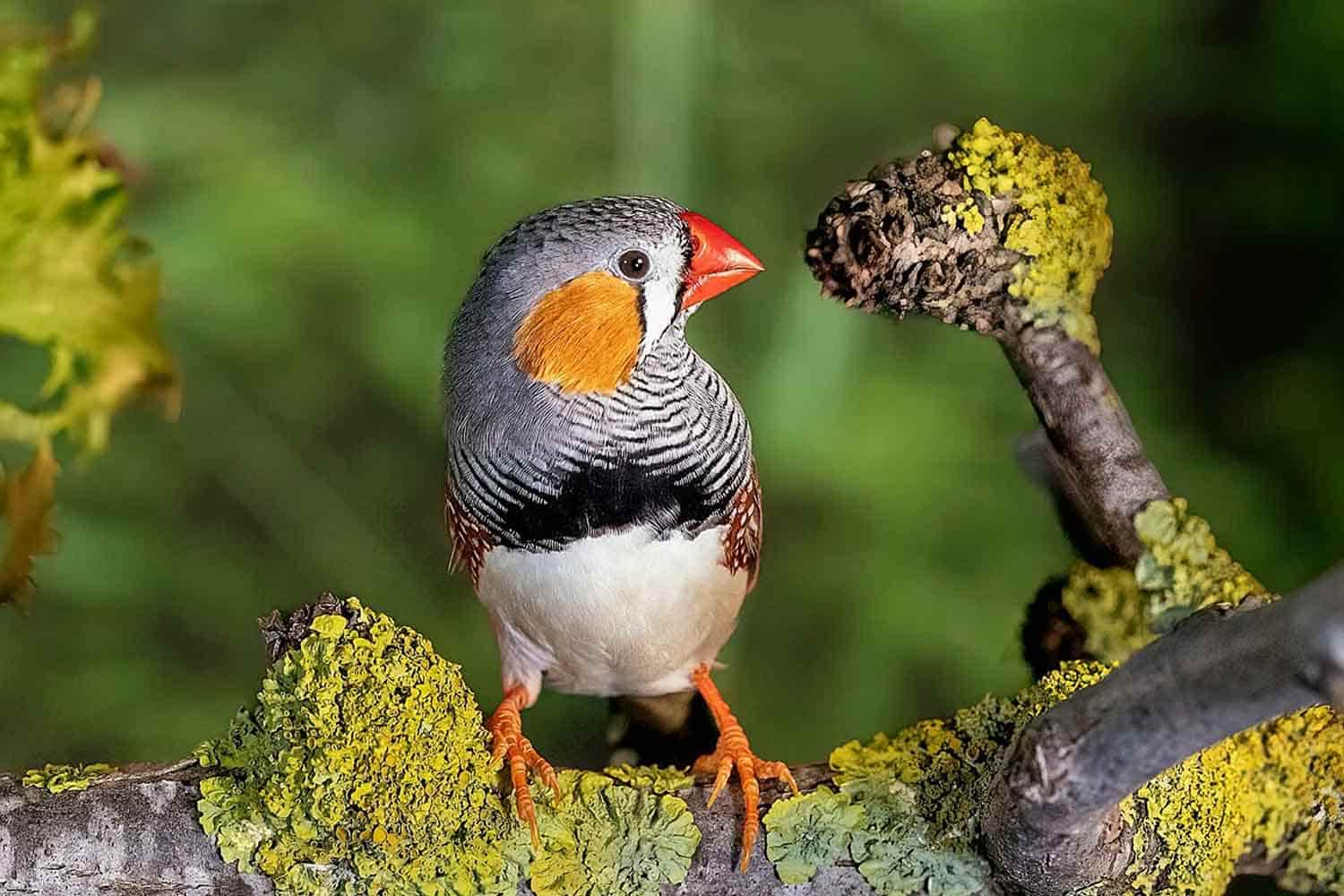
A zebra finch may confuse the call of a distant mate with one used to maintain contact when nearby. The two sounds are quite different, yet for him they seem to have something in common. On the contrary, it distinguishes a contact call from an alarm call quite well, even when the two are similar. It was by looking at these errors that a group of researchers at the University of California, Berkeley discovered something interesting: birds also recognize their calls based on their meaning.
The research, led by the ethologist Julie Elie and published on Sciencecombined years of observations, artificial intelligence, and behavioral experiments. The result is a sort of dictionary composed of 11 types of vocalizations used by zebra finches (Taeniopygia guttata), small Australian birds that have a lot to communicate to each other. So much so that Elie, awarded in June 2026 for her work, believes it is possible that a bird is among the first animals with which we will one day be able to interact vocally. So far, of course, no one has held a conversation with a tangerine. However, the scientists found a rather ingenious way to ask them whether their interpretations were correct.
Eleven calls to communicate, from courtship to danger
Julie Elie has been studying tangerine communication for over fifteen years. He started by observing them in Australia, following pairs and groups of birds in their natural environment. A job that is anything but simple, considering that these animals have the annoying habit of flying away just when someone would like to observe them. The research continued in the aviaries of the University of Berkeley, where it was possible to record vocalizations and associate them with behavior more precisely.
Zebra finches live in social groups, form pair bonds and use different calls to maintain contact, signal danger, show aggression or ask for food. Males also produce an elaborate song during courtship. Elie identified 11 types of vocalizations, grouped into six functional categorieswhich include contact calls, pair-related calls, alarms, conflict signals, chicks’ requests for food and courtship songs.
Through machine learning, an artificial intelligence technique, the group analyzed the characteristics of the sounds, comparing the frequency, duration and structure of the vocalizations. The database used in the study includes over 8,000 recordings from 45 birds.
A huge job, but with a problem still to be solved. Humans can observe an animal and attach meaning to its calls. This alone does not prove that the animal recognizes the same categories. Confirmation from those directly involved was therefore needed.
The seed experiment: do birds recognize their own calls?
To test the classifications, Elie and colleagues involved 12 adult zebra finches, six males and six females, in an experiment based on sound recognition. The birds had a button, or a sensor activated with their beak, through which they could listen to the recordings. Among the different calls played, only those belonging to a specific category allowed a food reward to be obtained.
The task consisted of recognizing the type of rewarded call and waiting for the seeds. If the sound belonged to another category, the animal could stop playing and move on to the next recording. A kind of remote control, in short, with a schedule made up of tweets and a reward that is decidedly more interesting than advertising.
The researchers periodically changed the rewarded category, verifying the animals’ ability to recognize all 11 types of vocalizations. The recordings came from different individuals, so as to check that the birds recognized the category of the call and not simply the voice of a familiar companion.
The results were remarkable. In 127 of 131 trials, the birds showed statistically significant discrimination. The few exceptions did not stop the researchers from observing that all categories could be recognized by mandarin diamonds. But the most interesting part came when the animals started making mistakes.
The errors revealed something the AI couldn’t explain
Among the vocalizations of zebra finches there is a small call, called tetused to maintain contact with nearby individuals. It is a discreet sound, repeated as the birds move and continue to signal their presence to each other. However, when they are far away and cannot see each other, they emit a louder and acoustically different call. During the experiment, the zebra finches sometimes tended to confuse these two vocalizations. They had different sound characteristics, but they both served to maintain contact.
It happened much less with the alarm call, which can sound a lot like the tetalthough transmitting different information. The researchers then compared the animals’ errors to those produced by acoustic classification systems. If the birds had recognized the calls only based on the sound, the confusions would have mainly followed the acoustic similarities. Instead errors were concentrated more often between vocalizations used in similar communicative contexts.
The phenomenon was called semantic magnet effectsemantic attraction effect: in the perception of birds, calls with similar functions are closer than what the sound characteristics alone suggest. According to the researchers, this behavior is compatible with the existence of a mental representation of the meaning of the calls. Animals, therefore, appear to process the information they receive, rather than simply reacting mechanically to a sound.
Why AI is so important for understanding animals
The contribution of AI was essential to analyze the recordings, compare acoustic characteristics and organize the calls into categories. But the experiment also showed how necessary it is to combine computer analysis with animal observation. An algorithm can recognize regularities among thousands of sounds. To understand whether those regularities correspond to something significant for those who produce and listen to them, behavioral checks are needed.
Elie demonstrated this by asking, so to speak, the mandarin diamonds to correct the dictionary prepared by the researchers. And it was the difference between the acoustic classifications and the animals’ responses that provided the most interesting clue. The work earned the researcher the 2026 Coller Dolittle Prize, an international $100,000 prize dedicated to studies that seek to make bidirectional communication between humans and other species possible.
During the award ceremony, Elie underlined that the birds’ errors allowed us to better understand their way of perceiving vocalizations. He also indicated how much work remains to be done, especially to integrate acoustic signals with visual ones. Animals, after all, also communicate through postures, movements and behaviors. And an identical sound can take on a different importance depending on the situation in which it is emitted.
Can we really talk to birds?
According to Elie, birds could be among the first animals with which humans will be able to establish a significant vocal exchange. The researcher considers this group of animals promising precisely because of the richness of their vocalizations and the frequency with which they are used in social interactions.
However, a considerable part of the work is still missing. Scientists need to understand how calls are combined, what rules govern responses between individuals, and how sound information integrates with body movements. Furthermore, knowing the 11 types of vocalizations of zebra finches does not mean being able to communicate with all bird species. The repertoire of a crow, for example, is different and would require specific work.
Among the prospects indicated by the researcher there is also the development of robots capable of reproducing the movements and postures of animals, accompanying them with recognizable vocalizations. A tool that could help study more complex communicative exchanges. As also reported by the University of Berkeley, Elie’s work was born from years spent listening to the birds and observing what happened every time they emitted a call.
Now we know that at least some of those sounds are also recognized through their communicative function. Getting to a conversation will require further experiments, perhaps new tools, and certainly a lot of patience. Meanwhile, twelve mandarin diamonds have already answered a question from scientists. And the most interesting information came when they pressed the wrong button.
