
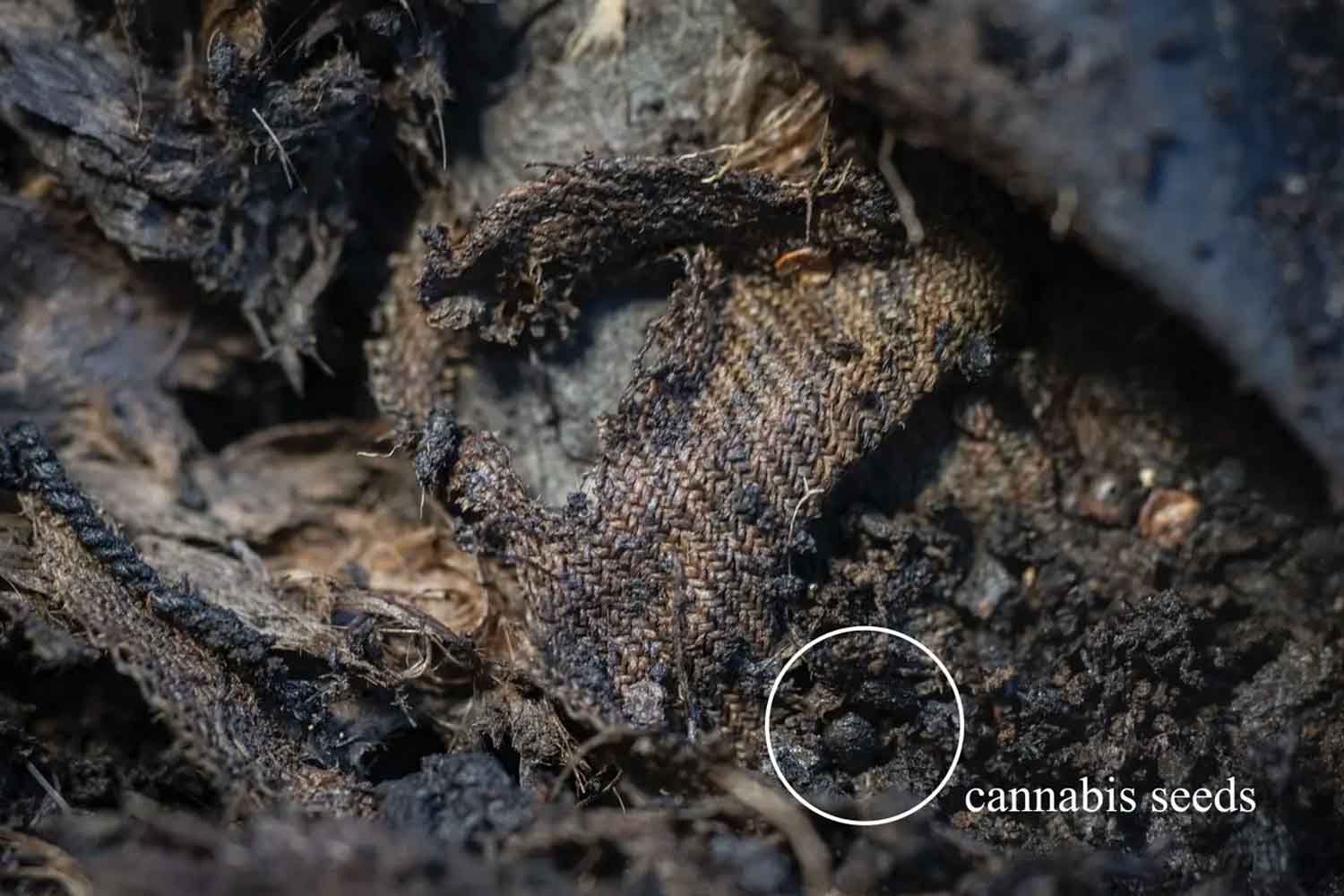
A thousand cannabis seeds and some strands of human hair remained buried for almost 2,800 years. This is what archaeologists found in a princely tomb in southern Siberia, along with something even more interesting: traces of cannabinoids in the hair of the deceased. According to researchers, this could be the oldest directly dated evidence of the use of cannabis for its psychoactive effects.
The discovery comes from the archaeological site of Tunnug 1, in the Republic of Tuva, Russia, where an international group of scholars led by Gino Caspari, of the University of Bern and the Max Planck Institute for Geoanthropology, analyzed the remains of a burial belonging to the Scythian culture. The results, published on Sciencewould anticipate the previous archaeological evidence of the use of the plant as an intoxicating substance by about three centuries. And there is also an old acquaintance from the history books who returns to make himself heard: Herodotus, who almost 2,500 years ago told how the Scythians threw hemp on red-hot stones to immerse themselves in the vapors and shout for joy.
A thousand cannabis seeds and cannabinoids in the hair
The Tunnug 1 mound held the burials of high-ranking people of Scythian society, a culture of nomadic peoples that inhabited the great Eurasian steppes. During the excavations, archaeologists recovered more 1,000 cannabis seedssome of which have been radiocarbon dated to the early 8th century BC.
The presence of the plant was already interesting, even though cannabis was used in ancient times to produce textile fibres, ropes and oil. Those seeds, alone, could have simply described one of these uses. However, archaeologists had another material at their disposal, much more unusual to find after almost three millennia: human hair preserved in the central burial chamber.
Through chemical analyses, including high-resolution mass spectrometry, the researchers identified signals compatible with the cannabinol (CBN)a compound that can form from the oxidation of tetrahydrocannabinol, THC, mainly responsible for the psychoactive effects of cannabis. Weaker signals consistent with THC also appeared. According to Caspari, the combination of the two findings suggests that the plant was also used for its intoxicating properties. As the University of Bern points out, the analyzes do not allow us to establish how much cannabis had been consumed nor whether the active ingredients had been inhaled or ingested.
Cannabis in Scythian funerary rituals
At Tunnug 1 cannabis was found in a rather particular funerary context. The burials were accompanied by sacrifices of horses and, probably, also of human beings. During previous excavation campaigns, archaeologists had identified the remains of 18 horses arranged on the mound, while subsequent investigations brought to light other equine remains and scattered human bones. These were elaborate ceremonies, in which the death of a high-ranking person involved animals, offerings and ritual practices.
According to the Max Planck Institute, the seeds indicate that cannabis played a role in burial ceremonies. It may have been burned, as happened in other Central Asian cultures, or consumed in different preparations. Scientists are also analyzing the DNA of the seeds to better understand the diffusion of the plant and the possible selection of varieties rich in psychoactive substances.
Herodotus already told it 2,500 years ago
The discovery acquires a particular significance going back to the 5th century BC, when Herodotus described the customs of the Scythians in the fourth book of his Histories. The historian said that, after burying the dead, the Scythians built a kind of tent with poles and felt blankets, placed red-hot stones inside and threw hemp seeds over them. The vapors produced were so abundant, he wrote, that they surpassed any bath known to the Greeks. The Scythians, meanwhile, shouted with joy. A practice that Herodotus interpreted as a form of purification of the body.
A first important archaeological finding arrived in 2019, when a study published on Science Advances had identified residues of cannabinoids in some wooden braziers found in the Jirzankal cemetery, in the Pamir mountains, in what is now western China. The containers, dating back to around 2,500 years ago, preserved traces of the burning of cannabis during funerary ceremonies. The tomb of Tunnug 1 would anticipate these testimonies by about 300 years, adding a different element: the cannabinoids also identified in human remains.
Cannabis was known and used long before the 8th century BC, especially to obtain fiber and oil. Determining when humans began to deliberately seek out its psychoactive effects is far more complicated. Herodotus had left us the description of men throwing hemp on the hot stones and shouting for joy. Nearly 2,500 years later, archaeologists found seeds and some strands of hair. To investigate those ancient ceremonies, this time a laboratory and a mass spectrometer were needed.
