
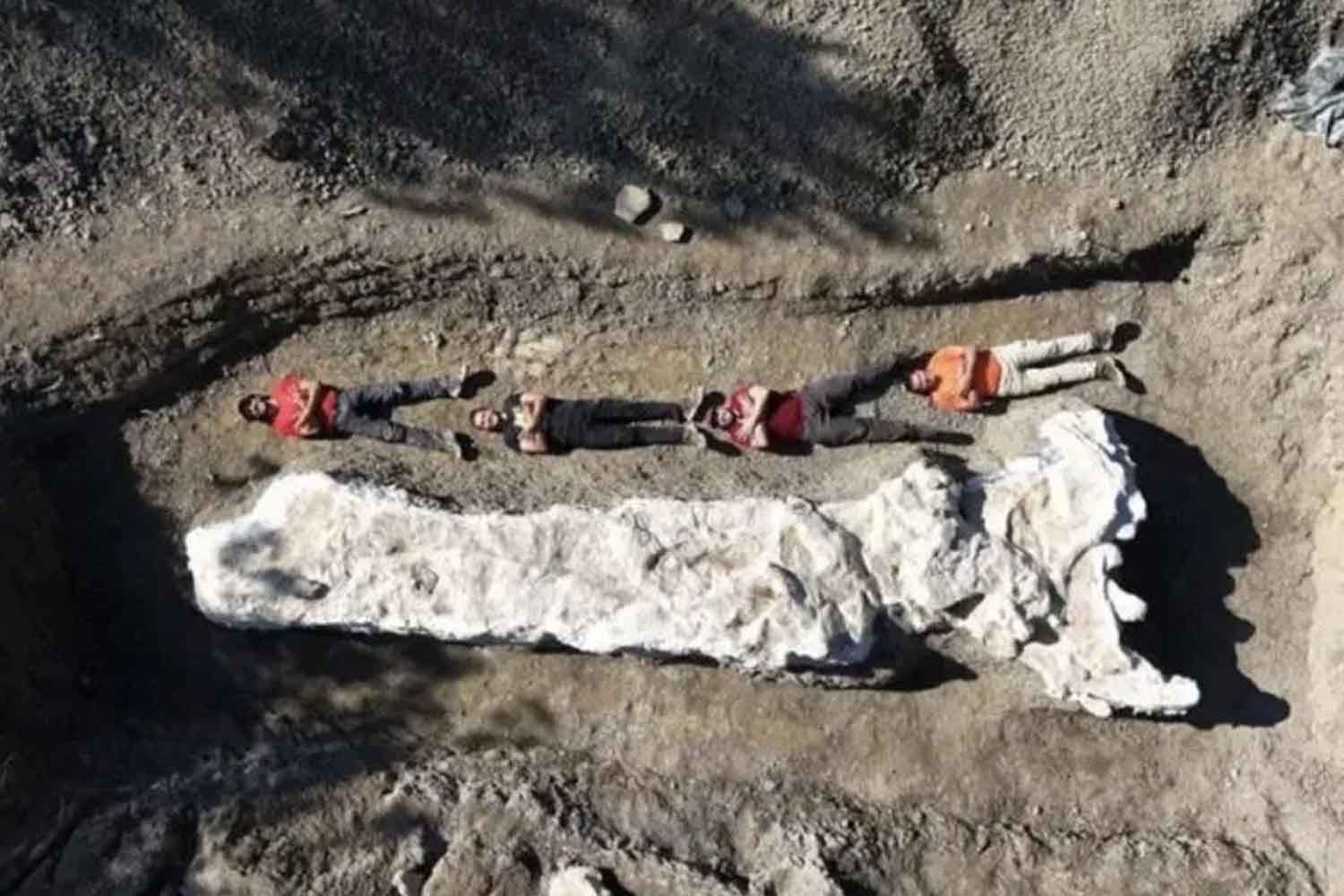
A gigantic neck, an 18 ton block of rock and four hours of work with a bulldozer to get it out of the ground. In Isona, in the Spanish province of Lleida, in Catalonia, paleontologists have recovered the remains of a titanosaur lived about 70 million years ago which could be the largest dinosaur ever discovered in Europe. The size of the bones suggests that the animal even surpassed Abditosaurus, one of the already known giants of the European Cretaceous. And it could belong to a completely new species.
The discovery comes from the Molí del Piteu deposit, where researchers from the Museu de la Conca Dellà and the Institut Català de Paleontologia Miquel Crusafont work. The draw took place on November 18, 2026, while the news was announced on November 23. The find is exceptional in terms of size and state of conservation. And to think that it all started with a few fragments of bone.
A seven meter and 18 tonne package to move
The deposit was identified about five years ago, but systematic excavations began later. Initially, some bone fragments had emerged. Then came bigger and bigger bones, until the researchers recognized a set of cervical vertebrae that could belong to a substantial part, perhaps even the entire neck, of the dinosaur.
At that point a rather concrete problem arose: How to take away such a large find without destroying it? The researchers consolidated the bones with acrylic resin, then built a protective structure of iron and polyurethane around the fossils. In paleontology it is called a “mummy”, even though it looks more like a gigantic transport container. The recovered block measures approximately seven meters long and two meters wide and contains approximately seven cubic meters of rock. The total weight reaches 18 tons, including the stone and the materials used to protect the fossils.
To extract everything, a large excavator was needed, which overturned the block and loaded it onto a trailer. The operation lasted over four hours. During the transfer, a fragment of the front part broke off, while the rest remained substantially intact. Paleontologists will still need to check the condition of the bones during preparation.
It could be the largest dinosaur in Europe
The new titanosaur already has a neighbor to compete with. In 2014, the fossil neck of another gigantic herbivore was extracted from the Orcau deposit, also in Catalonia. It belonged toAbditosaurus kuehneia species identified through a study published in 2022 on Nature Ecology & Evolution.
The Abditosaurus reached almost 18 meters in length and an estimated weight of 14 tons. Its skeleton, dating back to around 70.5 million years ago, is the most complete of a titanosaur yet described in Europe. At the time, the extraction of the neck, about five meters long, was considered an exceptional undertaking given the size of the find.
Now there may be an even bigger giant. Paleontological preparator Elena Nieto explained that the cervical ribs of the specimen found in Isona are longer than those of the Abditosaurus. A detail that suggests superior dimensions and which immediately attracted the attention of researchers.
The new specimen could therefore join the largest dinosaurs known in Europe, perhaps even surpassing previous records. To establish this, it will be necessary to reconstruct the proportions of the animal through the study of the individual bones. Even belonging to a new species is still an open possibility.
©Instituto Catalán de Paleontología Miquel Crusafont / ACN
Teeth of carnivorous dinosaurs also emerged among the bones
The find presents another particularly interesting feature. In addition to the neck, paleontologists have identified remains of the pectoral region, the forelimbs and the cranial areaelements that had not been recovered together with the neck of the Orcau specimen. Some vertebrae may still be preserved in their original anatomical position. According to Nieto, this suggests that the body was not dragged long distances by water currents after the animal’s death.
And then there are the teeth. Numerous teeth belonging to carnivorous dinosaurs were found in the surrounding terrain, a clue to the possible activity of animals that fed on the carcass. This part of Catalonia, moreover, was very different from today. During the Upper Cretaceous, Europe was fragmented into numerous islands, with coastal environments and plains crossed by waterways.
In this context, European titanosaurs were generally smaller than their relatives who lived on other landmasses. As researchers from the Institut Català de Paleontologia explain, the limited availability of resources on the islands may have favored the evolution of small-sized animals, through so-called insular dwarfism.
Abditosaurus already represented an exception to this trend. The new specimen could add another piece to the history of the large herbivores that populated Europe shortly before the extinction of non-avian dinosaurs, which occurred about 66 million years ago.
Now we need to free the bones from the rock
The most spectacular part of the operation is over. Now begins the probably longest one: slowly removing the rock, cleaning the bones, consolidating them and studying their structure. The preparation will take place in Isona, initially outdoors and subsequently in a covered space.
The Abditosaurus precedent suggests some patience. The preparation of its neck took about six years, while the scientific description of the species arrived in 2022. This time the museum has a specialized team working continuously on the fossils, so the researchers hope to shorten the time. The objective is to study the specimen and subsequently exhibit it at the Museu de la Conca Dellà, also allowing visitors to follow the preparation operations.
For the director of the museum, Àngel Galobart, the discovery represents above all an opportunity to learn more about the biodiversity of the dinosaurs that lived in the Pyrenees and conserve the paleontological heritage of the area. Meanwhile, in Isona, there is already a new giant to study. To know how big it really was will still take some time. And a lot of rock to remove.
