
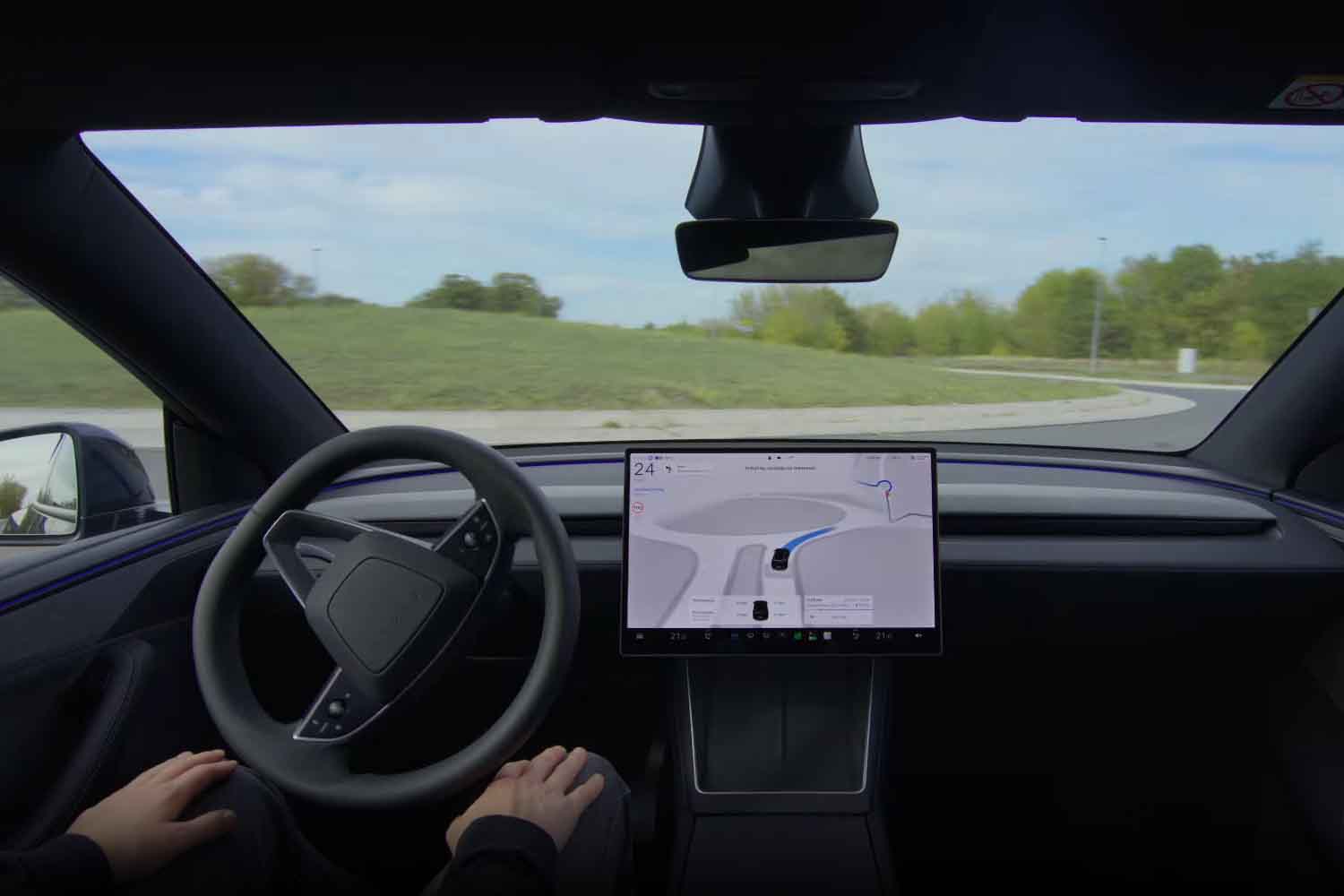
A Tesla will be able to tackle a roundabout, change lanes and follow city traffic by intervening on steering and speed. It will cost 99 euros per month and will arrive on compatible cars through a software update. The Ministry of Infrastructure and Transport has authorized the use in Italy of Tesla Assisted Driving, the advanced driving assistance system developed by Elon Musk’s company. With one condition: whoever sits behind the wheel remains responsible for every manoeuvre. Even when it’s done by car.
The green light arrived on November 19, 2026, when the Motor Vehicle Authority recognized the provisional approval issued by the Netherlands. The Ministry of Transport announced it the following day, specifying that Italy is the twelfth member state to authorize the system and the first among the four most populous countries of the European Union. Germany, France and Spain, for the moment, are still waiting.
The Tesla also tackles roundabouts, but it doesn’t drive itself
How it works is pretty simple to describe, at least on paper. You set a destination and the system can manage various operations normally entrusted to the driver: accelerating, braking, steering, changing lanes and navigating intersections and roundabouts.
Tesla claims the technology can follow almost any path, even bypassing vehicles and obstacles. However, the functions depend on the model, hardware and version of the software installed. Ministerial approval does not mean that any Tesla can use them immediately.
The technology belongs to level 2 of automation, that of advanced driver assistance systems. It means that the vehicle can control direction and speed at the same time, while the driver must continue to monitor the road, maintain control and be ready to intervene.
Therefore, those who imagined making themselves comfortable, perhaps reading a book while the car maneuvers through traffic, will have to postpone. Also because the Italian Ministry has specified that hands must remain on the steering wheel.
Hands on the steering wheel? The Italian and Dutch indications
On this detail, however, the authorities’ communications deserve further investigation. MIT expressly recommends keeping your hands on the steering wheel at all times. The Dutch authority RDW, which issued the first approval, explained in April that the driver can also remove them, as long as he is able to immediately regain control and keeps his eyes on the road. Furthermore, on November 16, the RDW approved an update that introduces the obligation to keep hands on the steering wheel when the system operates at speeds above 130 kilometers per hour.
The indications published by the two authorities, therefore, do not coincide completely. The press releases alone do not allow us to reconstruct every technical condition of Italian recognition. For those who use the system on our roads, the requirements communicated by the MIT remain.
RDW itself introduced stricter controls on attention. The driver will receive advance warnings when he becomes distracted and may incur internal system penalties, up to and including temporary deactivation, if he repeatedly ignores the warnings. The updates described by the authority concern vehicles equipped with HW4 or later hardware.
From 50% to 10%: Tesla also had to change the speed
The speed issue is another of the changes approved in the Netherlands. In the previous configuration, the software provided a margin that could be set up to 50% compared to the detected speed limit. On November 3, RDW authorized a version that reduces this margin to 10%. Furthermore, each time the car is started, the setting automatically returns to zero. The change concerns the system’s adjustment possibilities and does not, of course, authorize you to exceed the limits set by the Highway Code.
A name change also arrived in the same update. The technology known as Full Self-Driving (Supervised) has become Tesla Assisted Driving, a designation that more accurately describes what it actually offers. Because calling it “completely autonomous driving”, even supervised, could suggest capabilities beyond those permitted. And if to explain a function you have to continually add that the car doesn’t drive itself, perhaps there was some problem in the name.
How much does it cost and when does it arrive on Italian Teslas
The price is already established: 99 euros per month, VAT included. According to the conditions published by Tesla, the service will only be available by subscription, without the possibility of definitive purchase. Renewal is automatic, unless canceled. Those who cancel their subscription can continue to use the features until the end of the paid period, but Tesla does not provide refunds. Trial periods may be available for some owners, depending on specific requirements.
Before activation you will also need to accept the conditions of use, watch a mandatory video tutorial and pass a quiz dedicated to how the system works. A small check before entrusting the steering and accelerator to the software. For Italian distribution, Tesla has announced a launch soon, without communicating a precise date. The system will be installed via remote update on compatible cars.
Because the green light is still provisional
The Italian authorization is based on article 39 of the European Regulation 2018/858, which provides a particular procedure for innovative technologies not yet fully covered by the existing rules. The Netherlands issued the first certificate on April 10, 2026, after more than a year and a half of checks and tests conducted by RDW on track and public roads. The provisional approval is valid until 10 April 2029.
Other Member States may recognize it on their territory while the community evaluation continues. For the system to be authorized throughout the European Union, the required procedure still needs to be completed, which includes a vote by the Member States. Minister Matteo Salvini welcomed the decision as a step forward towards the mobility of the future, declaring that he wanted to keep citizens’ safety first.
Technological innovation is concrete: a car capable of dealing with numerous traffic situations under supervision represents a significant evolution in assistance systems. Homologation, however, does not equate to a guarantee of flawless operation in any situation.
Italy has authorized the software and Tesla is preparing to distribute it. The subscription costs 99 euros, the technology can also tackle roundabouts and the driver continues to respond to what happens on the road. The steering wheel can turn thanks to the computer. For liability, however, the update is not foreseen.
