
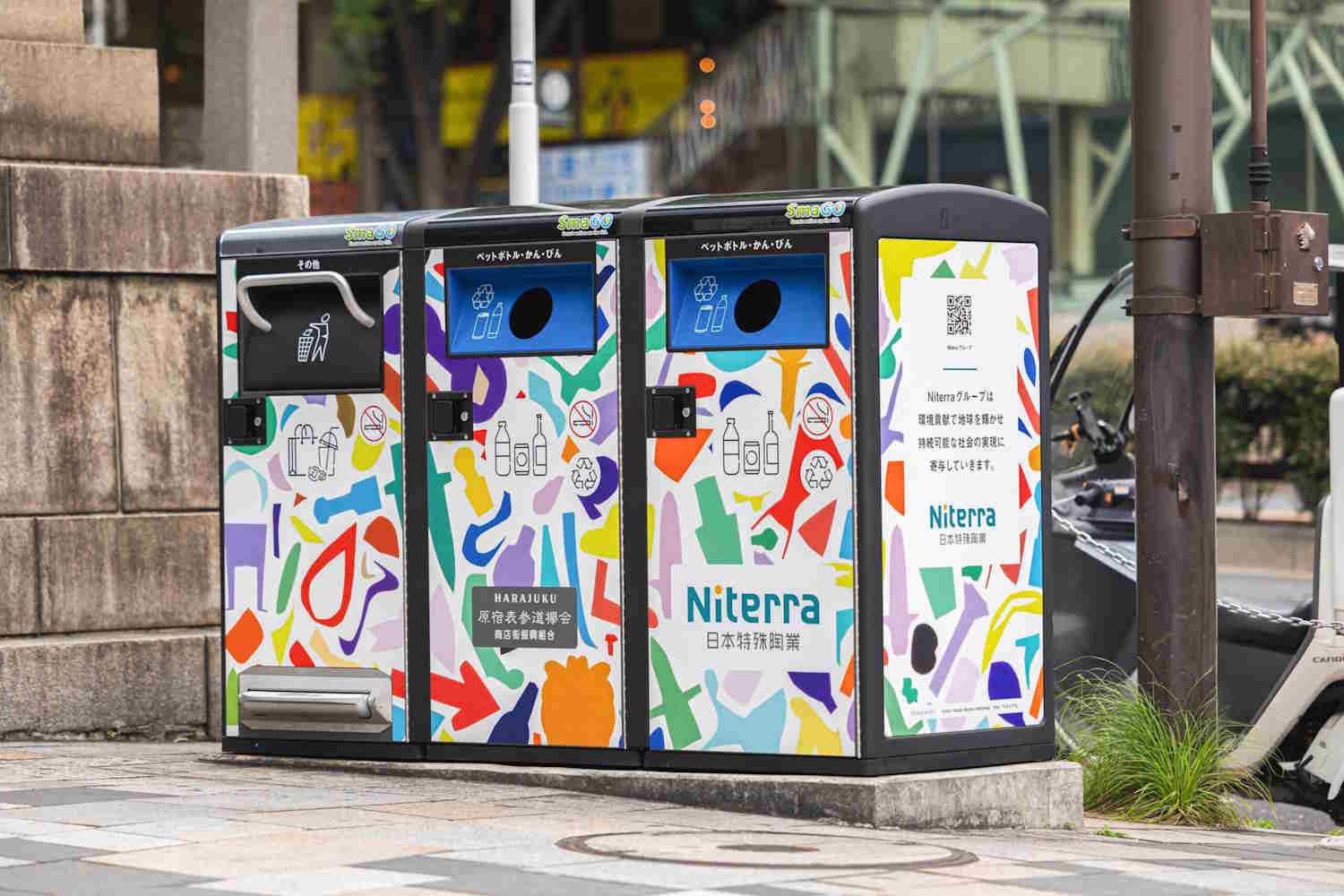
In Japan it is easier to come across a drinks vending machine than to find a bin in which to throw the bottle you just purchased. Now the country is trying to solve the problem with a rather curious solution: smart bins powered by solar energy, capable of autonomously compressing waste and alerting collection workers when it is time to empty them. Even those on wheels have arrived in Tokyo, capable of moving independently among the passengers in the train stations.
The scarcity of public bins in Japan is linked to safety reasons, management costs and a deep-rooted cultural habit: that of taking one’s waste home with oneself. A system that has to deal with the growing influx of foreign tourists, who are often unaccustomed to this practice.
According to a survey by the Japanese National Tourism Agency, published on April 28, 2026 and conducted on 4,110 foreign travellers, the lack of baskets represents the most frequently reported difficulty during the stay (17.2%), ahead even of communication difficulties with facility staff (15.4%) and crowding of tourist resorts (12.9%).
Solar-powered bins that hold five times more waste
They are called SmaGO and are distributed in Japan by the Forcetec company. At first glance they look like very normal waste collection containers, if it weren’t for the small photovoltaic panel installed on the top. The energy produced by the sun powers an automatic compaction system that comes into operation when sensors detect the accumulation of material.
The result? According to the technical characteristics of the device, in the same space occupied by a traditional bin it is possible to collect approximately five times more waste. Furthermore, before the container is completely filled, an email notification is sent. Employees can check the filling level directly from their smartphone and organize the collection round without necessarily having to go through all the bins.
And there are already some interesting results. In the Omotesando and Harajuku neighborhoods of Tokyo, before the introduction of SmaGOs it was necessary to replace waste bags three or four times a day. Now one is enough, with a reduction in collection frequency of around 70%. In the commercial area of Dotonbori, in Osaka, according to data released by Forcetec, the waste abandoned near the containers has decreased by around 90%, excluding cigarette butts.
Fewer bags to replace, fewer trips to collect them and less rubbish to collect on the pavements. As of November 2026, these bins have been installed in approximately 80 locations in Japan.
Photovoltaics also arrives in Buddhist temples
©SmaGO
Since November 9, 2026, smart bins have even entered the Kiyomizu-dera complex, one of the most famous Buddhist temples in Kyoto, a UNESCO world heritage site.
During the autumn tourist peak, between 20 thousand and 30 thousand people per day gather between the temple and the streets leading to its entrance. And between visits, drinks, snacks and take-away food are consumed. The cleaners carried out around four waste transports to the collection point every day, without always managing to prevent the containers from overflowing.
The project, financed through a program of the National Tourism Agency dedicated to combating overtourism, aims to reduce daily waste transport from four to one.
Alongside the containers for unsorted waste and those for glass, cans and plastic bottles, one has been installed with a very specific function: to collect leftover drinks. In this way we prevent bottles and glasses that are still half full from ending up with the other materials destined for recycling.
With the installation at the temple, SmaGO reached 19 different locations in the city of Kyoto.
In Tokyo the basket comes directly to you
In Shinjuku train station, one of the busiest in the world, they thought they would even save passengers the trouble of looking for a bin. From 8 September to 20 November 2026, the JR East railway company experimented with the use of mobile robots developed by the US company Cartken. These are autonomous vehicles originally designed to make deliveries, appropriately modified to collect and transport waste.
The robots travel pre-established routes within the station, using on-board sensors to move among travelers and avoid obstacles. Passengers can throw waste into the appropriate containers while the vehicles make their rounds, and then independently reach the point where they are emptied.
The objective of the experiment is to improve the service offered to passengers and lighten the workload of cleaning staff, especially in environments where hundreds of thousands of people pass by every day. Japan continues to ask tourists to respect the rules of separate waste collection and not to abandon their waste. In the meantime, it is making it decidedly easier to comply with them: in some areas, to empty a bin, you just need to wait for an email from it. In Shinjuku, however, it is the trash itself that gets in the way.
