
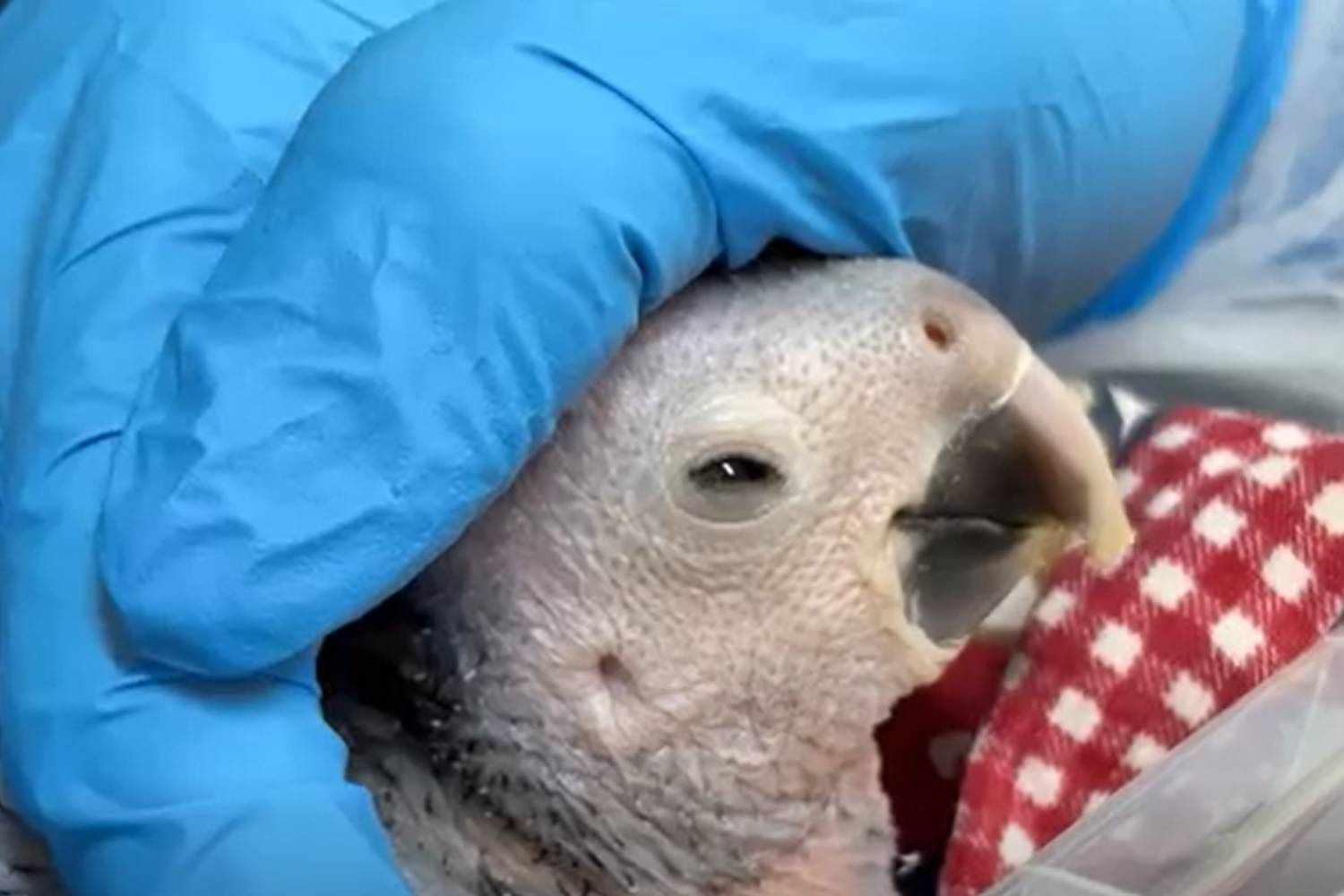
She weighs just 350 grams, her name is Hope and she was born on October 18th at the zoo in Sao Paulo, Brazil, but was only officially presented on Tuesday November 24th, immediately becoming viral. The reason for all the fuss is the fact that it is the first Spix’s macaw chick – known locally as ararinha-azul and made famous by the animated film Rio of 2011 with the protagonist Blue – never born in a Brazilian zoo.
Birth after 28 days of incubation
Its hatching required a very delicate intervention on the part of the team coordinated by biologist Fernanda Guida, head of the facility’s bird sector: after 26 days in an incubator at 37.5 degrees, the egg did not open and after another 48 hours of waiting, for a total of 28 days, the specialists had to manually break the shell because the little one was in an incorrect position.
The first two weeks were also critical, with the biologists constantly watching over her and feeding her through a tube as she refused the syringe, until the double positive turning point: overcoming the danger phase and the confirmation that Hope is a female, very precious in a population made up almost entirely of males and which arrived after 38 eggs laid by 2 couples had not hatched the previous year.
From illegal captures to the hope of returning to the Caatinga in Curaçá
Native to the semi-arid region of Caatinga, in north-eastern Brazil, the Spix’s macaw has been pushed to the brink of the abyss by deforestation and decades of illegal harvesting for the exotic pet trade, so much so that it has not flown free for over 20 years and is classified as extinct in the wild on the IUCN Red List.
Today only around 330 specimens survive in the world, all confined and marked by a very high rate of inbreeding, while the nucleus housed in São Paulo derives from the 27 birds entrusted in August 2023 by the Brazilian Ministry of the Environment after the exit of a private breeding farm from the national protection plan. The objective declared by Fernanda Guida is to increase the number of breeding pairs – aiming for 10 pairs, although reaching 2 is already considered a success – to prepare for a future release in Curaçá, in the State of Bahia, where the last wild individuals were spotted.
