
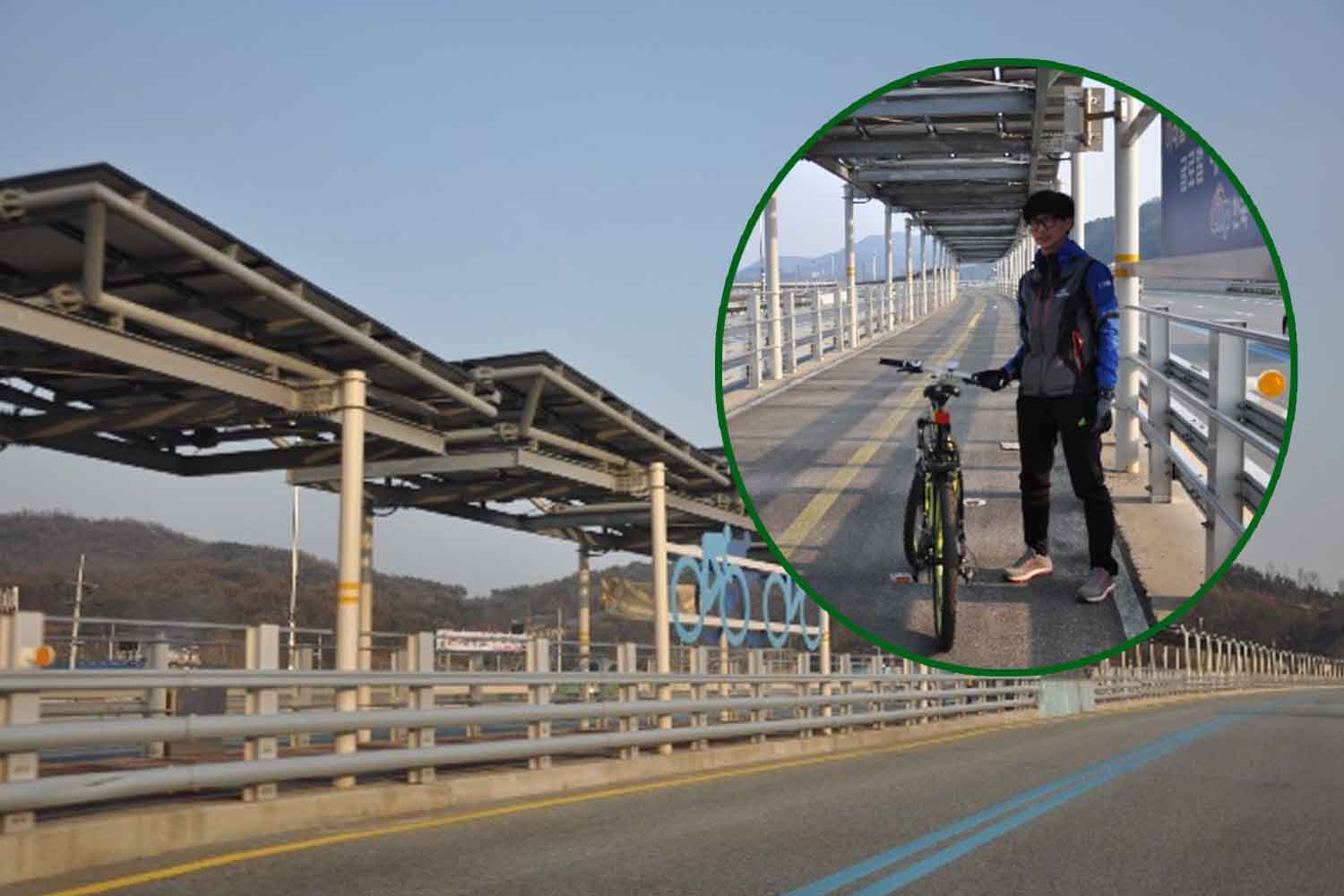
Eight lanes, a central traffic island and over 7,500 solar panels. Between Daejeon and Sejong, in South Korea, they found a decidedly intelligent way to exploit a space that we are used to seeing occupied by guardrails and concrete barriers: they transformed it into a cycle path covered by photovoltaic panels, capable of combining sustainable mobility and clean energy production.
The idea dates back to 2012, when, as part of the expansion of the road connection between the two cities, engineers rethought the function of the central traffic island. As documented by the South Korean Government, a 3.9 meter wide cycle path has been created along the approximately 9 kilometer route, equipped with photovoltaic coverage for 4.6 kilometres.
A solar power plant above the cyclists’ heads
The panels are installed on raised metal structures, forming a long shelter that offers shelter from the sun and rain to those traveling by bicycle. Below you pedal, above you produce electricity.
According to a report by South Korean public broadcaster KTV in 2015, the plant’s expected annual output was around 2,200 MWh of electricity, enough to cover the needs of around 600 families according to local estimates.
The most interesting part of the project, however, concerns what the Korean engineers managed to do without searching for new surfaces to be used for energy production. They exploited the space within a road infrastructure, creating a path reserved for bicycles and a photovoltaic power plant.
@AI generated
Of course, cycling in the middle of eight lanes involves some inconveniences, especially in terms of exposure to traffic noise and pollutants. The principle behind the project, however, can also be applied in contexts that are decidedly more pleasant for those who cycle.
The land we are looking for for photovoltaics could already be before our eyes
In Italy, the need to reconcile the growth of renewable energy with the protection of agricultural land is often discussed. In the meantime, we continue to have kilometers of uncovered parking lots, industrial warehouses, service areas and road infrastructure that could accommodate photovoltaic systems.
How much space do we already have available? According to data from the 2026 edition of the ISPRA and SNPA Land Consumption Report, 1,116 square kilometers of usable roofs for the installation of photovoltaic systems have been identified in Italy. And we’re only talking about building roofs.
The same report documents an increase of over 102 square kilometers in artificial surfaces during 2025. A rate of more than three square meters per second. Faced with these numbers, making better use of what we have already built should become one of the priorities of energy planning.
Also because a car park covered by solar panels would continue to accommodate cars, with the advantage of keeping them in the shade during the summer months. A photovoltaic shelter would continue to shelter passengers waiting for a bus. And even a noise barrier could produce electricity.
Where the conditions exist to integrate agricultural production with energy production, agrivoltaics represents a precious opportunity. However, we also have kilometers of already artificialized surfaces that could host photovoltaic systems: car parks, roofs, industrial warehouses and, as the South Korean experience teaches us, even traffic islands.
The energy transition also involves a different conception of the spaces we occupy. A cycle path can become a photovoltaic power plant, a car park can produce electricity while keeping cars in the shade. Two functions, one surface. In South Korea they understood this already in 2012. And to think that here, when we talk about photovoltaics, we almost always end up discussing agricultural land.
