
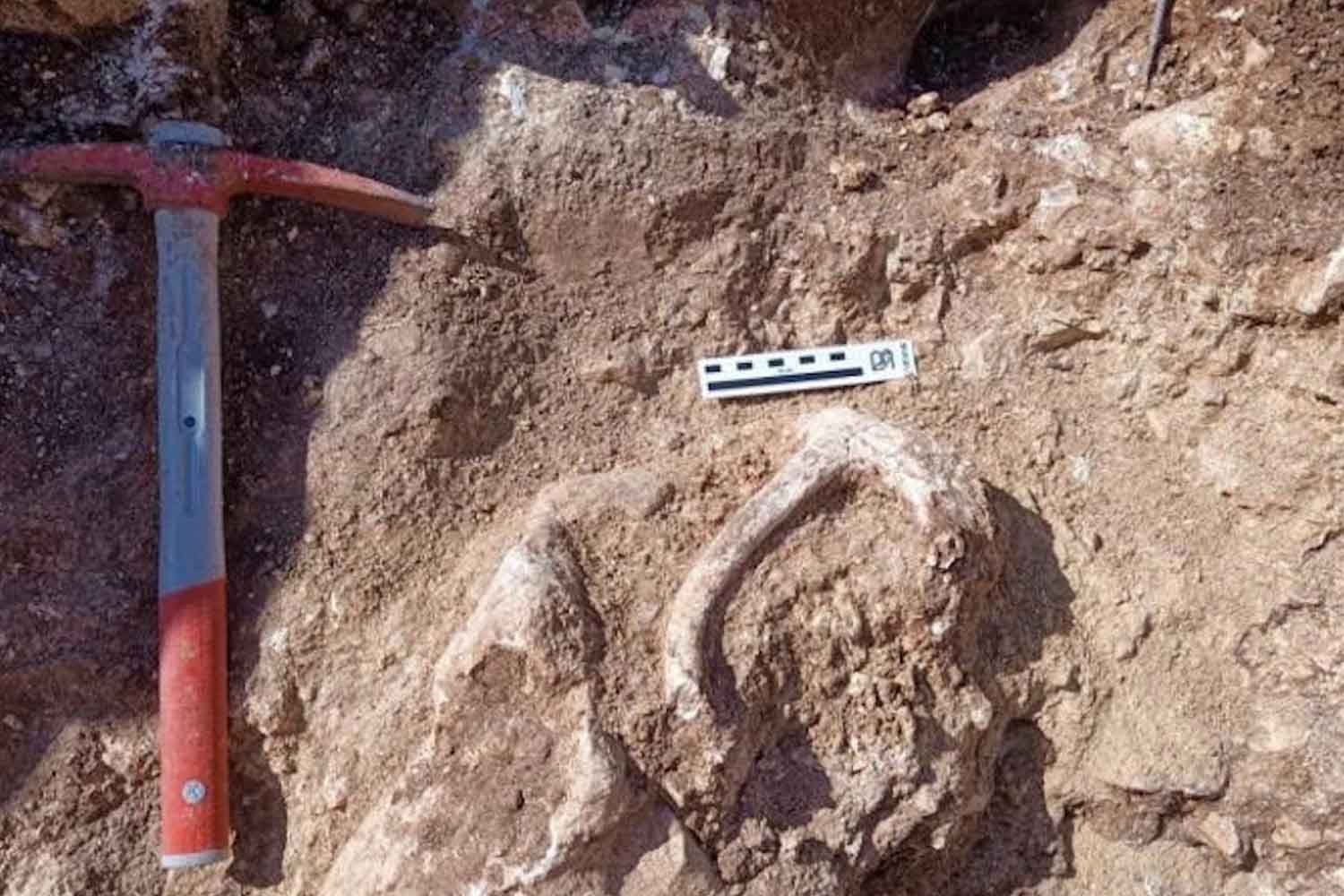
Half a million years before anyone thought of connecting Ragusa and Catania with a road, in the Sicilian hinterland there were giant tortoises. The remains were brought to light by the excavations for the construction of the new infrastructure, along the state road 194 “Ragusana”.
The discovery, announced by Anas on 26 November 2026, dates back to 2024 and affects two municipalities in south-eastern Sicily: Licodia Eubea, in the province of Catania, and Chiaramonte Gulfi, in the province of Ragusa. In addition to the fossils of large tortoises, the bones of an ancient cervid were also recovered.
The giant turtles under the future Ragusa-Catania
The lands of Piano Sciri and Quattropoggi, in the territory of Licodia Eubea, housed the remains of the turtles that lived there over 500 thousand years ago. In Chiaramonte Gulfi, however, the bones of the cervid were preserved in the Sciannecapurali district, within sediments deposited by the waters between 300 thousand and 100 thousand years ago.
For the occasion, the workers involved in building the road were joined by paleontologists and archaeologists. Among them Gianni Insacco, scientific director of the Civic Museum of Natural History of Comiso, and Carlo Veca, archaeologist from Anas.
The recovery operations, coordinated by Anas with the collaboration of the museum and the Superintendencies for Cultural and Environmental Heritage of Ragusa and Catania, took place in parallel with the road works. As stated in the note Anasthe finds were transferred to the paleontological laboratory of the Comiso museum, where they will be restored and preserved, also protected from the risk of clandestine excavations.
When dwarf elephants and giant tortoises lived in Sicily
Prehistoric Sicily had a decidedly curious fauna, at least in the eyes of those who live on the island today. Elephants had become small, while some land tortoises had reached considerable size.
The geographical isolation of the islands can in fact favor evolutionary phenomena such as dwarfism and insular gigantism. Over the course of generations, the availability of resources, the presence or absence of predators and different environmental conditions can also profoundly change the size of animals.
Precisely in the surroundings of Comiso, some of the oldest elephant fossils in Sicily have been found, dating back to around 500 thousand years ago, as documented by ISPRA. As for the large tortoises, some remained on the island until surprisingly recently, at least on a geological scale.
In 2022 a study published in the Zoological Journal of the Linnean Society described a species previously unknown to science, the Sicilian solitudethrough some bone remains found in the Zubbio cave of Cozzo San Pietro, in Bagheria, in the province of Palermo. The dating of one of the finds revealed an age of approximately 12,500 yearsmaking that tortoise the most recent known fossil record of a large species in the Mediterranean.
The fossils could be put on public display
The next stop for the giant tortoises of Ragusa-Catania could be a display case in the Civic Museum of Natural History of Comiso, which already houses tens of thousands of finds and houses a rich collection dedicated to prehistoric Sicilian fauna.
The hope is that, once the restoration operations have been completed, the new fossils can become part of the exhibition itinerary and can also be observed closely by visitors. In the meantime, work has resumed on the construction sites. Curious how, by digging to shorten the distances between two cities, we ended up traveling back half a million years.
