

For years now, we have become accustomed to buying everything for just a few euros: clothes, accessories, household items that we often didn’t even know we needed. An avalanche of products at rock-bottom prices, accompanied by intense advertising campaigns. Not to mention the frantic days of Black Friday.
Now, however, something may have gone wrong in the commercial model of giants like Temu and Shein. And what is gaining ground is precisely a platform created to give a second life to objects. The now well-known Vinted.
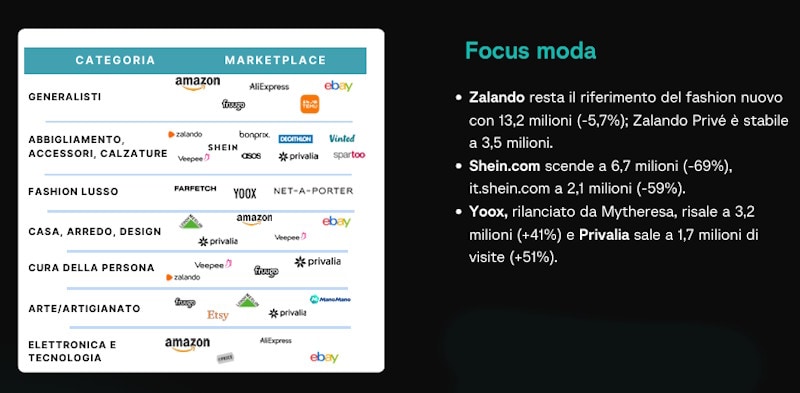
This change is photographed by the sixth edition of the 2026 Marketplace Map by Yocabè, a company specializing in e-commerce, which analyzed the average monthly web visits of the main online sales platforms in 18 countries and geographical areas, using SimilarWeb data.
How much Temu loses in Italy
In Italy, Temu went from 44.3 to 12.7 million average monthly web visits, a -71% compared to 2025 which practically took it out of the ranking of the five most visited marketplaces. At the same time, Vinted recorded a growth of 39%, entering the Italian top 5 and overtaking both Temu and Shein. Amazon remains firmly in first place, with 205.9 million monthly visits.
@Yocabè
@Yocabè
But it is not an exclusively Italian phenomenon. According to the same survey, Temu loses 76% of visits in France and 78% in Germany, while Vinted grows in the main European markets:
In France, in particular, Vinted reaches 39 million average monthly web visits, becoming the second most visited marketplace in the country after Amazon.
How much do the new European duties have to do with it?
Before attributing this change to a newfound environmental awareness among consumers, a fundamental element must be considered: the new European rules on imports. In fact, from 1 July 2026, the European Union has introduced a customs duty of 3 euros for each product category present in parcels with a value of up to 150 euros coming from non-EU countries.
The measure, as the European Commission explains, aims to ensure fairer competition, combat customs fraud, protect consumers from products that do not comply with European safety standards and address environmental issues linked to mass shipments.
A novelty that affects one of the main strengths of very low-cost trading platforms: convenience.
Particularly significant in this regard are the French data published by FEVAD, the French Federation of Electronic Commerce, based on the Médiamétrie/NetRatings surveys. In July 2026, the first month of application of the new duty, compared to the same period of the previous year, the audience of the main Chinese platforms recorded these changes:
FEVAD itself specifies, however, that Shein’s decline was already evident in June, before the introduction of the duty. It is therefore not possible to attribute the observed contraction entirely to the new customs measures.
Does buying used really mean consuming less?
Vinted’s success is certainly an interesting sign. Buying a second-hand item instead of a new one can help extend the life of products, reduce waste and limit demand for new raw materials. But be careful not to confuse the growth of the second-hand market with the reduction in consumption.
First of all, Yocabè data concerns web visits, not the number of purchases, turnover or overall application traffic. Furthermore, we do not know whether those who stopped visiting Temu actually moved to Vinted.
Then there is another question: the second-hand market can also fuel compulsive purchasing mechanisms. If low prices push us to continually buy clothes we don’t need, we risk replicating, through a different platform, the same habits that characterize the consumption of fast fashion. The growth of second hand therefore represents an opportunity, but its environmental benefit also depends on the ability to replace purchases of new products, rather than adding to them.
In short, it is still early to celebrate the decline of fast fashion. Certainly, however, the numbers tell the story of a European market in which the balance is changing.
