
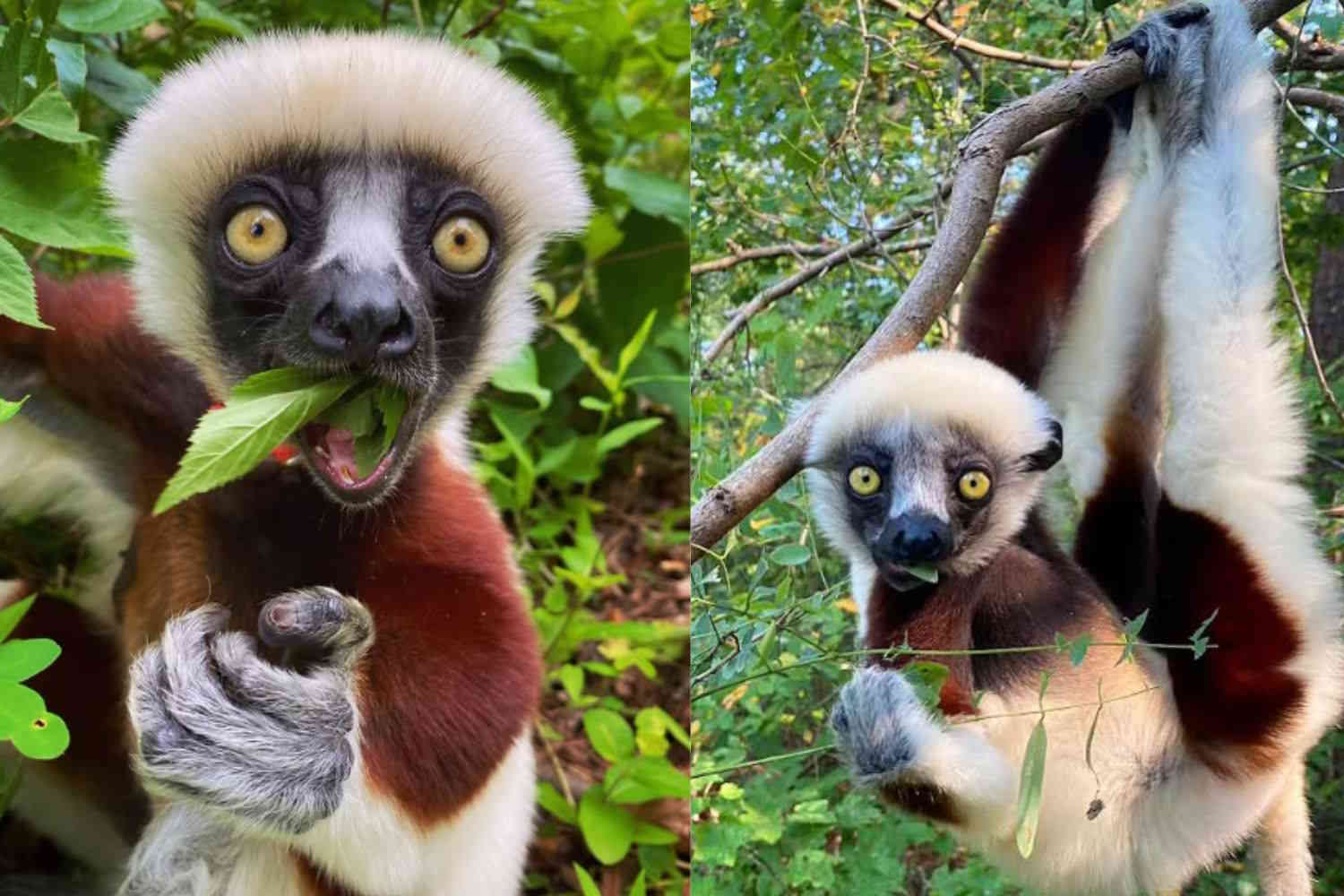
They call them lemurs dancing or dancers because they are capable of performing coordinated jumps and acrobatics, but also the name assigned to these primates reveals some characteristics of an endemic species of Madagascar.
The sifaka by Coquerel, Propithecus coquereli, it is one of the wild animals that roam the forests of Madagascar. Distinguishing them from other similar ones is quite simple, just observe their leaps and their movements, almost always vertical.
Even their expressions like their poses are truly incredible. A naturalist and photographer gives us a taste, sharing some extraordinary shots of this particular but extremely vulnerable species.
View this post on Instagram
Lydia Greene is a lemur specialist at Duke University and has been conducting field research on the African island for over 10 years. During these expeditions he had the opportunity to closely study the biodiversity of Madagascar and observe several specimens of Coquerel’s sifaka in their natural habitat.
Through her photographs, Dr. Lydia Greene disseminates curiosities and valuable information about Coquerel’s sifaka or dancing lemur. Every content shared on social media is an adventure between lush trees and new sounds to discover the fauna of Madagascar.
View this post on Instagram
In this photo, a Coquerel’s sifaka is sitting comfortably on a tree trunk and stretching its long, powerful hind legs. The latter are precisely the part of the body that the primate uses to move by hopping from one point to another, covering long distances.
View this post on Instagram
In this very funny shot, a sifaka tastes tender leaves, which can however be more bitter due to the presence of polyphenol compounds such as tannins (the same ones present in wine, responsible for sensations of astringency). Unlike other species, including humans, the sifaka does not encounter problems because its organism has perfectly adapted to the diet.
To give an example, the expert mentions the taste buds of the dancing lemur, which do not perceive the bitterness of the leaves it munches. But even the name, as we were saying, is decidedly interesting.
Sifaka is a onomatopoeic term, it is in fact the sound emitted by the species when it is moving. We thus imagine hearing his voice, but we also try to imagine how difficult it is for the dancing lemur to survive in an environment full of threats.
The species is classified in the International Union for Conservation of Nature (IUCN) Red List as in critical danger of extinction.
His posts are a warning to become aware of how much of a priority it is to safeguard these ecosystems and their specimens at risk.
