
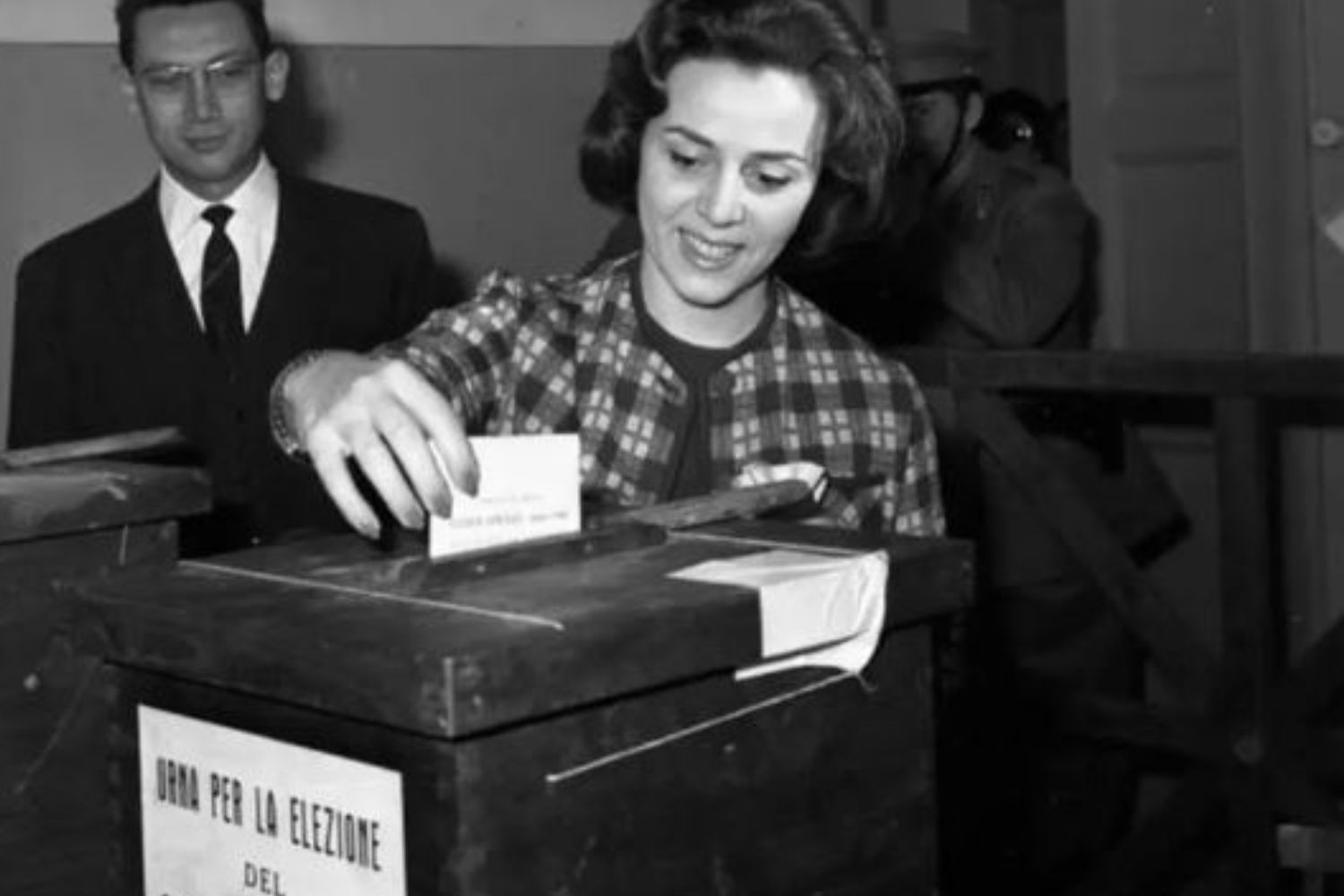
The January 30, 1945 He marked a historical turning point for Italian democracy and for women: the Council of Ministers finally opened the doors to female suffrage. The decision materialized in the Lieutenant Legislative Decree n. 23 of 1 February 1945, which recognized women the right to vote, with some limitations. In fact, women under the age of 21 and prostitutes remained excluded.
It was still a monarchical Italy, which saw the end of the Second World War on the horizon. The historic decision was born from the push of two key figures of Italian politics: Palmiro Togliatti, leader of the Communist Party, and Alcide De Gasperi, exponent of the Christian Democracy. The country could no longer ignore the instances of modernization that crossed post -war Europe.
The decree, signed by Umberto di Savoia during the government of Ivanoe Bonomi, It represented only the first step. It was necessary to wait for another year for women to also get the right to be elected, thus completing the path towards full political citizenship.
As we have come to universal suffrage: the stages
In reality it was not only in 1945 that there was talk of right to vote for women. In the path to female suffrage in Italy, the first attempt dates back to 1919, when the San Sepolcro program of the fighting bundles including this proposal. Mussolini himself seemed initially favorable, proposing to start from the administrative vote. However, this first glimmer closed with the reforms of the fascist regime of 1926 and 1928.
The real turning point came during the Second World War. In November 1943, the Communist Party gave birth to Milan to Woman defense groups, An organization that united female activism to the support of the Resistance. The commitment of women structured further in September 1944 with the birth of the Union of Italian Women (Udi) in Rome, then flanked by the Italian Italian Center of Catholic inspiration.
The Movement for female suffrage took strength in October 1944, When Udi and other associations presented the Bonomi government a formal request for universal suffrage. The trial accelerated in January 1945, when Togliatti and De Gasperi united the forces to bring the question to the Council of Ministers.
In January 1945, Togliatti sent a letter to De Gasperi in which he affirmed how The question of women’s vote is inevitable in the imminent council of ministers and so it was that the January 30, 1945in the Council meeting, as the last topic, the vote to women were discussed. The majority of the parties (excluding liberals, shareholders and republicans) proved to be favorable to integration. The February 1, 1945 the Lieutenant Legislative Decree n. 23 who conferred the right to vote to the Italians who were at least 21 years oldaccording to which the only women who were excluded were the prostitutes for the card who worked outside the houses where they were allowed to practice the profession (the so -called “wandering”, mentioned in art. 3).
Even from the clergy there was an opening towards suffrage: on October 21, 1945 Pope Pius XII announced:
“Every woman, therefore, without exception, has, well, the duty, the close duty of consciousness, not to remain absent, to get into action (…) to contain the currents that threaten the hearth, to combat the doctrines that The foundations undermining, to prepare, organize and perform its restoration “.
However, the Bonomi decree still did not refer to the possibility of a passive electorate for women, that is, of the possibility of being voted. In fact, at least a year before Italian women – of at least 25 years – could enjoy elegibility (decree no. 74 of March 1946). The first elections administrative to which the women were called to vote took place starting from 10 March 1946 in 5 shifts, while the first political elections (carried out together with the institutional referendum monarchy-repubblication) were held the June 2, 1946.
In the elections of June 2, 1946 for the election of the deputies of the Constituent Assembly, the elected women will be 21. Of these, five (Maria Federici, Angela Gotelli, Nilde Jotti, Teresa Noce, Lina Merlin), will be part of the Commission for the Commission Constitution in charge of elaborating and proposing the republican constitution project.
Curiosity about the lipstick
On June 2, 1946, Corriere della Sera published an article with which he invited women to present themselves to the polling station without lipstick on the lips, under penalty of some sign of recognition on the card. In fact, there was the risk that women, in thehum The flap to be glued, would have involuntarily left a trace of lipstick:
“Since the card must be glued and must not have any sign of recognition, the women in dumping with the lips the flap to be glued could, without wanting it, leave you a little lipstick and in this case make their vote null. Therefore, the lipstick is brought with it, to revive the lips out of the seat “.
