
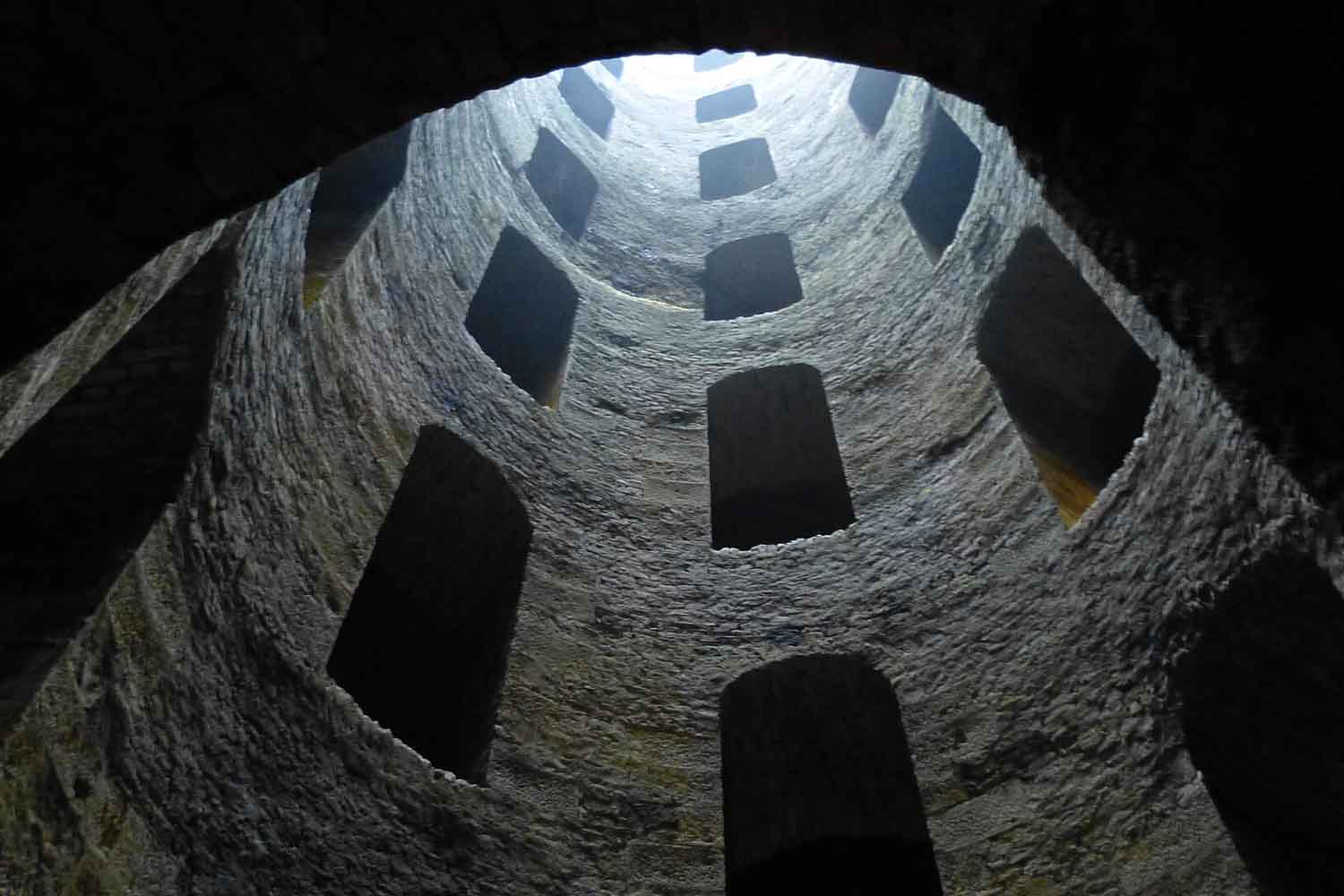
The Well of San Patrizioarchitectural jewel set in the heart of Orvieto, has always been celebrated for its extraordinary engineering. But what if a very specific mathematical logic was hidden behind its harmonious perfection? According to the study of Luciano Cencionidoctor and passionate of history, the structure of the well would respond to the principles of Aurea section and of the Fibonacci sequencetwo elements that regulate beauty in nature and art, as explained by Cencioni himself in an Ansa interview.
There are works that appear eternally beautiful, and their harmony is not accidental. From the pyramid of Giza to the Sistine Chapel, passing through the Mona Lisa and the Vitruvian man, all share the same mathematical proportion that our brain instinctively recognizes as perfect.
It is the Aurea sectiona formula that appears everywhere in nature, from the design of the galaxies to the arrangement of the petals of a flower, and that in 1611 Kepler connected to the famous Fibonacci sequence. Cencioni examined the size of the well of San Patrizio, noting that it too could respond to this mathematical proportion.
The calculations that reveal the hidden harmony of the well
According to Cencioni, the test would be in numbers:
If we take the diameter of the internal cylinder, which measures 4.65 meters, and we multiply it by the constant of Fidia (1,618), we get about 7.5 meters.
But the most surprising data emerges adding this value to the internal diameter: the total is 12.17 metersa measure practically identical to that of the external cylinder, which is 12.20 meters.
This correspondence with the golden section cannot be only a coincidence. Although perhaps unconsciously, Antonio da Sangallo the young man designed a work that reflects the laws of nature and mathematical beauty.
So is the San Patrizio well mathematically perfect? Here the opinions are divided. There are those who think it is all the result of the case, and those who believe that the genius of Sangallo was so rooted in the mathematics that they had created a timeless work, even without realizing it.
One thing, however, is certain: whether or not there is the golden section, the well of San Patrizio remains one of the most fascinating buildings in history. A place designed to collect water, but which in the end ended up collecting mystery, beauty and – why not – a pinch of numerical magic.
