
There is something profoundly revolutionary in the way in which science today manages to restore voice to the bodies of the past. For decades we have observed them as artefacts, as silent testimonies of a very distant humanity; now the Ancient DNA it allows us to enter their personal stories, family relationships, even genetic fragilities. And this is how a discovery made in 1963 speaks to us again with a new force.
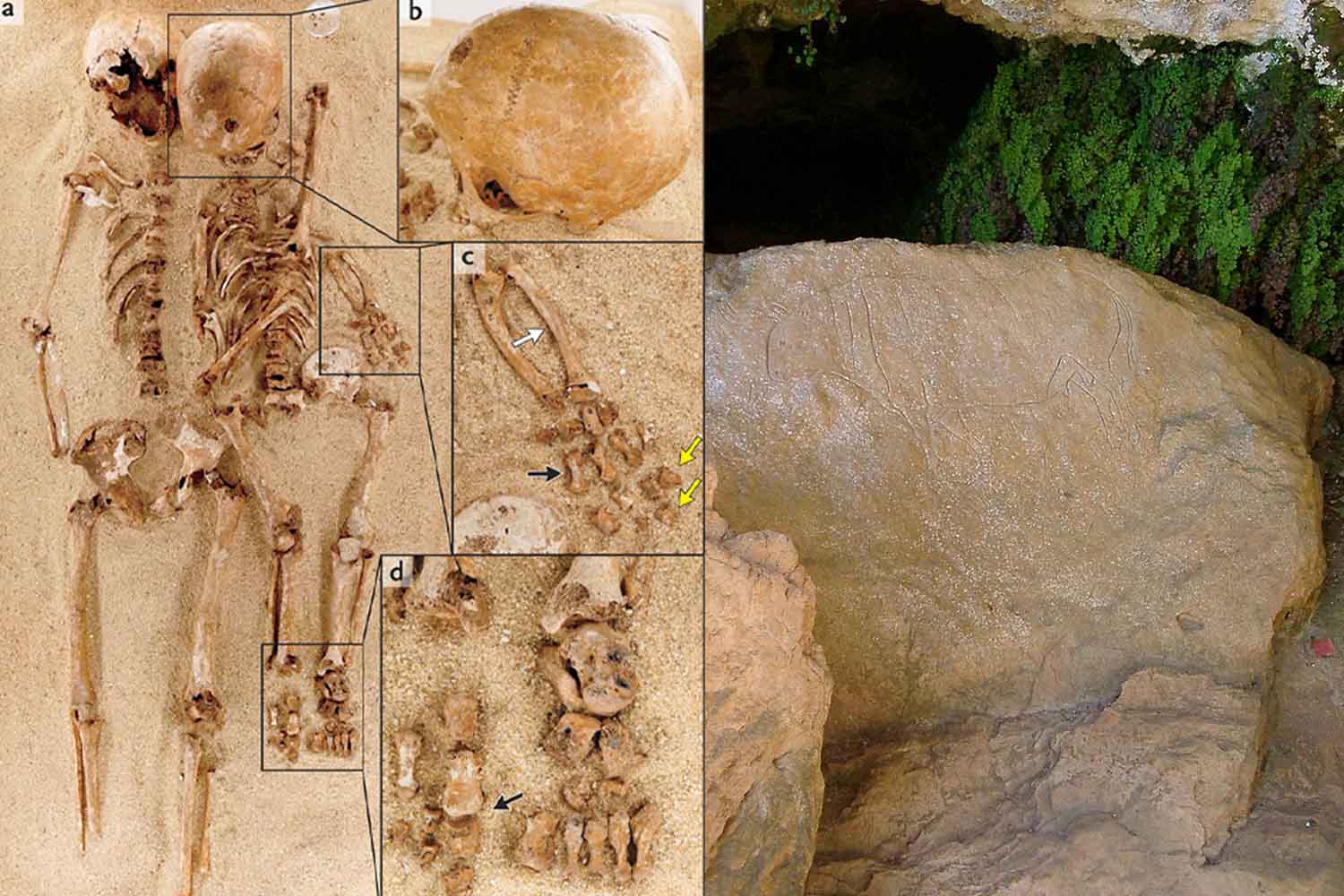
In the Grotta del Romito, in the heart of the Pollino National Park, two skeletons have been lying next to each other for around 12,000 years. For archaeologists they were “Romito 1” and “Romito 2”. For a long time they remained an enigma. Today we know that they were two women, first degree relatives, most likely mother and daughterand that one of them was suffering from a very rare genetic growth disorder.
The study, signed by Alfredo Coppa della Sapienza University of Rome, Ron Pinhasi of the University of Vienna and Adrian Daly of the University Hospital of Liège, was published in the New England Journal of Medicine and represents a fundamental step for the paleogenetics European.
The diagnosis written in DNA: a rare disease 12,000 years ago
To truly understand the significance of this discovery we need to imagine what it means to extract DNA from human remains from the Upper Paleolithic. The scholars analyzed genetic material obtained from the temporal bone, one of the most compact parts of the skull, capable of preserving biological traces even after millennia.
The results overturned some previous assumptions: both individuals were female and shared a first-degree relationship. The youngest, Romito 2, was a teenager approximately 110 centimeters tall and had very short limbs. Genetic analyzes have identified a homozygous mutation in the NPR2 gene, which is fundamental for bone development.
This alteration is associated with Maroteaux-type acromesomelic dysplasiaa very rare genetic disease that causes greatly reduced stature and marked shortening of the limbs. This is the oldest genetic evidence documented so far for this pathology.
The adult woman, in all likelihood the mother, instead presented the same mutation in a heterozygous form, an attenuated version which explains her height, lower than the average of the time, around 145 centimetres, without the severe manifestations of the disease. A detail that tells a story hereditary defect transmitted within the same family, twelve thousand years before modern genetics understood the mechanisms.
Disability in the Paleolithic: a story of care and solidarity
The most powerful part of this story is not just about the medical diagnosis, but about the human meaning that emerges from the context. Living 12,000 years ago meant moving in a hostile environment, facing hunting, constant travel, difficult climatic conditions. A girl with such a clear motor disability would have needed daily help.
Yet Romito 2 has reached adolescence, perhaps even surpassed it. This detail changes the perspective with which we look at hunter-gatherer communities. Its survival implies constant support from the group: access to food, protection, assistance in moving. As Alfredo Coppa underlined, such a case presupposes a level of social organization and collective care that we often struggle to attribute to prehistoric societies.
The fact that mother and daughter were buried together, in a position that suggests an embrace, reinforces the idea of a recognized and respected emotional bond. We are not just talking about genetics, but about ancient humanityof a community capable of protecting even those who could not contribute to the survival of the group with the same physical strength as others.
An archaeological cold case finally solved
The discovery of the remains in the Grotta del Romito dates back to 1963. For decades scholars have questioned the nature of that burial and the skeletal anomalies observed. Today, thanks to genetic sequencing techniques, that “cold case” has found an answer.
Paleogenomics is transforming archeology into a discipline capable of intertwining biology, medicine and anthropology, offering a more complex look at the populations of the past. This discovery demonstrates that rare genetic diseases already existed in the Paleolithic and that human communities had developed forms of assistance and solidarity long before the birth of organized civilizations.
Twelve thousand years later, that hug continues to speak to us. It reminds us that caring for others is not a modern invention, but a deep root of our evolutionary history.
