
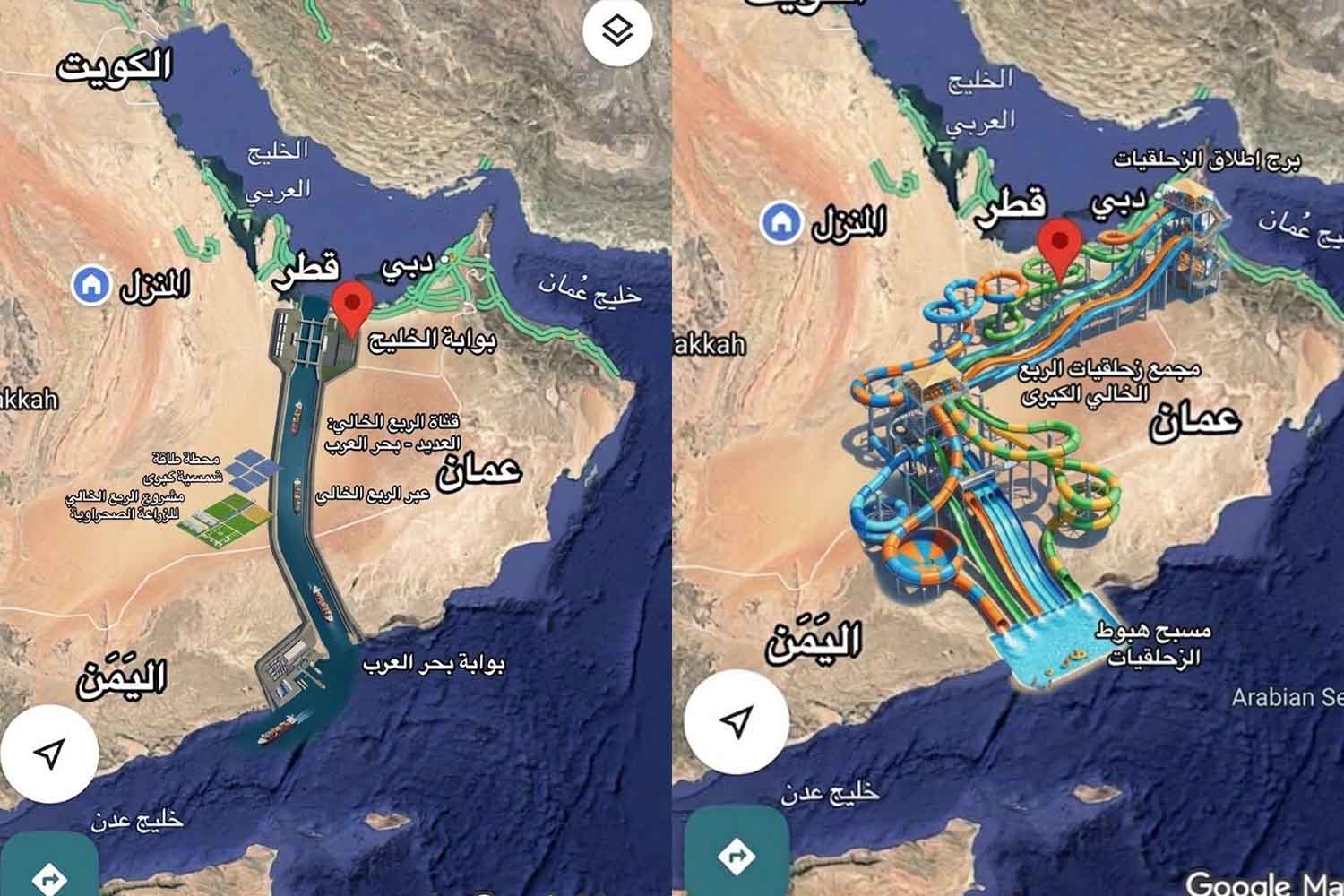
When oil exceeds one hundred dollars a barrel and it Strait of Hormuz is blocked by a conflict that no one knows how it will end, a curious thing happens: the world stops being pragmatic and starts being creative. A Saudi engineer publishes a map on
Not because it is a realistic solution (and we will see it), but because the web, faced with a global energy crisis, responds exactly as a group of friends would do at three in the morning faced with an unsolvable problem: with a creativity inversely proportional to the feasibility of the proposals.
هذا الممكن pic.twitter.com/IhbD13Q14G
— dayanoof (@EDayanoof) March 17, 2026
So they arrived, in order: a gigantic oil tanker on off-road wheels that hurtles across the dunes raising clouds of sand worthy of a Mad Max film, a water park as large as the entire Arabian peninsula with the slide tower positioned above Dubai and the “landing pool” on the Arabian Sea.
There is also Modi rowing on the canal with Indian oil barrels while an ayatollah greets him good-naturedly from the shore, and – the absolute pinnacle of human civilization – an infographic map with African swallows carrying coconuts full of crude oil bypassing Hormuz, complete with directional arrows, “drop off points” and “pickup points” drawn with the graphic seriousness of a report from the International Energy Agency. The Monty Python quote was implicit. Someone made it explicit. And ultimately he was right.
عندي فكرة أفضل ليه ما نركب تواير للسفن pic.twitter.com/nbLV8dEr8p
— 44 (@44lll8) March 17, 2026
The 800 kilometer Saudi canal in the Rub’ al Khali
Abdulaziz Al-Suhaibani, civil engineer and member of the Saudi Council of Engineers, illustrated his project with images generated by artificial intelligence, which is now the PowerPoint of visionaries without budgets. The route would start from the industrial areas of Dammam and Al Jubail, on the Persian Gulf, and cross the Rub’ al Khali desert until reaching the Arabian Sea, near the border with Oman. Eight hundred kilometers of excavation in one of the most difficult places to cross even just by car with full air conditioning, summer temperatures over fifty degrees, sand as the only abundant resource.
However, the vision does not stop at the alternative oil route. According to Al-Suhaibani, the canal would facilitate “large aquaculture projects”, “cutting-edge tourism projects on the sand” and “agricultural projects using water desalination via solar energy”. Aquaculture in the desert, tourism on the sand, agriculture with the sun.
Basically Vision 2030 with fins. The water park that the web has superimposed on the map of Saudi Arabia – with the “Rub’ al Khali slide complex”, launch tower above Dubai and landing pool on the Arabian Sea – is not that far from the original spirit of the project, if you look closely. Someone read between the lines better than the author himself.
— IranArmy (@Iranarmy001) March 17, 2026
However, the idea did not arise out of nowhere. The so-called Salman Canal it already exists as a proposal included in the Saudi economic diversification strategy, with a route that can reach 950 kilometers and costs estimated between 80 and 100 billion dollars in the basic version, capable of rising up to 250 billion including ports, infrastructures and logistics corridors. To give the measure: The Line, the 170 kilometer long Saudi linear megacity, was suspended in September 2025 after having already absorbed around 50 billion dollars. The canal would be almost six times as long. Surely this time it goes differently.
The context that has relaunched all this in a few days is the one that can also be felt at the distributor near your home. Every day around 20 million barrels of oil, equal to a fifth of global consumption, pass through the Strait of Hormuz, and with the ongoing conflict that route has suddenly become much less reliable than the world energy system had anticipated. Existing land-based alternatives cover approximately 4.7 million barrels per daya respectable figure, which however resembles carrying water with a teaspoon when the main tap is closed.
To date, there are no official tender announcements, contracts for operational areas or binding government timetables relating to the Salman Canal. Building an infrastructure of this scale takes decades, not quarters, and a regional political stability that the Middle East does not have on the cards for the foreseeable future. The environmental critical issues are concrete: impacts on marine and coastal ecosystems, excavation volumes comparable to or greater than those of The Line, emissions linked to materials, risks of brine discharge from desalination.
Not to mention that the Rub’ al Khali desert is exactly as hostile as it seems on the map, and that desalinated sea water with solar energy is a technological marvel that still requires energy, infrastructure, time and money, in the precise order in which it is difficult to have them all together at the same time.
— ☭ (@sappho2000) March 18, 2026
The off-road wheeled oil tanker hurtling across the dunes is probably the quickest solution to implement. African coconut swallows have the advantage of not requiring building permits or environmental impact assessments.
Modi rowing shows at least that Asian oil demand does not stop for logistical reasons. And the water park the size of Saudi Arabia has the advantage of bringing tourism, water and fun in one fell swoopalso solving the problem of desalination with a certain creative elegance.
The web, in its chaotic and at times brilliant way, has said what the official press releases don’t say: that depending on a single strait for a fifth of the world’s oil is a gamble that will pay off sooner or laterand that when the time comes the solutions on the table range from the oil tanker on wheels to the 250 billion canal, with little concrete stuff in between. At least the African swallows are funny. The fuel bill, much less. And in 2026, while we joke about Dubai slides and rowing barrels, somewhere an engineer is designing the next impossible infrastructure that will go viral at the next crisis.
