
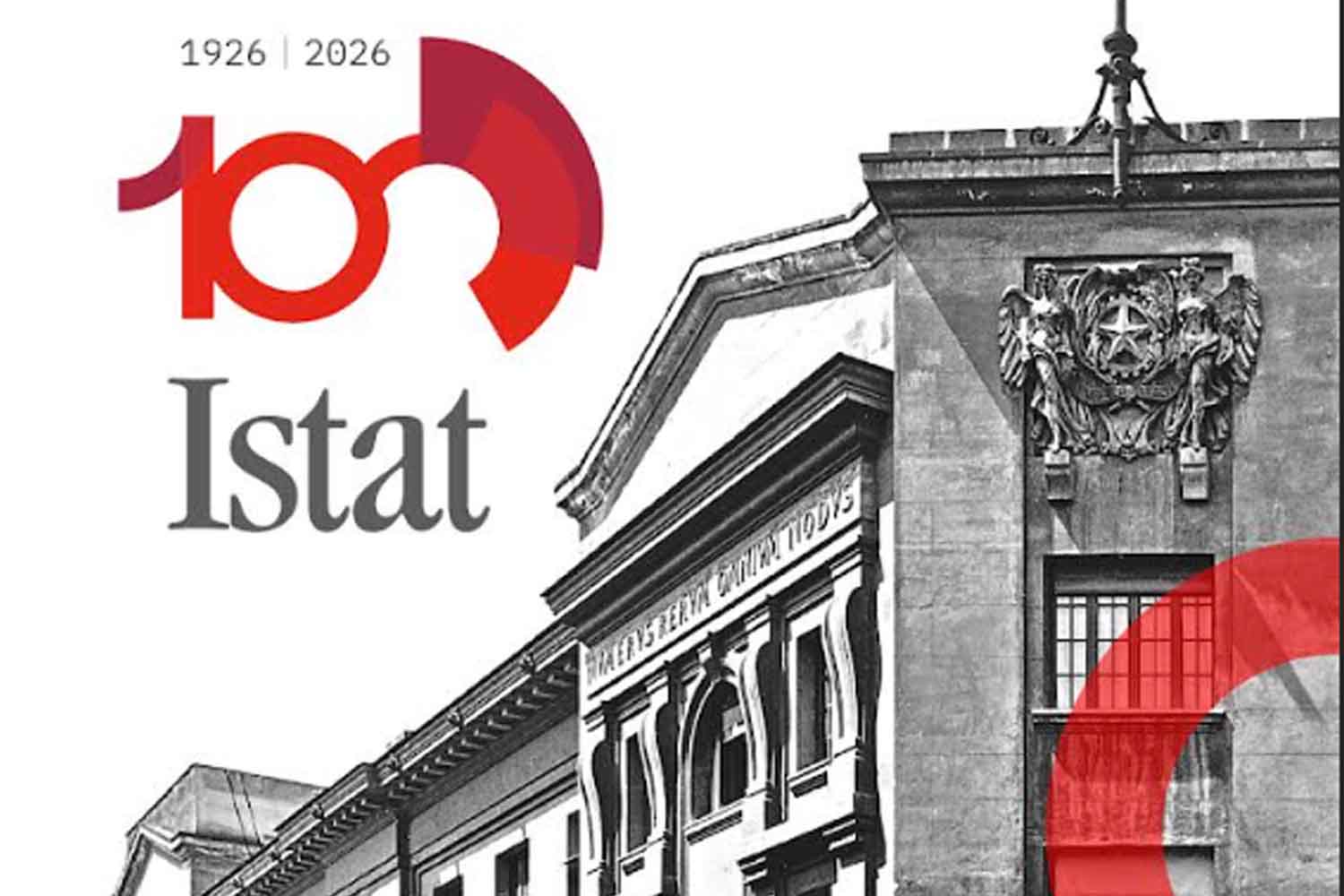
The official Italian statistics turns one hundred years old. Exactly a century since, on 9 July 1926, with law no. 1162, the Central Institute of Statistics, today Istat, was established. An anniversary that is not just an institutional anniversary, but an opportunity to stop, look back and, above all, try to better understand the present and future of the country through numbers.
The year of Istat’s Centenary officially opened with a press conference in which President Francesco Maria Chelli presented a broad, detailed program designed to go beyond the offices and reach people. Because the data, if told well, is not cold: it talks about us, our choices, our lifestyles, the environment in which we live.
The first innovation is visual and symbolic: a new logo and a web page dedicated to the Centenary, destined to be progressively enriched with contents, initiatives and events. A sort of public diary that will accompany the whole of 2026.
A year of initiatives
The first key appointment is set for 21 May 2026, when the 2026 Annual Report will be presented in the Hall of Parliamentary Groups, in the presence of the President of the Republic Sergio Mattarella. A moment that marks the official opening of the celebrations and which, like every Istat report, will offer an updated photograph of Italy: population, work, economy, inequalities, territory.
But the informative heart of the Centenary are the “Data Stories”, sixteen short reports that span a century of demographic, social, economic and environmental transformations. Not simple tables, but stories built on numbers, accompanied by the updating of the historical series available on the seriestoriche.istat.it portal.
The first story, dedicated to the education of Italians, was released during the meeting with the press. During the first half of 2026, those on health and disability, consumption and living conditions, technological diffusion, culture and free time, work, transport and communications, life paths of generations, production structure, environment and energy, crime and justice will follow.
To these will be added in-depth studies on the agricultural sector, price dynamics and inflation, population structure, international openness and the role of exports, tourist resources. The publication dates will be communicated through the Institute’s weekly agenda, while all other historical series will be updated by December 2026.
For those who deal with sustainability, ecological transition and the impact of daily choices, this data is a precious compass: it helps us understand where we are going and which policies really work.
Immersive exhibitions, seminars and public meetings
Between October and November 2026, thanks to an agreement with the Azienda Speciale Palaexpo di Roma Capitale, the Centenary will physically enter the city with an immersive digital exhibition hosted at Palazzo Esposizioni. The inauguration is scheduled for October 9th, with opening to the public from October 10th to November 30th. The objective is to tell the history of Istat and its technological evolution with accessible, interactive languages, capable of involving even the youngest and schools, focusing on edutainment experiences.
The Exhibition will not remain confined to Rome. A traveling module will stop in various cities that host Istat territorial offices and in other significant contexts, including Treviso, a city that in recent years has welcomed StatisticAll, the Festival of Statistics and Demography.
During the same period, a series of seminars will also be held on the present and future of official statistics, designed as a space for multidisciplinary comparison. At the center there will be the evolution of the data ecosystem, the technological and methodological challenges, the new information needs, the most effective forms of communication and the prospects of public research. Representatives of institutions, civil society, the business world, academia and communication will sit at the discussion tables. A path that will ideally lead towards the XVI National Statistics Conference, scheduled for the last week of November 2026, the final event of the celebrations.
Books, public consultations, local events
The Centenary does not end with events. During the National Statistics Conference, a historical volume will be presented that traces one hundred years of statistical production, combining memory with a look at future prospects. The work will be published in Italian and English and will contain numerous thematic insights. To this will be added the volume “1926-2026. The history of the National Institute of Statistics through images and documents”, which recounts the main stages of Istat through the work of its Presidents.
A public consultation will also be activated on the Centenary web page, designed to gather users’ points of view on their information needs. A way to reiterate that official statistics are not self-referential, but a tool at the service of the community. Other initiatives will be created in collaboration with Istat’s partner scientific institutes.
On 9 February 2026, the Ministry of Economy and Finance and the State Printing and Mint Institute also presented the 2026 Numismatic Collection, which includes a commemorative coin of the Istat Centenary, a tangible sign of an anniversary that also enters the material memory of the country.
Alongside all this there will be widespread local events, communication activities such as celebratory videos, social formats – including IstatTalk – video interviews with Presidents, editorial and digital products such as Nuovo ASI2026, NoiItalia100, dashboards and graphics for the web. There will also be space for schools, with workshops in the area and with the national statistical poster competition “One hundred years of history of your territory”, aimed at students of secondary schools and three-year degree courses, to introduce younger people to the critical reading of data.
Finally, there will be no shortage of initiatives dedicated to Istat workers. In July, the month in which the founding law is promulgated, an Open day is planned at the central headquarters, with connections to the other central and territorial offices, to enhance a professional community that has been the true lifeblood of the Institute for a hundred years.
You might also be interested in:
