
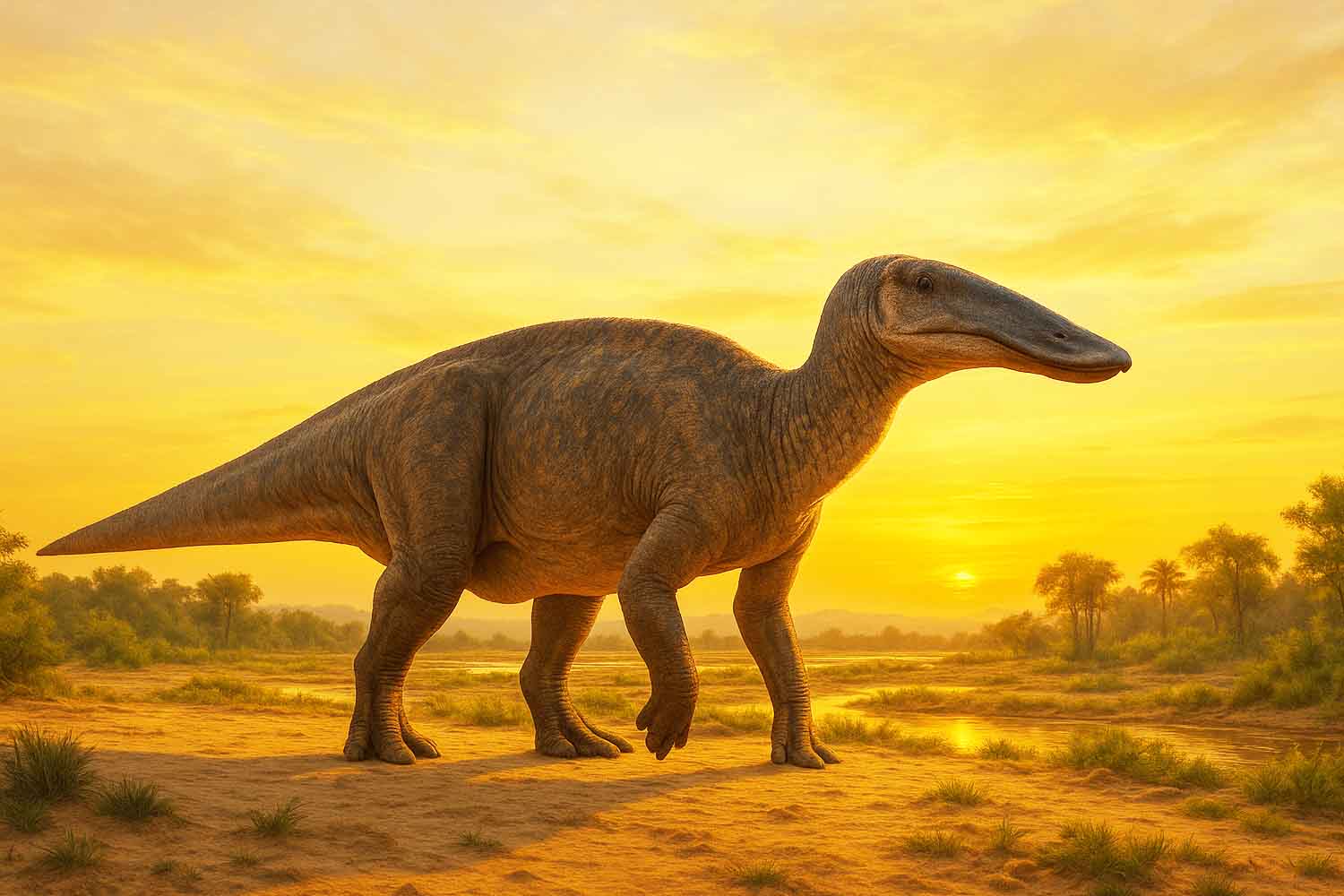
A prehistoric colossus, with a flat snout and the look of a giant duck, has returned to light in the sands of New Mexico. The remains of this duck-billed dinosaurdiscovered way back in 1916 and filed by mistake under another name, have finally been recognized as belonging to a new species: Ahshislesaurus wimani.
The animal wandered about 75 million years agoin the late Cretaceous, when North America was divided by an inland sea and New Mexico was a coastal plain dotted with rivers and lush vegetation. Despite the impressive dimensions — ten meters long and about nine tons in weight — this dinosaur was a peaceful herbivore, part of the large family of Hadrosauridaethe famous “duck-billed dinosaurs”.
A new prehistoric species from New Mexico
The story of this discovery seems like something out of a scientific novel. The fossils, found more than a hundred years ago inAh-shi-sle-pah Wilderness of San Juan County, were initially attributed to the already known Kritosaurus navajovius. Only today, after a careful review led by Spencer G. Lucasa paleontologist at the New Mexico Museum of Natural History and Science, it turned out that those bones actually belonged to a completely different species.
The morphological analysis of the skull revealed details never observed before: a more robust jawone wide zygomatic area and one flat headwithout crest. All clues that allowed researchers to classify it as a new specimen of the group of Saurolophinaethe duck-billed dinosaurs without the characteristic tubular crests typical of the most striking ones Parasaurolophus.
To establish its position in the evolutionary tree, scientists used sophisticated phylogeny analyses, comparing common traits and differences with other similar species. THE’Ahshislesaurus wimani is related to the Naashoibitosaurusanother giant coming from nearby geological layers, belonging to the Kirtland Formation.
A world of giant herbivores and ferocious predators
Seventy-five million years ago, New Mexico was part of the legendary Laramidiathe western portion of the American continent separated by an inland sea. Countless species of dinosaurs lived here – come on armored ankylosaurs to the majestic ceratopsisto the tyrannosaur-like predators that dominated the floodplains.
In this scenario rich in life, the Ahshislesaurus wimani moved in herds, feeding on conifers and flowering plantsshredded by its numerous teeth and perfectly suited to continuous chewing. According to Lucas:
Every new discovery like this demonstrates how little we still know about North American dinosaurs: Many new fossils are just waiting to be recognized in museum storage.
The very name of the dinosaur is a double tribute: “Ahshislesaurus” recalls the region where it was found, while “wimani” honors Carl Wimanpioneer of the study of fossils in the area.
