
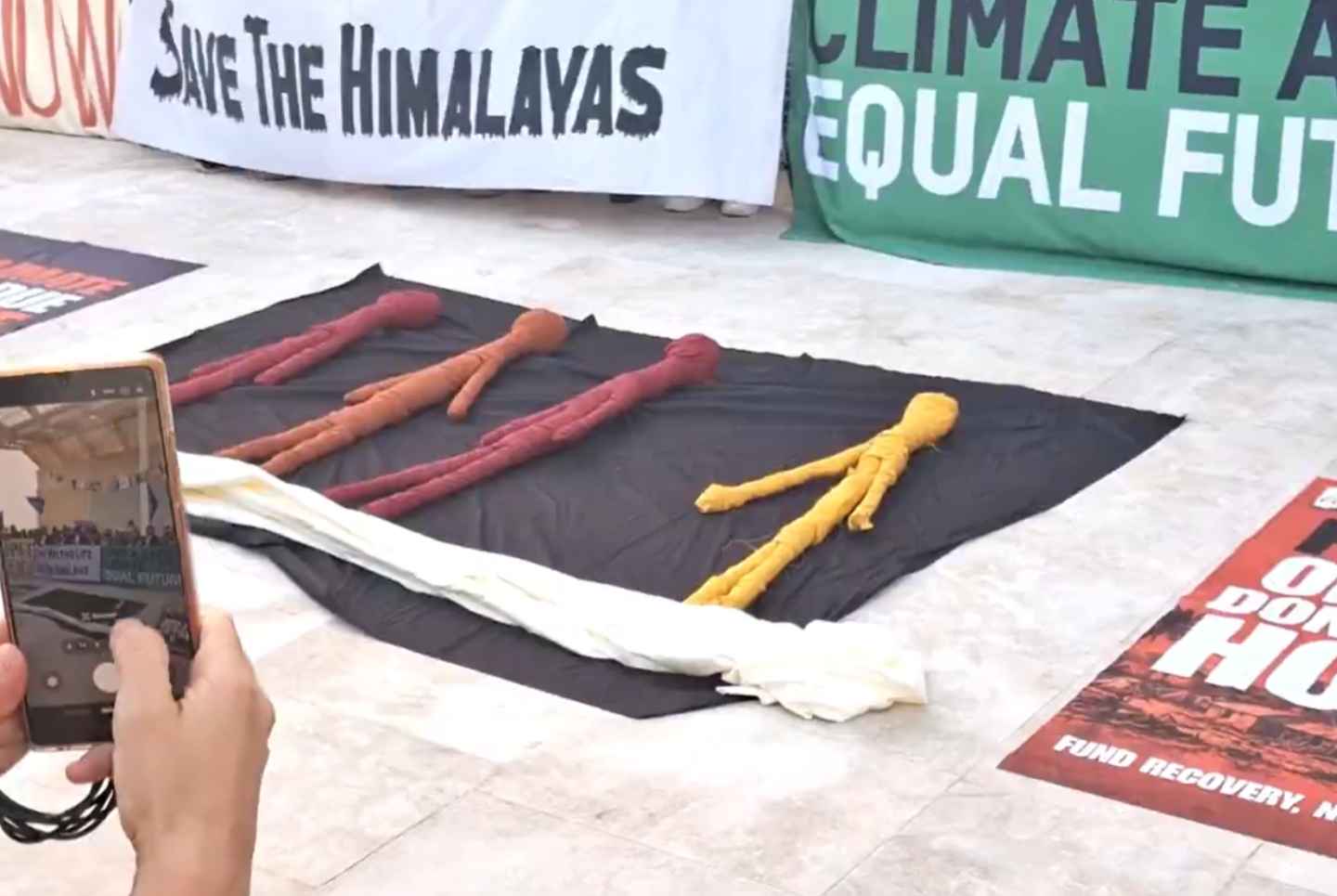
Four bodies wrapped in sheets, laid on the ground in front of the COP31 participants. They are silhouettes, but they represent real people: the victims of the floods that devastated Nepal, many of whom are still missing. In Antalya, Turkey, around a hundred Nepalese activists staged a symbolic funeral to ask governments gathered at the UN climate conference to assume their responsibilities. The demonstration, reported by the Nepalese newspaper myRepublica and the Kathmandu Post, remembered the over 1,500 people who died or were missing in last summer’s floods. The request is precise: economic resources and technical assistance to rebuild the affected territories and protect those still exposed.
At #COP31, people held up candles and observed a moment of silence for those killed in Nepal’s floods.
DCJ stands with Nepal. Wealthy countries must pay up for #LossAndDamage so the money reaches the families and communities rebuilding their lives. pic.twitter.com/lsF2jDuUJk
— Global Campaign to Demand Climate Justice (DCJ) (@gcdcj) November 17, 2026
Damages in the billions, insufficient aid
According to a letter from Greenpeace South Asia addressed to the Nepalese delegation, the damage and losses caused by the floods amount to approximately $2.7 billion. 4.8 billion would be needed for reconstruction. Activists are calling for countries historically responsible for greenhouse gas emissions to pay. And they contest the use of loans, which risk increasing the debt of a state already struggling with enormous adaptation costs. The reference is also to the international Loss and Damage fund, established as part of the UN negotiations to support the most vulnerable countries in the face of losses and damage caused by the climate crisis.
Sujeeta Mathema, director of ActionAid Nepal, denounced the gap between the announced commitments and the resources actually available. As reported by Ratopati, civil society is asking for non-repayable loans, which do not have to be repaid, rather than new debts.
Mountains and glaciers enter negotiations for the first time
The protest comes as Nepal achieves its first diplomatic result. In the official draft of COP31, paragraphs 31 and 32 propose a work program dedicated to mountains and climate change. The initiative, also supported by Bhutan and Kyrgyzstan, aims to make the issue permanent on the negotiating agenda and to promote a high-level dialogue at COP32.
The Kathmandu Post is reconstructing the diplomatic path. For Nepal the issue is urgent: the melting of Himalayan glaciers changes water availability and increases the risk of flash floods of glacial lakes, basins that can pour enormous quantities of water downstream.
The financing issue
The recognition of the mountains remains a proposal still subject to government approval. And the text lacks guarantees on specific funding for mountain communities. As reported by the Nepalese RSS agency, Kathmandu requests that the new program have concrete times, objectives and tools. The distance between negotiations and immediate needs emerges precisely from the Antalya protest: while governments discuss how to address climate risks in mountain regions, Nepal has yet to find the resources to rebuild what the floods have destroyed.
