
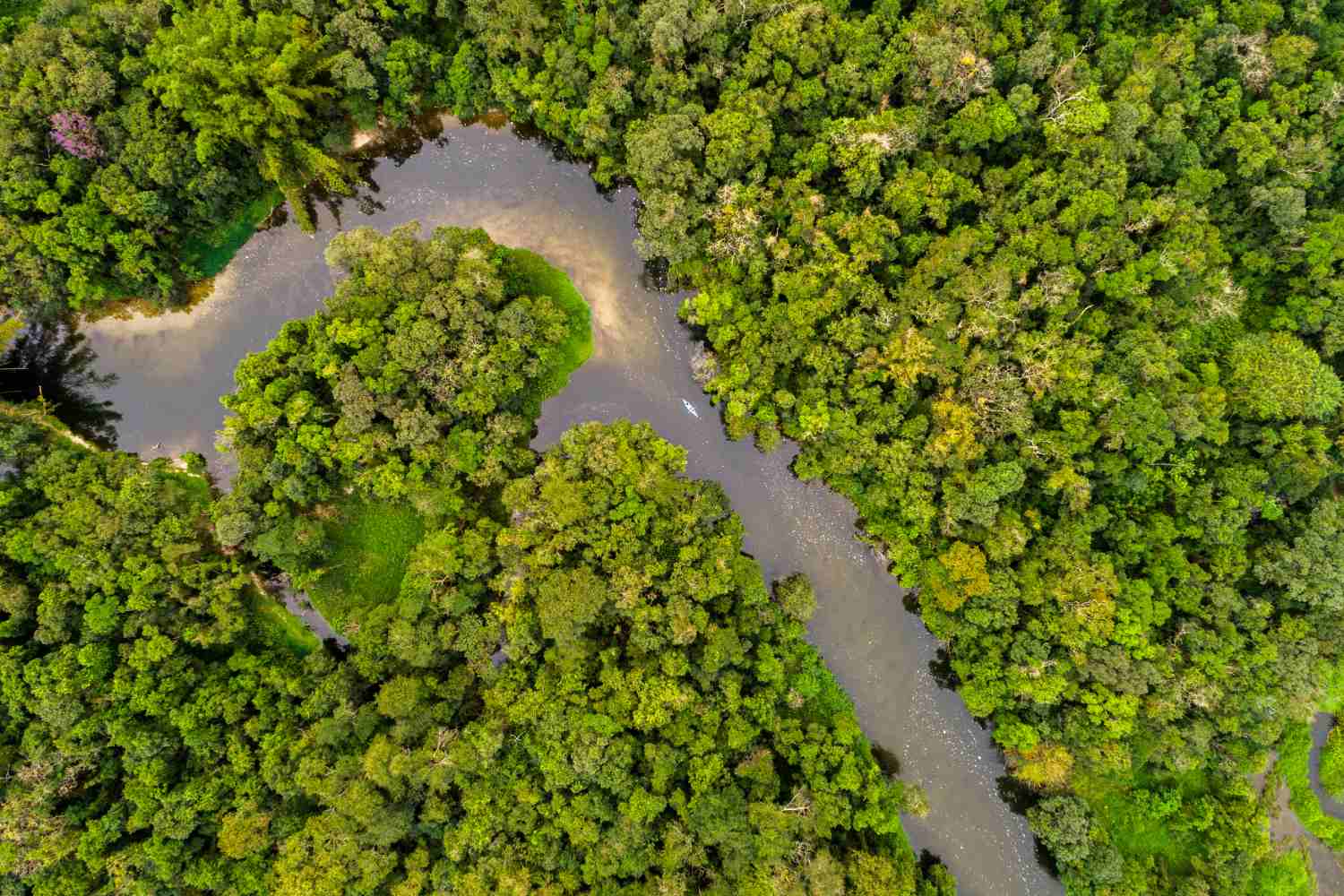
To understand how the Amazon might change tomorrow, scientists are looking at what happens today, at its worst moments. The great droughts of recent years, increasingly longer and increasingly hotter, are no longer considered just climatic anomalies: they are becoming the preview of a possible future. This is the central message of a study published in Nature, which analyzes over thirty years of data collected in the heart of the Amazon forest and introduces a concept destined to spark discussion: the “hypertropical” climate.
A climate that the Earth has not seen for millions of years
The term hypertropical describes conditions hotter than 99% of all historically observed tropical climates, accompanied by much more frequent and intense droughts. A climate structure which, the researchers explain, has not occurred on Earth for at least 10 million years and which could establish itself in large areas of the Amazon by 2100, if greenhouse gas emissions continue at current levels.
Thirty years of data in the forest
The work, led by Jeffrey Chambers of the University of California at Berkeley, combines field observations, ecophysiological measurements and global climate models. The data comes from research plots north of Manaus, in central Brazil, where sensors installed in the trunks and soil made it possible to follow the response of trees to climate stress year after year.
A critical threshold emerged during the El Niño-related droughts of 2015 and 2023: When soil moisture drops to about one-third of normal levels, tree transpiration rates decline rapidly.
It’s a defensive reaction, but a costly one. By closing their stomata to limit water loss, trees also reduce the absorption of carbon dioxide, which is essential for growth and tissue repair. If the heat persists, bubbles can form in the lymph that disrupt water transport, a process researchers liken to an embolism. At that point the risks of mortality due to hydraulic insufficiency or carbon deficiency increase drastically.
The most fragile species and the role of secondary forests
Not all species react the same way. The most vulnerable are those with fast growth and low wood density, which show higher mortality rates than trees with denser wood. “This implies that secondary forests may be more vulnerable… because they host a greater percentage of these types of trees,” Chambers explained. A significant figure in a region where large surfaces have regenerated after deforestation and fires.
Simulations based on climate models from Phase 6 of the Coupled Model Intercomparison Project indicate that, under high-emissions scenarios, the Amazon could face up to 150 days per year of “intense drought” by the end of the century. Episodes that could occur even in today’s rainiest months. “When these intense droughts occur, this is the climate that we associate with a hypertropical forest,” Chambers said, noting that these are conditions “that go beyond what we consider a tropical forest today.”
The annual mortality of Amazonian trees is currently just over 1%, but could rise to around 1.55% by 2100. An apparently small increase which, on a forest the size of the Amazon, translates into a massive loss of trees and a significant reduction in the capacity to absorb carbon. In some particularly dry years, the forest has already released more CO₂ than it has stored.
A laboratory on the future of the climate
One of the most relevant aspects of the study is the consistency of the results: the same stress signals appear in different sites and in different periods. The forest’s response to heat and drought appears to follow predictable patterns. For this reason, the authors explain, current droughts represent a unique window to observe extreme conditions today that could become common tomorrow.
“It all depends on what we do,” concludes Chambers. Without a drastic reduction in greenhouse gas emissions, the hypertropical climate risks quickly moving from a scientific hypothesis to a reality that the largest rainforest on the planet will have to deal with.
