
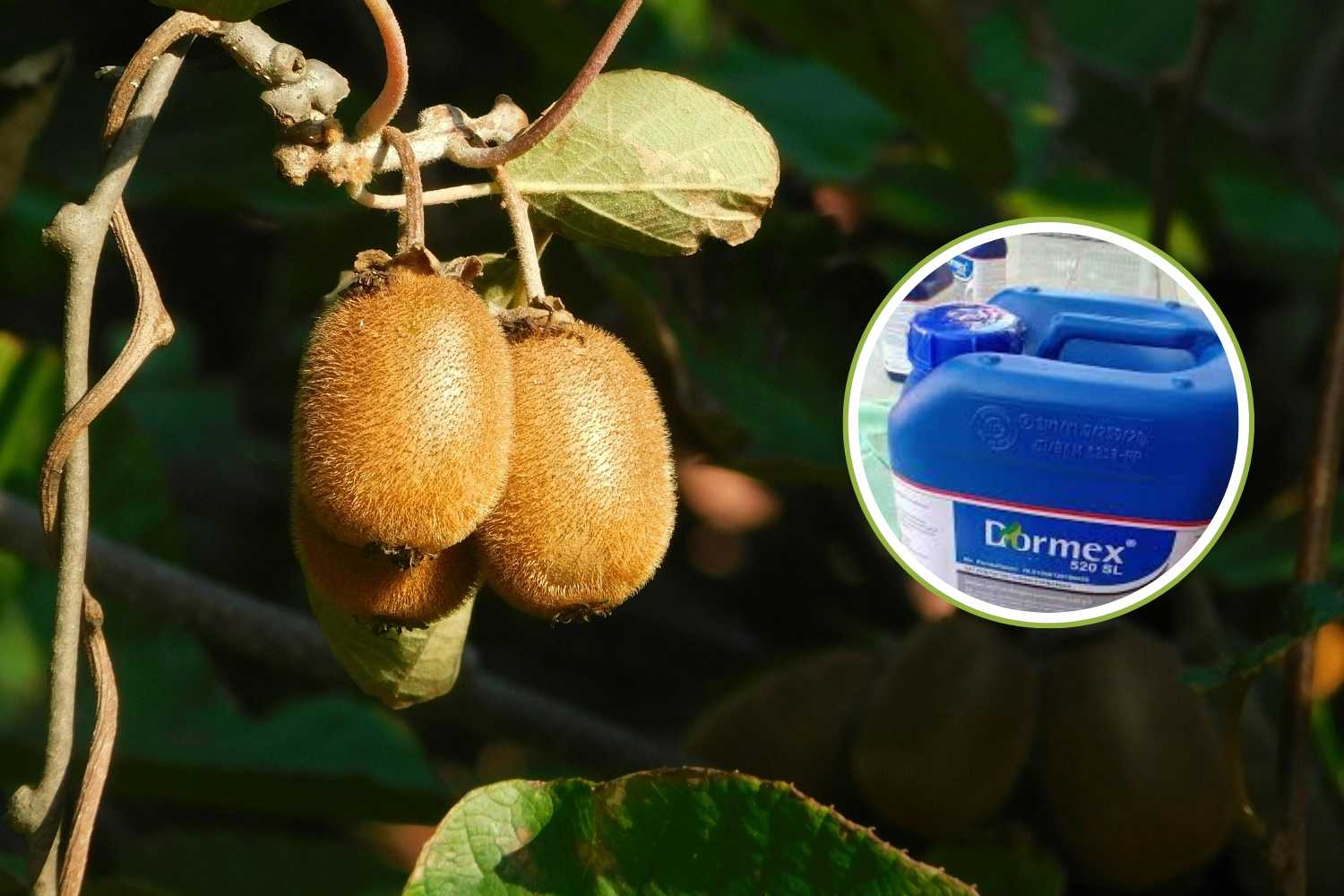
There is a chemical substance that should no longer have entered Italian fields. Yet Dormex — whose active ingredient, hydrogen cyanamide, was banned in the European Union in 2022 — has just received a temporary exemption authorization from the Italian Ministry of Health. Use is permitted in kiwi cultivations in five southern regions: Lazio, Campania, Basilicata, Calabria and Puglia.
Behind this decision, three threads intersect that are difficult to separate: climate change, the competitiveness of the agricultural market and concerns for the health of those who work the land and those who then eat those fruits.
What is Dormex and what is it used for
Dormex is a phytostimulant whose active ingredient is hydrogen cyanamide. It works by “convincing” the plant to emerge from winter dormancy, i.e. from that state of hibernation which normally ends after a sufficient number of hours of cold. It is used on kiwis, cherries, vines and apple trees, crops that require low and prolonged temperatures to germinate and bear fruit evenly.
The problem is that winters are changing. The increasingly mild seasons reduce the so-called “cold hours”, those hours below 7°C that plants, biologically, expect. When these hours are insufficient, the vegetative growth becomes irregular: the plants struggle to germinate, production drops and quality drops.
Dormex, sprayed on the foliage of the plants, then acts as a ‘chemical switch’ that replaces the natural stimulus of cold. Normally kiwi buds remain in hibernation until they have accumulated a sufficient number of cold hours, but in mild years this signal may be insufficient. Dormex makes the plant believe that winter has already ended, thus anticipating vegetative growth and flowering.
Because it was banned
The European Union had already excluded Dormex from the list of active substances approved in 2008, with a ban then consolidated at a regulatory level in 2022. Why? Hydrogen cyanamide is classified as a suspected carcinogen and possible endocrine disruptor. International studies associate it with potential damage to fertility and fetal development. In case of prolonged or repeated exposure, it may cause damage to organs.
However, it is important to make an important distinction: the highest risks are for those who work in direct contact with the substance – farmers and seasonal workers – not necessarily for those who consume kiwis at home. The molecule degrades over time and, if applied in compliance with the expected withdrawal times, residues on the finished product should be limited. “Should” however is a heavy word, especially when talking about exemptions and field checks which are not always guaranteed uniformly.
The substance is also considered dangerous for the environment, with possible toxic effects on aquatic organisms and beneficial insects, as well as an impact on the soil microflora in the phases immediately following treatment.
The pressure of Greek competition
One of the arguments that pushed producer organizations to ask for the exemption — and the Ministry to accept it — is competitiveness with Greece. Italy’s main competitor in kiwi production has been using Dormex as an exception since at least 2021. This benefits Greek producers not only in terms of yield, but also in terms of timing, Dormex accelerates vegetative growth and allows for earlier harvests, with the possibility of arriving earlier on the market and obtaining higher prices for first fruits.
Italia Ortofrutta, the union that represents around 40% of national fruit and vegetable production, welcomed the news with satisfaction, underlining how the exemption was necessary to rebalance the conditions of competition. The reasoning is understandable on an economic level: if your main competitor uses a tool that you cannot use, you are at a disadvantage. But this mechanism risks triggering a race to the bottom in health protection, where each country takes a step back expecting the other to do the same.
The black market
There is a detail that makes the story even more complicated: according to some judicial and customs investigations, Dormex was already in circulation illegally in Italy. The most striking case is that of the seizure of 40 tonnes of product in the port of Bari, an operation which highlighted how the ban was not a sufficient deterrent. Faced with real demand from the sector, smuggling found space.
The exemption, in this sense, could also be read as an attempt to bring the use of the product into the open, making it traceable, controllable and subject to the rules on application and withdrawal periods. However, the fact remains that it is a substance banned at European level, and that authorizing its use as an exception sends an ambiguous signal to the sector.
However, the authorization is temporary in nature: it is an emergency measure granted for the current season, not a structural revision of the legislation. The Ministry of Health will be able to evaluate whether to renew it or not in light of the data collected in the field. The hope of many experts is that in the meantime resources will be invested in the search for less toxic alternatives: other plant growth regulators, agronomic techniques adapted to new climates, varieties more resistant to mild seasons.
