
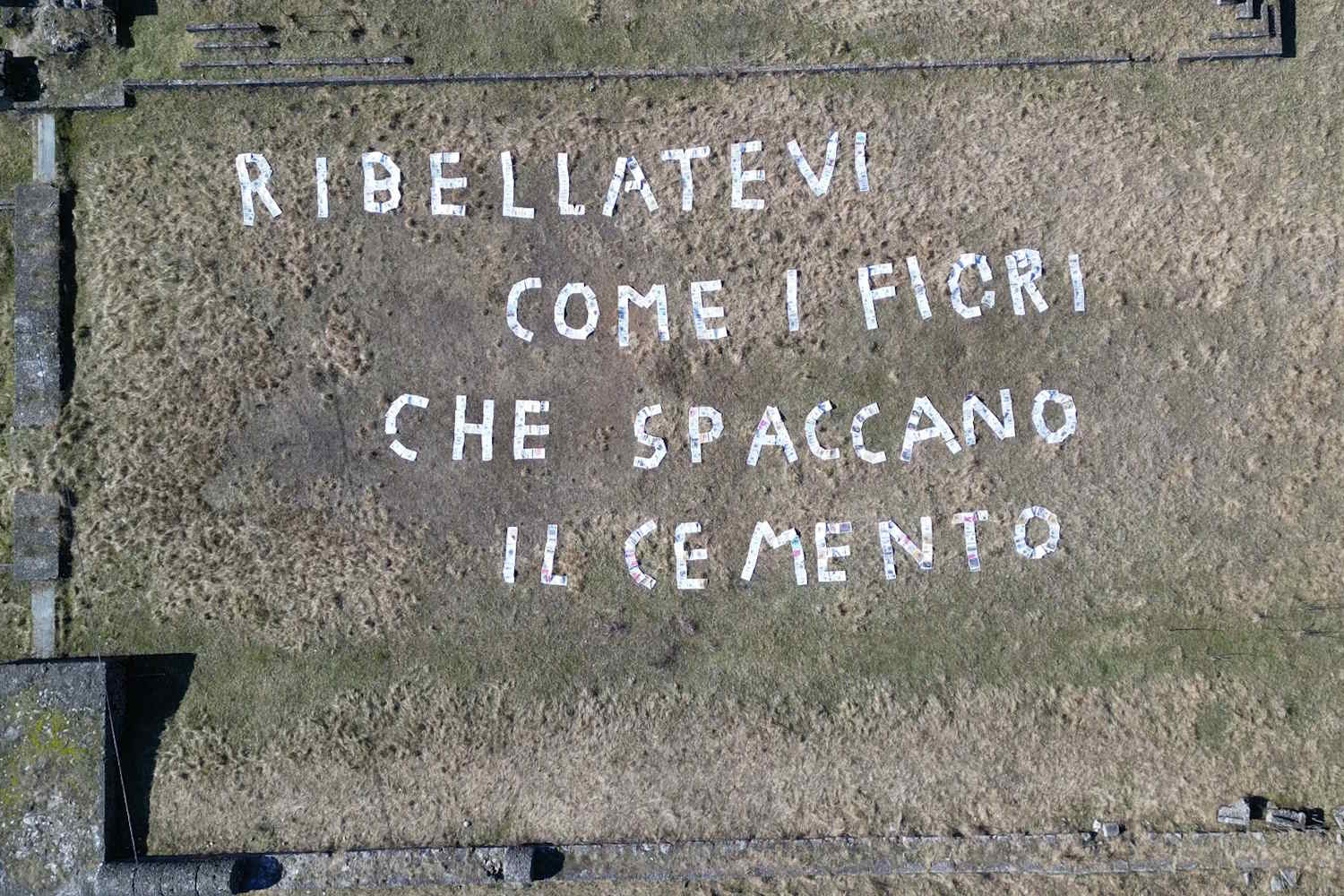
On the lawn of the Germanic Ossuary of Pinzano, overlooking the Tagliamento, one of the most intact rivers in Europe (it is one of the few that maintains its original morphology of “intertwined channels”) a huge sentence appeared, readable only from above: “Rebel like flowers that break concrete”.
This is the warning launched by Mathias PdS (evening poet), artist and activist, for the sixth action of Land Poetry: over 500 copies of paper newspapers, folded and placed together with precision, which formed that precious word that speaks al Cutting e Of Cutting. Paper that usually tells the facts of the world has become a visual, temporary, non-invasive message: at the end of the installation everything was removed, leaving no traces. A symbolic and light, but powerful gesture.
Friuli Venezia Giulia is a land rich in biodiversity. Endemic species and native animals that are not found elsewhere live here. It is an extraordinary territory from a naturalistic point of view, but also extremely fragile. The ecosystem today risks being compromised – Mathias PdS explains to us.
In these areas, in fact, the construction of new crossings risks destroying this fragile ecosystem, with the danger of altering the natural dynamics of the sediments, modifying the river’s freedom to move and branch, interfering with a river system considered among the most natural in Europe.
Alongside the artist, activists, the director Roberto Pizzutti (author of Giving space back to rivers), the drone operator Alessandro Scruzzi and the videomaker Enrico Folisi, who documented from above an action that invites us to take a stand in a firm and non-violent way. Because here we are not just talking about a work of art, but about a river that risks changing forever.
What’s happening at the Tagliamento
The Friuli Venezia Giulia Region, together with the District Basin Authority of the Eastern Alps, is discussing a hydraulic safety project which includes laminating crossbars between Dignano and Spilimbergo and in Madrisio, as well as expansion tanks to contain floods.
The declared objective is to reduce the risk of flooding. But numerous associations – including WWF, Legambiente, LIPU, Club Alpino Italiano and Pro Natura – contest the approach of the intervention.
The Tagliamento is one of the last large Alpine rivers still largely free, with a bed of braided channels, gravelly islands, riparian woods and extraordinary biodiversity. Inserting rigid barriers means altering its natural dynamics, interrupting ecological connectivity and irreversibly modifying a millennial balance.
The critical issues raised by the experts
Many technicians and associations propose an alternative: “give back space to the river”, letting floods expand into controlled natural areas, focusing on re-naturation and territorial planning, rather than rigid infrastructures.
A poem that talks about the future
And this is how Mathias PdS explained to us how art is his precious way of intervening, because the word – if used responsibly – can open spaces of awareness. And awareness is urgent about the Tagliamento.
View this post on Instagram
Here, essentially, it is a question of asking ourselves what security we want: the one built with concrete or the one born from respect for natural dynamics? The Tagliamento is not just a watercourse. It is a living laboratory of biodiversity, an ecological corridor, a geological memory that still breathes.
The poem that appeared in Pinzano has already been dismantled. But the question remains, etched in the consciences of those who have seen it: are we ready to defend one of Europe’s last wild rivers before it becomes yet another tamed river?
