
Modern medicine has a silent and very powerful obsession: to get there before the tumor, intercept it when it is not yet showing symptoms, when it does not appear in diagnostic images and when the chances of a cure are drastically higher. Early diagnosis of cancer is the real turning point that can change the fate of millions of people, yet the enemy, in its initial stages, moves with an almost invisible ability.
Microscopic clues circulate in the blood, fragments of genetic material called microRNAs (miRNAs), which represent a sort of molecular signature of the disease. The problem is that these traces are so rarefied that they are almost imperceptible even for the most advanced technologies currently in use. Identifying them is equivalent to distinguishing a whisper amidst the noise of a crowd.
And this is precisely where a technology comes into the picture that until recently we associated almost exclusively with gene editing: CRISPR. A group of researchers from Shenzhen University have transformed the famous “genetic scissors” into something different, an extremely precise sensor capable of detecting tumor biomarkers at concentrations that touch the physical limits of measurement.
Extreme sensitivity
The data that is immediately striking is the detection limit reached by the new system: 168 zeptomolars. To put the idea into concrete terms, this is a sensitivity comparable to that needed to detect a single grain of sugar dissolved in the water of the North American Great Lakes. A level that approaches the boundaries of physics.
At the basis of this innovation is a sophisticated mechanism that combines nanotechnology, biochemistry and advanced optics. The sensor exploits a phenomenon called Second-Harmonic Generation (SHG), a process in which two photons combine to generate a single double-energy photon when they hit certain materials. This property allows you to monitor even minimal variations on the surface of a material with extreme precision.
The researchers used molybdenum disulfide (MoS₂), a two-dimensional material similar to graphene, as a platform for the reaction. Its very thin structure makes it extraordinarily sensitive, but requires signal enhancement. To do so, the team employed the DNA origami technique, building tiny molecular scaffolds at the nanometer scale. Quantum dots are positioned on these structures, microscopic particles capable of amplifying the light signal while maintaining a perfectly calibrated distance from the sensor surface.
At this point CRISPR comes into play, in a completely new guise.
CRISPR as a molecular switch: the sensor that turns off
The system uses CRISPR-Cas12a, but not to edit DNA. In this case it works like a structural switch. The sensor is exposed to the patient’s blood sample and, if a specific tumor biomarker, miRNA-21, is present, the enzyme recognizes it by activating a reaction that causes the detachment of the quantum dots.
The result is surprising: the light signal dims. While many devices turn on when they locate the target, this system does the opposite. It darkens. It is precisely the decrease in light that allows researchers to precisely calculate the amount of tumor RNA present in the sample.
The idea is as elegant as it is powerful: listening to the silence generated by a particle that moves away to discover the presence of cancer.
Clinical tests on real patients: comparison with PCR
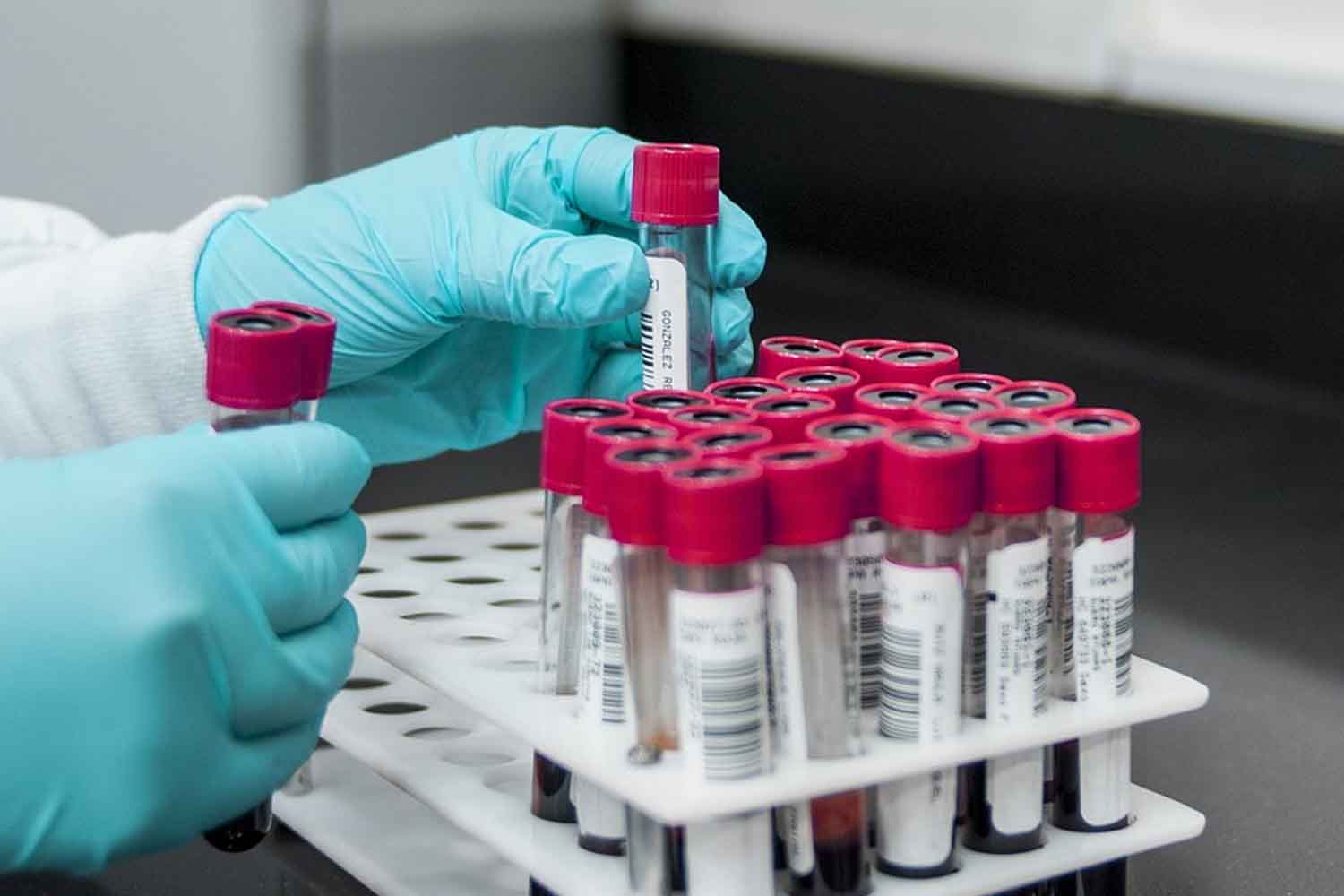
Many discoveries remain theoretical promises. In this case, the team tested the sensor on real clinical samples, analyzing the blood of ten lung cancer patients and five healthy subjects.
The comparison was carried out with the current diagnostic standard, RT-qPCR (Reverse Transcription Quantitative Polymerase Chain Reaction). The results showed a significant difference. The PCR showed signal variations of between 0.36% and 8.64% between healthy and diseased individuals, while the new SHG-based sensor recorded much larger variations, from 11% to 54%.
In the diagnostic field this means only one thing: greater clarity. A clearer signal reduces uncertainty, limits the need for repeat tests and can help reduce anxiety related to ambiguous results. Furthermore, since it is a simple blood test, the system could reduce the need for invasive and painful biopsies.
A modular platform for many diseases
One of the most interesting aspects concerns the programmability of the system. DNA origami can be reconfigured and, by modifying the guide RNA of the CRISPR complex, the same device could be adapted to detect biomarkers linked to Alzheimer’s, infectious diseases or cardiovascular diseases, without intervening on the physical hardware.
This opens up the prospect of a modular diagnostic platform, capable of adapting to different clinical conditions with simple molecular reprogramming.
We are still in the research and validation phase, but the idea that a simple blood sample can reveal the presence of a tumor before it appears in a CT scan or MRI represents a profound change in our vision of cancer prevention. It means shifting attention from the cure to the actual anticipation of the disease, offering a concrete possibility of intervening when the cancer is still silent.
You might also be interested in:
