
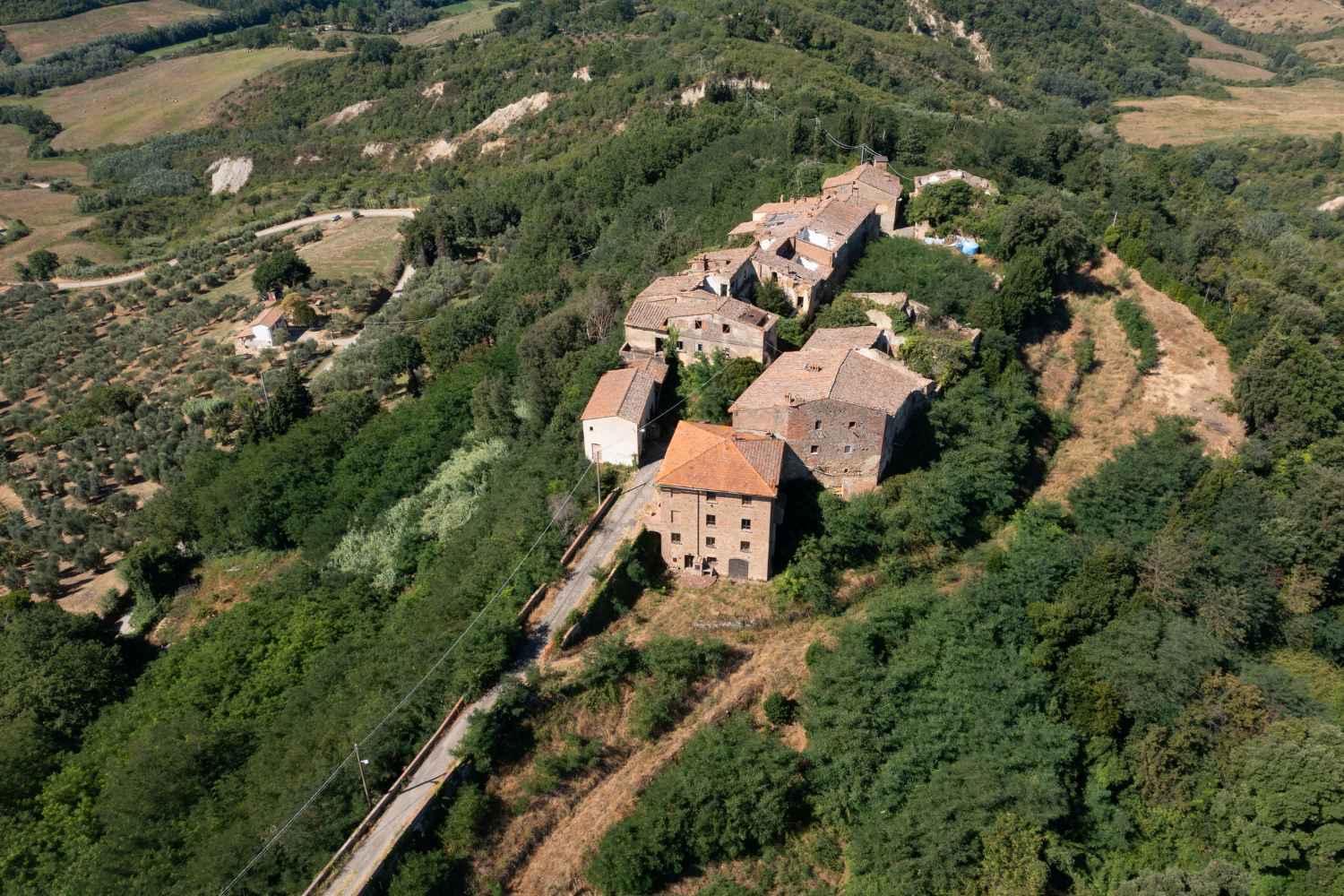
There is a place in Tuscany where silence has taken the place of voices, where the stone and tuff houses overlook a single street just fifty meters long, suspended between the hills that separate Pisa from Volterra. Toiano is its name, and whoever reaches it has the impression of crossing the threshold of a lost era, of entering a dimension where history has stopped flowing.
Traces of the early Middle Ages are still visible
Founded in the early Middle Ages, this tiny settlement still retains traces of its remote past. Access to the village is via a bridge that once must have been a drawbridge, a tangible sign of its ancient defensive function. All around, the landscape becomes harsh and majestic: Volterran gullies and crags, tuff spurs that rise up to fifty meters high, creating scenarios of an almost lunar beauty. The dirt road that leads up here winds for about five kilometers, and the journey itself becomes a journey back in time.
The cemetery, the church and the Via del Castello
The first element you encounter when climbing the hill is the small cemetery, followed by the small deconsecrated church dedicated to San Giovanni Battista, now inaccessible. Then you cross the bridge and find yourself in the heart of the village, where a handful of houses squeeze along Via del Castello, the main artery which measures less than one hundred metres. Five hundred people lived here in the nineteenth century, before the exodus towards the industrialized cities progressively emptied the country. In the 1960s, the last inhabitant left, leaving Toiano to silence and nature.
The unsolved mystery of the beautiful Elvira Orlandini
This village is not just an abandoned architectural jewel, a dark shadow hangs over its history, an unsolved mystery that continues to fuel legends and tales. On 5 June 1947, the day of Corpus Christi, Elvira Orlandini was found dead in the nearby woods, having had her throat cut near the spring where she went to draw water. She was twenty-two years old and was about to marry Ugo Ancillotti, a war veteran with a dark character who was accused of the murder. The trial ended with an acquittal due to lack of evidence, but the real culprit was never identified.
The tomb of the “beautiful Elvira”, as it is still remembered today by the local elders, is not found in the cemetery of Toiano but in the Botro della Lupa, where the crime was committed. That unsolved cold case has merged with the soul of the village, making it even more spooky and fascinating.
From the domination of Lucca to that of Florence
The history of Toiano has been troubled since its origins. Born as a medieval castle, it came under the dominion of Lucca, then Pisa, and finally Florence. The leader Rodolfo II Da Varano, after gaining control of it, took a bell away from the fortress and sent it as a trophy to Florence, where it was placed in the gallery of Palazzo Vecchio. In the fourteenth century the village was razed to the ground by the Florentines and rebuilt by the Pisans, who called it Toiano Vecchio. The inhabitants refounded it not far away with the name of Toiano Nuovo, but in 1406 they definitively surrendered to the Medici dominion.
The failed attempts to revive the village
Today this abandoned village breathes only through the footsteps of visitors who come to discover it, attracted by the melancholic charm of the ruins and the power of the surrounding landscape. The FAI has highlighted it among the places to be preserved, even though in the census of “Places of the heart” it received just thirteen votes, ranking in a marginal position. Even Oliviero Toscani, the great photographer who recently passed away, fell in love with this forgotten corner of Tuscany, dedicating a photography competition to it in an attempt to restore its visibility and dignity.
Where memory becomes tangible
Yet Toiano resists, suspended between the memory of those who knew him alive and the curiosity of those who come looking for him today, traveling along dirt roads that cross woods and hills. Here you can only breathe the wind, you can only listen to the sounds of nature, you walk among stones that tell stories of life, death and abandonment. It is a place where memory becomes tangible, where every stone seems to hold a secret, where the past has never truly disappeared but continues to live in the immobility of the present.
