
THE KIPUthe registers ofInca Empire made of locks of threadswere also known to the ordinarynot only toelite. The inhabitants of this famous pre -Columbian population thus recorded their economic, religious, demographic and historical data, but so far it was thought that it was a science of rich and wise. Instead it was not so, as a research guided by theUniversity of St Andrews (Scotland).
Until now, the researchers believed that the only people knowing how to create the khipus In the Inca empire they were high -ranking officials. But in reality this “conviction” has always been based on the descriptions of the Spanish colonial chroniclers, having received some very few tests on the subject today.
What are the KHIPU of the Inca
As reported on The Conversation The first author of the work Sabine Hylandi khipus were made by High rank bureaucrats who appreciated the most refined food and drinks. But in the Inca tradition, there was no distinction between the author and the scribe, because both roles were combined in one.
The term used to describe a manufacturer of khipus Inca, or ‘KiPu Kamayuq’derives from the verb ‘Kamay’ referred to the concept of creation but in the meaning ‘give energy to the matter’. Experts of KIPUtherefore, gave them energy infusing one’s vitality in the ropes.
But this did not mean, evidently, that this was one elite science.
I direct a team of researchers who found new tests of the fact that also the ordinary citizens built Khip in the Inca Empire – writes the researcher – which means that the literacy relating to the KHIPUs may have been more inclusive than previously thought. The key to this discovery is the awareness that Khipu’s experts sometimes signed the Kiu who built with locks of their hair
In the Inca cosmology, on the other hand, human hair brought theessence of a personbecause they maintained their identity even when they were physically separated from the body. The first haircut of a child, for example, was an important rite of passage. For this hair removed during this ritual were offered to the gods or stored at home as a sacred object.
And for this the cut hair of the emperor Inca came preserved during his lifeand, after death, they were modeled in a natural simulacrum, venerated as the emperor himself.
Historically, when human hair was linked to khipusthe hair was the “signature” of the person from whom they were removed.
Our team observed this recently in the village of Juculon the Peruvian plateau, where the inhabitants of the village own Over 90 ancestral khipussome made centuries ago
On the contrary, when i KIPU They contained information on several people, the data of each person was represented by a band of pendants of the same color or which included the hair of several people in pendants.
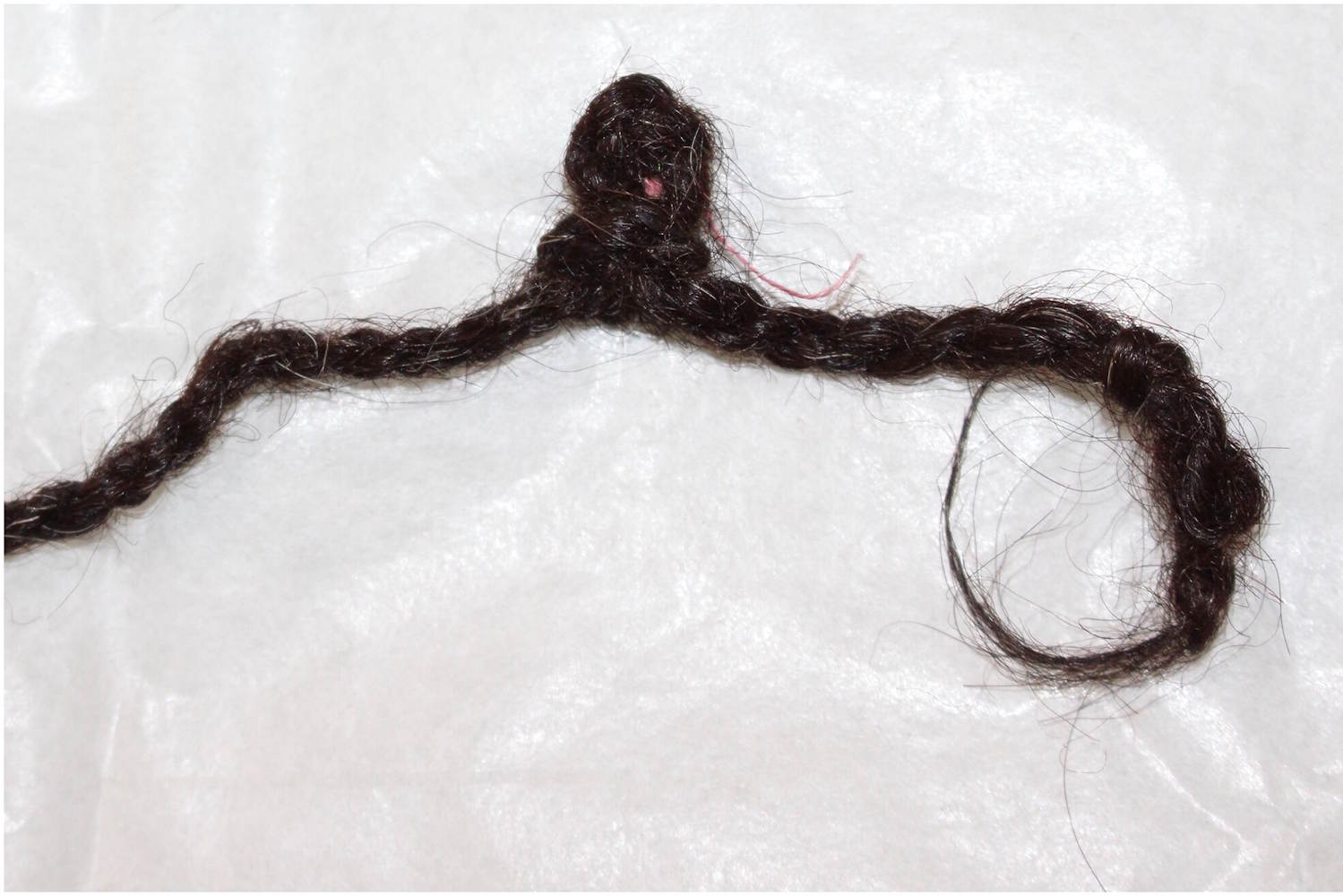
Khipu Kh0631
Our team has identified a KHIPU of the Inca era, known as Kh0631with a primary cordon composed entirely of human hair of a single person (…) human hair in the primary cord of Kh0631 probably represented the person who had built the Khipp, imprinting the authority and essence of this person on the structure
The hair in the primary cord of Kh0631, 104 cm long, were bent halfway and twisted at the time of the construction of the KHIPU. By assuming a hair growth of 1 cm per month, the hair therefore represent over eight years of growth.
Since the hair was folded in two, the free end included cut hair closer to the scalp and those coming from the end of the locks. This meant that the sample represented two periods of the person’s life separated for eight or more years
To find out more about the person who had built the khipo, they were carried out Simultaneous measurements of carbon isotopes, nitrogen and sulfur from a champion at the end of the cord.
In other words, the researchers have chemically analyzed the sample with particular reference to most common chemical elements that make up the hairwith the aim of verifying the presence and distribution of isotopes of these elements, or atoms with a different number of neutrons (with the same protons).
The presence of isotope C4 (instead of C3) generally indicates the consumption of corn in the Andean diets – explains on this Sabine Hyland – the relative levels of stable nitrogen isotopes allow us to deduce information on the proportion of meat in the diet, while those of the stable isotopes of sulfur to determine the amount of marine food sources
How we came to the discovery
The diet of high status groups compared to that of lower status groups in the Inca state differs considerably. The elites consumed more meat and corn dishes, while the popular ones ate more tubers, such as potatoes and vegetables. With our surprise, the isotopic analysis of human hair in Kh0631 revealed that this person followed the diet of a population of lower status, a vegetable -based diet of tubers and vegetables with very little meat or corn
In addition, the analysis of the isotopes of Zolfo shows one poor marine contribution to the dietindicating that this person probably lived on the plateaus rather than on the coast. In the ancient Andes, the elite feeds on meat and corn beer, while the popular people feed on potatoes, legumes and pseudocereals such as quinoa. It therefore seems that the Khipu expert who made Kh0631 was a mutual man.
Also, not knowing where Kh0631 was made, the team analyzed the isotopes of oxygen and hydrogen present in the sample.
Our results show that the person lived on the plateaus between 2,600 and 2,800 meters above sea level, in southern Peru or in northern Chile (in the absence of more reliable data on the values of local waters, the exact position remains provisional))
This is the first time that an isotopic analysis is conducted on fibers of KIPU. There “Signature” of human hair In the primary cord of Kh0631 it made it possible to discover more about the person who made this object.
Although other researchers have claimed that only elite officials made Khips in the Inca empire – concludes the scientist – our new tests suggest that ordinary people also made KHIU
The work was published on Science Advances.
Sources: The Conversation / Science Advances
