
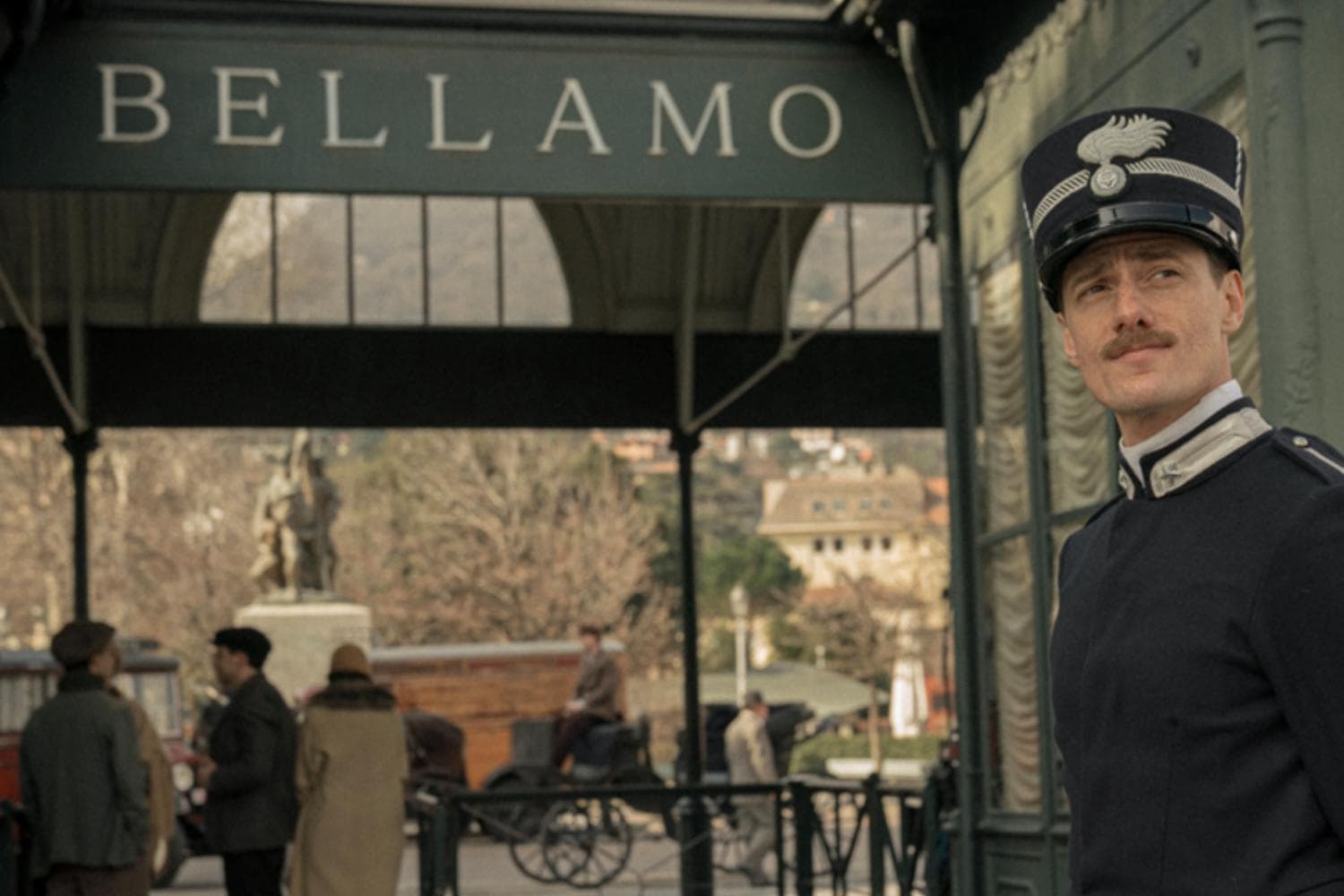
It debuts on Tuesday 24 November in prime time on Rai 1 and in streaming on RaiPlay, continuing in 4 evenings for 8 episodes of approximately 50 minutes until 15 December, A window overlooking the lakea TV series directed by Marco Pontecorvo, written by Salvatore De Mola and Simona Coppini with the collaboration of Andrea Vitali and based on the author’s four novels published by Garzanti. At the center of the plot is Bellamo, an imaginary town born from the pen of Andrea Vitali and inspired by the real Bellano, the writer’s birthplace in the province of Lecco, populated by strange, funny, disturbing or hilarious figures.
View this post on Instagram
The plot of “A window overlooking the lake”
Set in Italy in the 1930s, the story follows the young Carabinieri Marshal Ernesto Maccadò (played by Antonio Folletto), who arrived from Calabria for his first command in the station of a small northern town overlooking the lake. Curious, attentive to the humanity of people, respectful of the law and reserved about his political ideas, he fears that his wife Maristella (Giulia D’Aloia), originally from Diamante and as lost as a stranger, suffers from being away from home. A figure that many have already compared to that of Inspector Montalbano but set in the past during the fascist period and in Northern Italy, despite Folletto having specified that the cases in question do not deal with murders, but with very light detective stories.
Helping them are the Sicilian brigadier Letterio Misfatti (Domenico Centamore), who arrived about 8 years ago, passionate about good food and puzzles and guide of the country, and his wife Agata (Claudia Potenza), a precious informant and friend who helps Maristella to overcome her nostalgia for Calabria and to rediscover her desire for a child.
View this post on Instagram
The other inhabitants and the tensions of the town in the 1930s
Completing Bellamo’s choral fresco are unforgettable characters: Vinicio Diotallevi (Leo Besozzi), a 10-year-old boy from the orphanage who wins the affection of Maristella and Ernesto to the point of raising the possibility of adoption; Sister Anastasia (Paola Minaccioni), director of the orphanage and occasional nurse, expert in rifles and attentive to Maristella’s fragility; the mayor Mongatti (Antonio Catania), an official closer to a civil servant than to the rigidity of the regime and a supporter of Maccadò.
On the opposite front, Tartina (Vincenzo Nemolato), born Bartolo Piazzacampo, is a local fascist secretary and boatman at odds with his wife Limetta, determined to push Maccadò into the transfer, flanked by the publicist Fiorentino Crispini (Dario Vergassola), the postman Erminio Fracacci and the porter Cagaia (Gianmarco Vettori), Tartina’s hypocritical right-hand man ready to screw him over.
View this post on Instagram
Four episodes inspired by Andrea Vitali’s novels
The fiction, as mentioned, intertwines dramatic and surreal events taken from four novels by Vitali who said that he drew inspiration for many of his stories from old newspaper reports from the 19th century linked to the Lake Como area and from events that actually happened in the area, then reworked in a literary and ironic key.
In the first appointment, Stage name Doris BrilliMaccadò picks up Desolina Berilli – aka Doris Brilli – at the pier, an actress sent back from Milan after an escape with an operetta company and a possible attempted suicide linked to a secret love. In the second chapter, Certain fortunesErnesto Maccadò has to deal with the escape of the bull Benito, 1,200 kilos and 170 centimeters at the withers, triggering a hunt with Tartina, Cagaia and the owner Morcamazza.
In the third episode, A man in his underwearwhile choosing the place for the shooting range, Salvatore Chitantolo and the midwife Zambecchi talk about attacks linked to a man in his underwear and Maristella uses some trousers found by Vinicio for the communion dress. Finally, in Miss Tecla Manzithe theft of a small painting of the Sacred Heart reported by Tecla Manzi opens up entanglements between loan sharks, former bankers turned friars, hostile letters in the newspaper and Ernesto Maccadò’s doubts about asking for the transfer, while in Bellamo the real power remains in the hands of women.
View this post on Instagram
The filming locations between Lake Orta and Lake Como
Behind the atmosphere of the Thirties there are 88 days of filming between Piedmont, Lombardy and Rome, on a budget exceeding 10.6 million euros. Most of the scenes were filmed on Lake Orta between Orta San Giulio (with Piazza Motta and the Island of San Giulio as protagonists) and Miasino, where Villa Nigra became the barracks and the narrow alleys of the historic center became the streets of the fictional town of Bellamo.
Another 15 days of filming involved Lake Como between Como, Cernobbio (Villa Pizzo, landing stage and views of the lakefront), Brienno, Torno and Carate Urio. A location that is not just a backdrop. Pontecorvo – already behind the camera for Alfredino – An Italian story And For Elisa – The Claps case – in fact he wanted the lake as a living and surreal presence, also filmed underwater and on the surface as a witness and operator of human events in a small period village between fascism and traditions.
View this post on Instagram
