
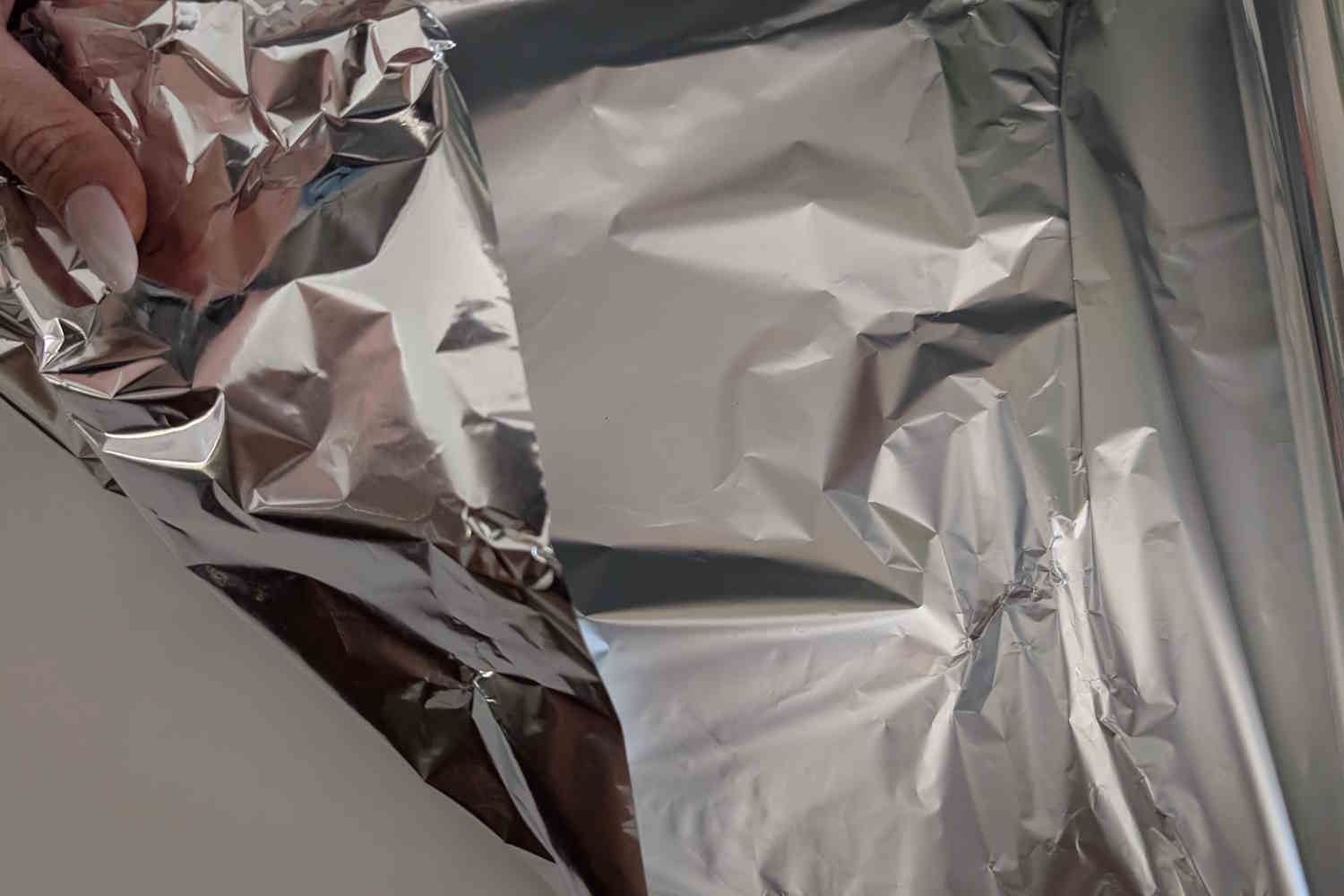
How many times have we found ourselves unrolling an aluminum sheet (commonly said foil) without thinking too much about how to fix it? Yet that thin film that envelops our dishes for generations has a small secret that few really know. The invention dates back to 1910, thanks to the Swiss industry Robert Victor Neherand since then the foil has become a constant presence in all the kitchens in the world. Although today we try to reduce its use for environmental reasons – and with good reason – it is undeniable that its practicality remains almost irreplaceable.
The dilemma, however, remains: Should the shiny or opaque side be used? The answer is not at all obvious.
Shiny or opaque? A difference born from manufacture
If you have always thought that the two sides served for different purposes, know that you are not the only one. But reality is a little different from what you imagine. The different finish does not depend on a chemical treatment or on different layers: It is the result of the mechanical production process. When thealuminum It is laminated, two sheets are pressed together: the one in contact with the rollers acquires the lucid surface, while the other, which touches only the nearby sheet, remains opaque.
From a structural point of view, therefore, nothing changes. If you are covering a tray to put it in the oven or in the refrigerator, the choice of the side is completely irrelevant: thermal insulation and resistance are identical.
Only the aesthetics? Not exactly
However, if we move to situations where light and heat come into play – for example, a picnic in the sun or a trip with packed lunch – the speech changes slightly. The two sides reflect the light in a different way: The lucid one tends to reflect it more, while the opaque absorbs a minimal part of it.
In practice? If you have to keep a hot food, it is better to put the shiny side to the outside: it will reflect the heat and help to keep the temperature longer. If, on the other hand, you want a dish to remain fresh, better to have the opaque side outside: it will slightly absorb less external heat, helping to preserve freshness.
A practical guide to better orient yourself
In order not to get lost between the shiny side and the opaque side, it can be useful to remember some simple rules, which we have summarized in the following table:
| Use | Recommended side outwards |
| Keep a dish hot | Lucid |
| Keep fresh (fruit, desserts) | Opaque |
| Bake in the oven or grill | Indifferent |
| Conservation in the fridge | Indifferent |
| External use (picnic, excursions) | Depends on the temperature to be maintained |
As you can see, the question is not fundamental for each use, but in some cases it can make a difference. A detail that few know and that makes this material even more interesting in its simplicity.
It is not a revolution, but it can be comfortable
In short, it is certainly not an epochal discovery, but knowing how to orient the foil can help exploit it better, especially when you are outside the home and you need to best keep hot or cold foods. And then, if you are among those who fight every time to unroll it without tears and wrong folds – and let’s face it, not all brands make the task easy – know already in that towards orienting it it can save you time and nerves.
Now that you know the “hidden side” of the foil, you may no longer look at it with the same eyes. And you ever thought that even in a simple film there could be a pinch of science and cunning of use?
