
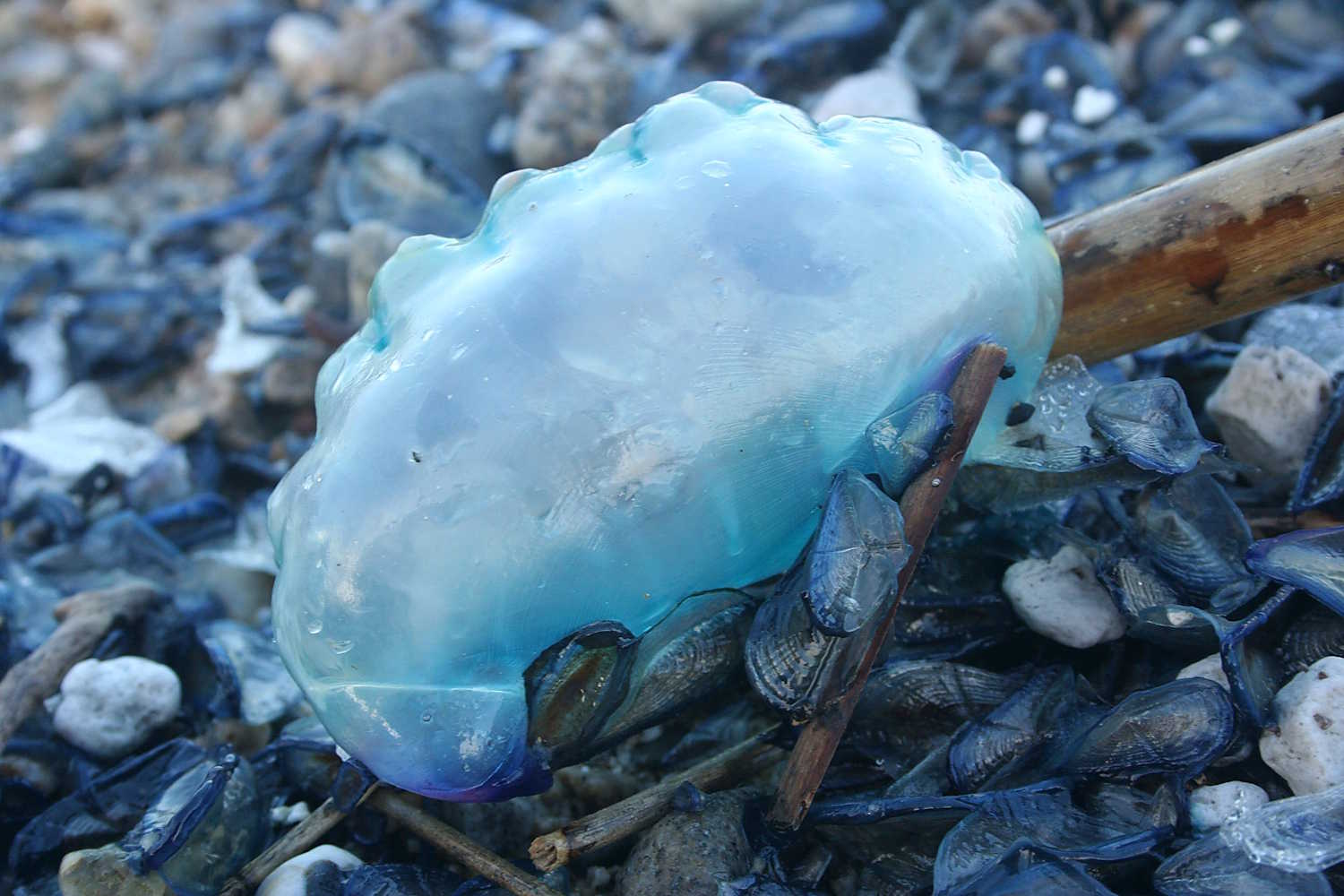
An example of Portuguese Caravel (Physalia physalis) was found in recent days on the Calabrian coast of the Strait of Messina. The report comes from the volunteers of Ambiente Mare Italia (AMI) APS during an ecosystem monitoring led by the territorial representative Alessandro Taverriti.
A decidedly rare sighting: considered scientifically relevant, the species, native to the Atlantic Ocean, is only present occasionally and non-permanently in the Mediterranean.
Often mistaken for a jellyfish, the Portuguese Caravel is actually a pleustonic siphonophorethat is, a colonial organism composed of numerous specialized individuals (zooids) that operate together as a single living being.
Some zooids capture prey thanks to long stinging tentacles, others deal with digestion and still others with reproduction. The characteristic floating bag filled with gas works like a natural sail, allowing the organism to move carried by wind and currents.
View this post on Instagram
A fascinating but dangerous organism
The Portuguese Caravel,”a tropical alien on the Calabrian coast“as scientists have said, it can represent a risk for both humans and marine fauna. Its tentacles, which can extend for tens of meters below the surface, are equipped with stinging cells that are active even after stranding, capable of causing skin irritation even after days.
Furthermore, the resemblance to plastic waste can lead some marine species to accidentally ingest it, with potentially lethal consequences.
Among its natural predators is the sea turtle Caretta caretta.
I was photographing the seasonal stranding of Velella velella – explains Alessandro Taverriti – when I noticed something that looked like a plastic bag on the sand. As I got closer, I recognized a Portuguese Caravel. It is a rare event in the Mediterranean, considering that the last report dates back to Favignana.
The specimen was wrapped in a small piece of wood and had tentacles partially damaged by the stranding, up to 10 meters long. After photographic documentation, the sample was processed according to scientific protocols and stored in 70% ethanol for study purposes.
How it gets to the Mediterranean
The Portuguese Caravel is typical of the tropical and subtropical waters of the Atlantic. Its presence in the Mediterranean occurs episodically, transported by currents through the Strait of Gibraltar, often in conjunction with persistent westerly winds and favorable weather and sea conditions.
The simultaneous presence of Velella velellaanother floating siphonophore, suggests oceanographic conditions that favored the transport of pleustonic organisms towards the Italian coasts.
Every sighting is precious – underlines Alessandro Botti, president of Ambiente Mare Italia – because it provides useful data for understanding complex ecological phenomena. The presence of alien species such as the Portuguese Caravel requires attention and constant monitoring to prevent risks for marine fauna, humans and local ecosystems.
The sighting of the Portuguese Caravel in the Strait of Messina is not just a naturalistic curiosity. It is a sign of how much our seas are connected to global dynamics, where currents, climate changes and alterations in ocean balance can move species even thousands of kilometers away from their original habitat.
Events like this are a reminder of how essential it is to observe, document and understand what happens along our coasts. Because knowing the sea also means knowing how to read the signs of ongoing transformation and acting to protect increasingly fragile ecosystems.
