
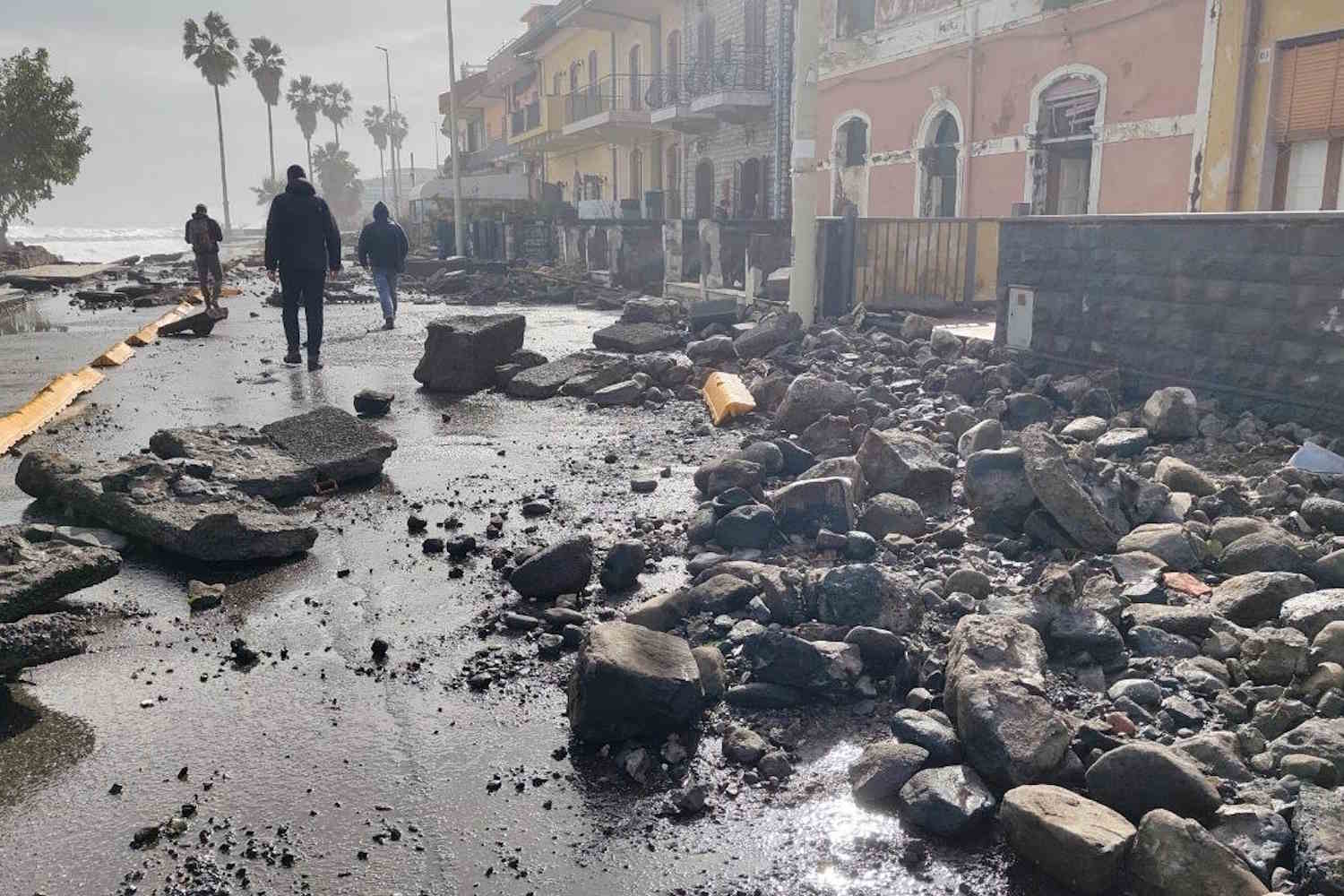
The cyclone Harry it did not leave a trail of blood behind it: fortunately there were no victims thanks to the early warning of the civil protection which closed the schools and issued the red alert which emptied the streets. Now that it is time to count the damage and concretely help, however, Cyclone Harry is no longer news and the affected territories are left alone. The absence of deaths does not make this disaster any less serious, but it seems to have provided the perfect pretext to “downgrade” the event to “ordinary administration”, causing the South to slip into a media shadow cone just as the face-to-face with the consequences begins.
The brutal face of the climate crisis
We can no longer afford to call it “bad weather”. What we saw was the brutal face of one climate crisis which makes no geographical distinctions, but which finds more fragile defenses in the South. The whole of Italy has become an open-air laboratory of extreme events: from record hailstorms in the Po Valley to floods in the Marche region. However, when the emergency hits the South, the narrative changes.
While disasters in the North are treated as national emergencies that shake the productive heart of the country, the wounds in the South are often archived as “local news” despite the fact that waves more than 16 meters high were seen and it was a real tropical cyclone that poured in a few hours a quantity of water never seen before in territories usually thirsty for most of the year.
This is particularly evident in the paradox of an island, Sicily, which until yesterday was dying of thirst with empty reservoirs and today finds itself submerged by volumes of water that the soil, dried up by desertification and made impermeable by concrete, is no longer able to absorb. It’s an ecological short circuit: desertification makes the land hard as concrete and when extreme events like Harry’s arrive, water doesn’t nourish, but destroys.
When the water recedes and the media spotlights go out, the real wound emerges: that of a territory falling to pieces.
The wound of Niscemi and the burden of illegal construction
The case of the Niscemi landslide is the emblem of this programmed fragility. There, where the land gave way, it was not just the rain that struck, but decades of failed management of hydrogeological risk and, in several cases, of illegal building practices which in the South continues to be a festering plague, transforming every hill into a potential house of cards.
Building where it shouldn’t is not just an offense waiting to be remedied: in an era of climate crisis, it is a weapon aimed at everyone’s safety. Yet, even in the face of an entire side slipping away, national attention already seems elsewhere.
The resilience that doesn’t make the news: Sicily gets up on its own
In this scenario of institutional silence, however, the extraordinary strength of network of volunteers. While the spotlights go out, in the streets of Niscemi, but also in the municipalities of Messina, Catania and Siracusano, hundreds of young people and ordinary citizens have rolled up their sleeves.
Without waiting for decrees or political catwalks, spontaneous solidarity was born in the media silence: gyoung people and students who shovel mud from the homes of the elderly, afarmers who share the few remaining means to clear rural roads, comunity who self-organize so as not to remain isolated. This is the Sicily that doesn’t make the news: the one that gets up on its own because it’s used to not expecting anything. B-series mud angels? No influencers or politicians with rubber boots to shovel and yet the damage and consequences of this disaster are incalculable with entire coastlines swept away by the violence of the sea.
A question of justice
As Greenmewe ask that the reconstruction starts from a principle of climate justice. There are no second-class territories: we are all in the same sinking boat. Massive investments are urgently needed to secure a South that is paying the highest price for a global change that affects everyone and, above all, to stop considering these lands as expendable suburbs of Europe.
Harry’s mud will dry, but our attention will not. Let us stand by those who dig today, not to count the victims, but to rebuild a future that does not drown in the next rain. After the mud, the duty remains not to turn off the lights because the right to safety cannot depend on the postal code.
We are not all at the same level: because the climate crisis is also social injustice
