
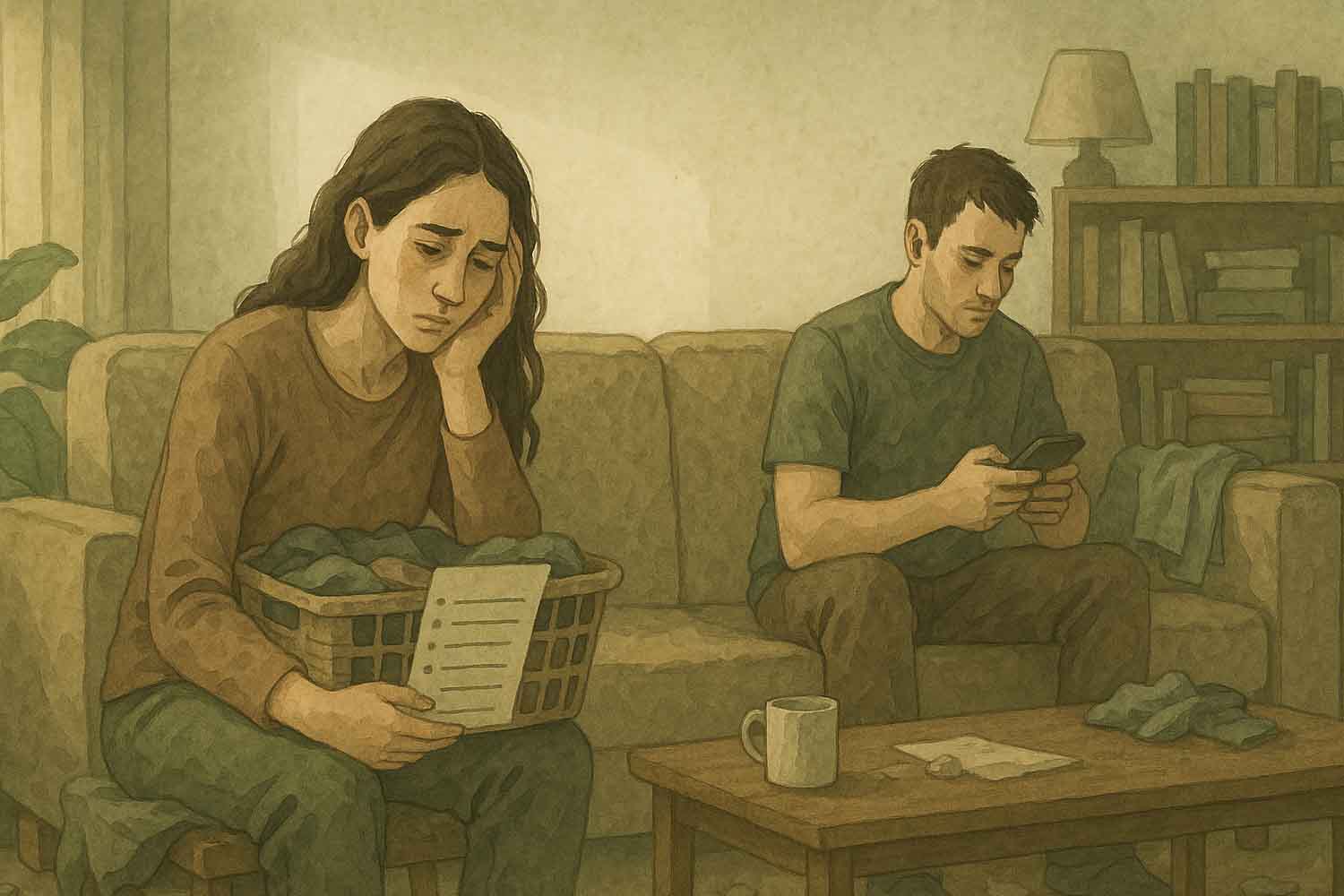
There are those who wash the dishes, those who spread the laundry, those who keep an eye on the common current account and … who finds themselves doing all this alone, while the other “forgets”. No, it is not the incipit of a new sitcom on couple relationships: it is the daily reality of many people – mostly women – who without wanting it, are transformed into the parents of their partner.
It is not a question of character. It is that by dint of taking care of others, one forgets how a equal relationship is within. Psychologists call it parentification – And no, it’s not a dirty word.
“Did you get the keys? Did you call the plumber?”
If you find yourself managing everything like a manager of marital life, maybe you fell into a trap that you didn’t even know it existed. Stop a second. Do local mind. How many times do you happen to remind your partner deadlines, appointments, things to do? And how many times the load of daily life – physical, mental, organizational – does it end up falling on your shoulders?
If it often happens to you, maybe you’re not just “helping”, but you are playing a parental role. A relational model that often activates when you feel responsible too early as children. That phrase “you are so mature for your age” that it seemed like a compliment, over time it turned into a script difficult to rewrite.
What is parentification (and why it has nothing to do with love)
Parentification is an inversion of roles. It happens when, from an early age, we find ourselves doing as “great” for others: taking care of the brothers, mediating the conflicts of the parents, becoming their emotional support.
An early maturity that may seem “admirable” in the eyes of adults, but that leaves its mark. Because, as adults, we continue to believe that love proves to be through sacrifice.
Those who have lived all this is struggling to ask. To receive. To leave room. He does not feel “authorized” to be fragile, in need, or simply … tired.
In pairs, the roles count. Even when we do not name them
If one makes the parent and the other the son, the relationship stops working
In the podcast Sex and Psychologythe therapist Kate Balestrieri explained how Parentification can emerge, even years later, within the couple’s relationships. The Parentified partner takes care of everything and everyone. The other simply is placed.
On the surface, it seems a form of efficiency. But underneath, an unbalanced dynamic is insinuated: those who look out it exhausts, and the intimacy disappears.
The desire drops. The agreement goes off. And you find yourself managing frustration. Breathless. Without space.
It’s not your fault, but it’s up to you to break the cycle
In many relationships, these roles settled over time. You do. The other lets it. And maybe you also feel guilty to ask for something in return, because “I don’t miss anything” or “it’s done so”.
But the truth is simple: a relationship cannot survive if only one of the two keeps everything standing.
And no, it’s not about demanding the impossible: it’s about rebalancing.
As? Starting from a clear conversation:
If the dialogue does not lead to a change, stop doing everything for two. Not for punishment, but out of respect for yourself.
And if you feel that alone you cannot, you can ask for help. A therapeutic path is not a failure. It is an act of self -defense.
If you take care of everyone, but nobody takes care of you, something doesn’t come back
In a healthy relationship, you choose. Everyday. The other is not educated. It is not done as a tutor, as a guide, as a life jacket. If you have always felt “strong”, “responsible”, “the one that solves”, perhaps it is time to take a step back. Not to abandon, but to find you. Because you too deserve lightness. And you’re not wrong if you decide to remove the superhero cloak. If nothing else, to see what happens.
It is not disinterest. It is called cure. And it starts with you.
Don’t you want to lose our news?
You may also be interested in:
