
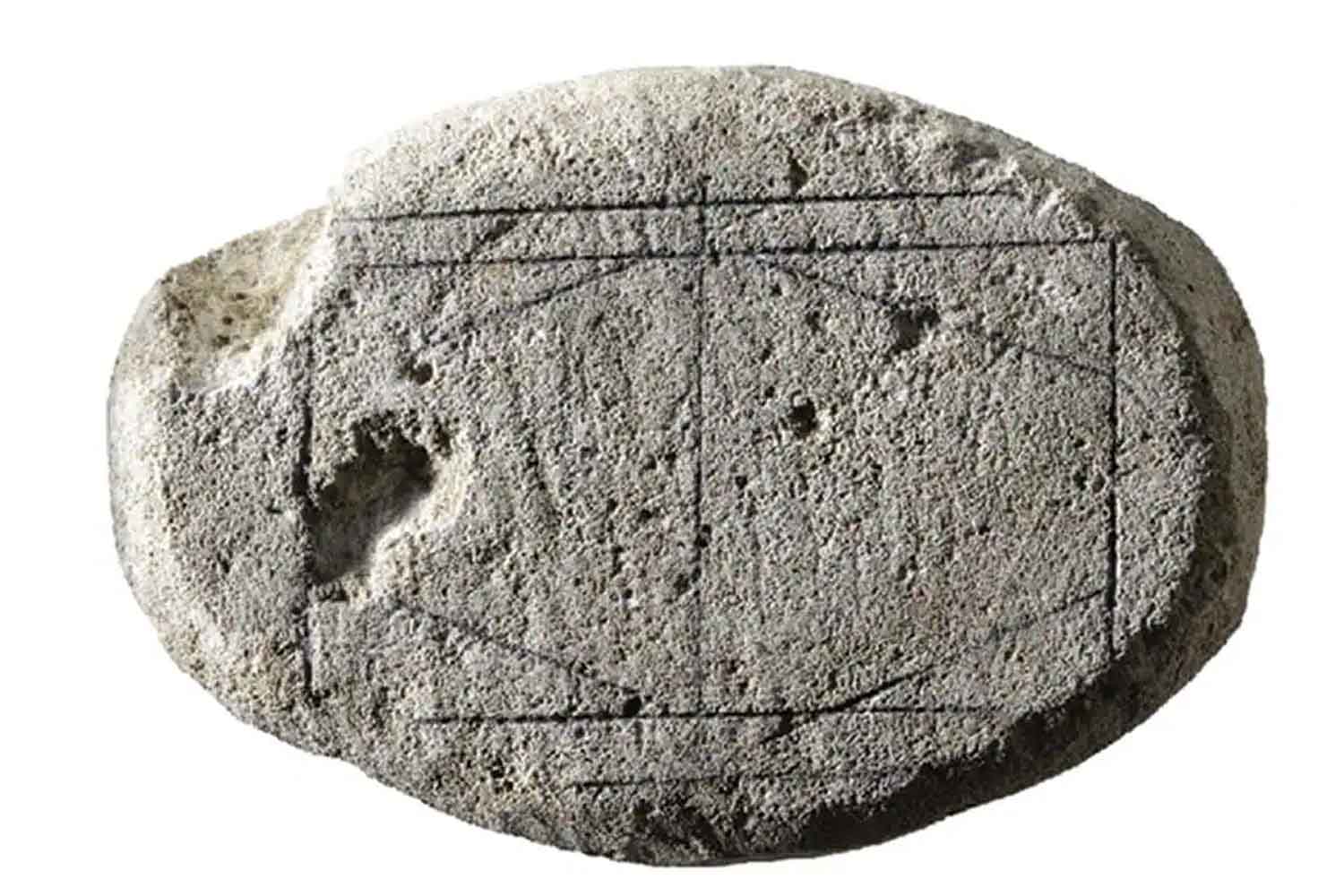
Sometimes discoveries do not come from digging in the desert, but from walking in silence among the display cases of a museum. Summer 2020. A brief respite from lockdowns. The archaeologist Walter Cristspecialized in ancient games, is located atHet Romeins Museum from Heerlen, the Netherlands. He is looking at the remains of Coriovallumthe Roman city that once lived beneath modern streets. Then he notices a block of white limestone, about twenty centimeters wide, engraved with geometric lines. It is listed as a probable gaming board.
Yet, something doesn’t add up. The incisions form an elongated octagon within a rectangle. It’s not three of a kind. It’s not the fillet. It is not any of the Roman games already known to scholars. For an expert like Crist, used to recognizing ancient boards at first glance, that geometry is an anomaly.
It is precisely from that sensation that the story of Ludus Coriovallia Roman game that remained hidden for centuries and was reconstructed thanks to artificial intelligence.
The stone that didn’t match any known Roman game
The find, identified as object 04433, is made of Norroy limestone, a stone that the Romans imported from France for important columns and monuments. Not the most common material for a home pastime. The block, however, had been reused. It was probably one spoliaan architectural fragment recovered and engraved with a simple but intentional grid.
The main problem was another: the object had been found between the end of the 19th century and the beginning of the 20th century without a documented scientific excavation. No precise context. No reliable stratigraphic dating. Just a hypothesis: maybe a game. To understand if it was really a board, the researchers analyzed the surface under a microscope. When glass or stone checkers are slid over a limestone surface for years, they leave polished areas, areas that are smoother than the rest of the surface.
And those areas were there. Concentrate along very specific lines, especially on a diagonal. Not random scratches, but consistent traces with repeated movements. The stone told a story. We just had to interpret it.
Ludus Coriovalli: the rules reconstructed thanks to AI
At this point technology enters the scene. The team involved the Digital Ludeme Project and the Ludii artificial intelligence system. The goal was to simulate hundreds of possible variations on a digital replica of Heerlen’s board to understand which rules would produce exactly those same wear marks.
Virtual agents played 1,000 games of each variant, using Alpha-Beta pruning techniques to mimic competent players. Lineup games, similar to tic-tac-toe, running games and blocking games, where the aim is to trap the opponent, were tested. The result was clear: the wear did not correspond to an alignment game or a race. It was consistent with a block game.
This is how the Ludus Coriovallian asymmetrical comparison reminiscent of the “dogs and hares” model, known in medieval Scandinavia but never before documented in the Roman Empire.
According to the most convincing simulations, one player controlled four “dogs” and the other two “hares”. The dogs started from the four leftmost points of the board, the hares from the two internal points on the right side. In turns you could move a pawn along the engraved lines towards an adjacent free space. The dogs had to block the hares; the hares had to remain free for as long as possible. The winner was the one who, as the hares, managed to avoid the block the longest.
Today this game can also be tried onlinethanks to digital reconstruction.
A piece that changes the history of European games
Until now it was thought that block games only arrived in Europe in the Middle Ages, with examples such as Haretavl or Fox and Geese. The Ludus Coriovalli anticipates this typology by several centuries, demonstrating that forms of “hunting games” already existed in Roman times.
The Romans were known for strategic games such as Latrunculi and Duodecim Scripta, the ancestor of backgammon. But this discovery suggests that alongside the more documented games there existed a less visible popular tradition, perhaps played on wood or earth, materials that have not survived.
The study, published in the journal Antiquity, also opens up a new methodological perspective: using artificial intelligence not only to analyze archaeological data, but to simulate human behavior and interpret objects from the past.
And perhaps this is precisely the most fascinating aspect of Ludus Coriovalli. A stone slab smoothed by hands from two thousand years ago. Sliding pawns. Strategies. Attempts to block the other. The desire to win, but also to share a slow time.
The supports change, today a screen, yesterday a stone, but the need to play remains surprisingly identical.
