
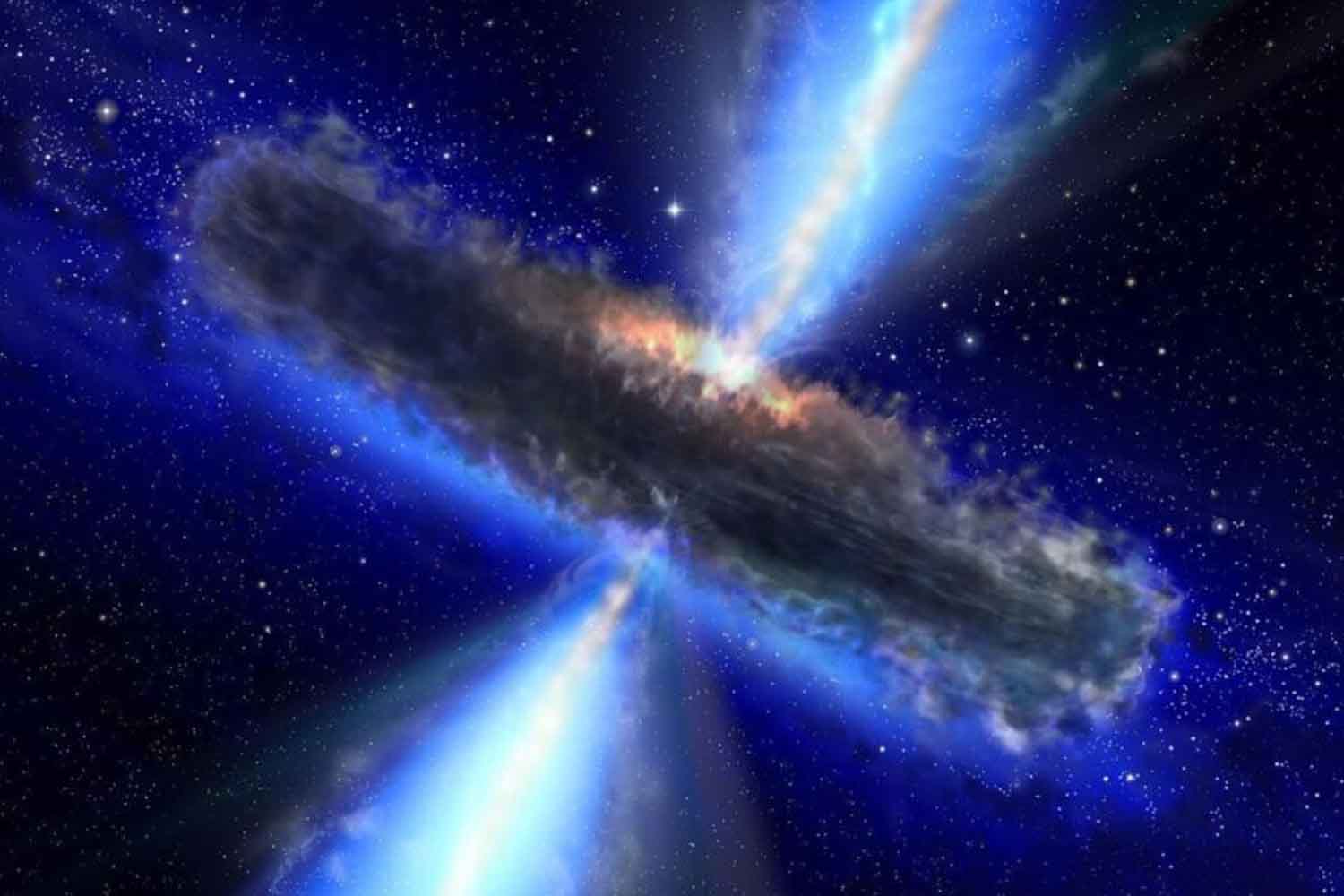
In the heart of a remote corner of the universe, astronomers have identified an exceptional discovery: the largest water tank ever observed in space. This immense quantity of water, equal to 100 trillions of times the water contained in all the oceans of the earthis located at about 12 billion light years with us, wrapping an active quasar known as APM 08279+5255.
The quasar apm 08279+5255 It’s not just any quasar. At its center there is a Black supermassive hole with a mass equal to 20 billion times that of the sunmaking it one of the most powerful objects of the known universe. This Quasar releases an extraordinary energy, equal to that produced by 1 trillion of onlyfeeding the huge cloud of gases and dust that surrounds it.
What makes this discovery even more surprising is the enormous amount of water vapor this around Quasar. To make a comparison, the Milky Way contains 4,000 times less Gassy water, and most of it are in frozen form. The presence of this colossal water reserve suggests that the gas around Quasar is heated up to extreme temperatures, emitting X -rays and infrared radiation. This phenomenon makes the gas incredibly dense and warmcreating unique conditions than the galaxies closest to us.
Water in the Quasar: a key to understanding the evolution of black holes
The discovery of water vapor Around this far quasar is not only an astronomical curiosity, but a precious clue to understand The primordial environment of the Quasar And the way in which the supermaxicci black holes grow. Although the water is considered a minor molecule in astronomy, its study helps to determine important thermodynamic properties as a temperature and pressure of the surrounding gas.
In the case of APM 08279+5255the gas around Quasar has a temperature of about -63 degrees Fahrenheitwhich although it may seem low, is actually much warmer and dense than what is observed in the Milky Way. This Quasar is found at a Redshift by Z = 3.9dating back to an era in which the universe had only 1.6 billion years. The study of this region full of water helps scientists to better understand The evolution of black holes in the oldest phases of the cosmos.
According to the researchers, the central black hole of the Quasar could increase its mass up to Six times the current onethanks to the amount of gas available. However, it is not yet clear whether all this material is absorbed by the black hole or if a part of it gives rise to new stars or will be expelled from the guest galaxy.
This extraordinary discovery was possible thanks to the development of cutting -edge tools in the field of Millimetric and Sub -Millimetric Radio Aastronomy. The first water vapor detection in Quasar APM 08279+5255 took place through the Z-Spec Spectrograph at the Caltech Submillimeter Observatory in Hawaii. Subsequently, observations conducted with the Plateau de bure interferometer and the Carma (Combined Array for Research in Millimeter-Wave Astronomy) have confirmed not only the presence of water, but also its immense quantity.
The use of these sophisticated technologies made it possible to explore the primordial universe with unprecedented precision. Future tools, such as the Ccat telescopecould open new paths in understanding the galaxies formation and cosmic expansion, offering further clues on how our universe took shape in its first billion years.
A discovery that changes the understanding of the primordial universe
The identification of the larger and largest tank of water ever discovered It represents an important milestone in modern astronomy. The quasar apm 08279+5255with its immense cloud of water vapor fueled by a ultra-milesty black holedemonstrates how rich and dynamic the primordial universe is.
Thanks to technological progress, scientists are increasingly close to answering fundamental questions about the origin of the cosmos and the evolution of black holes. How many other discoveries await us in the depths of the universe? Only time and the continuous exploration of the space will be able to reveal it.
