
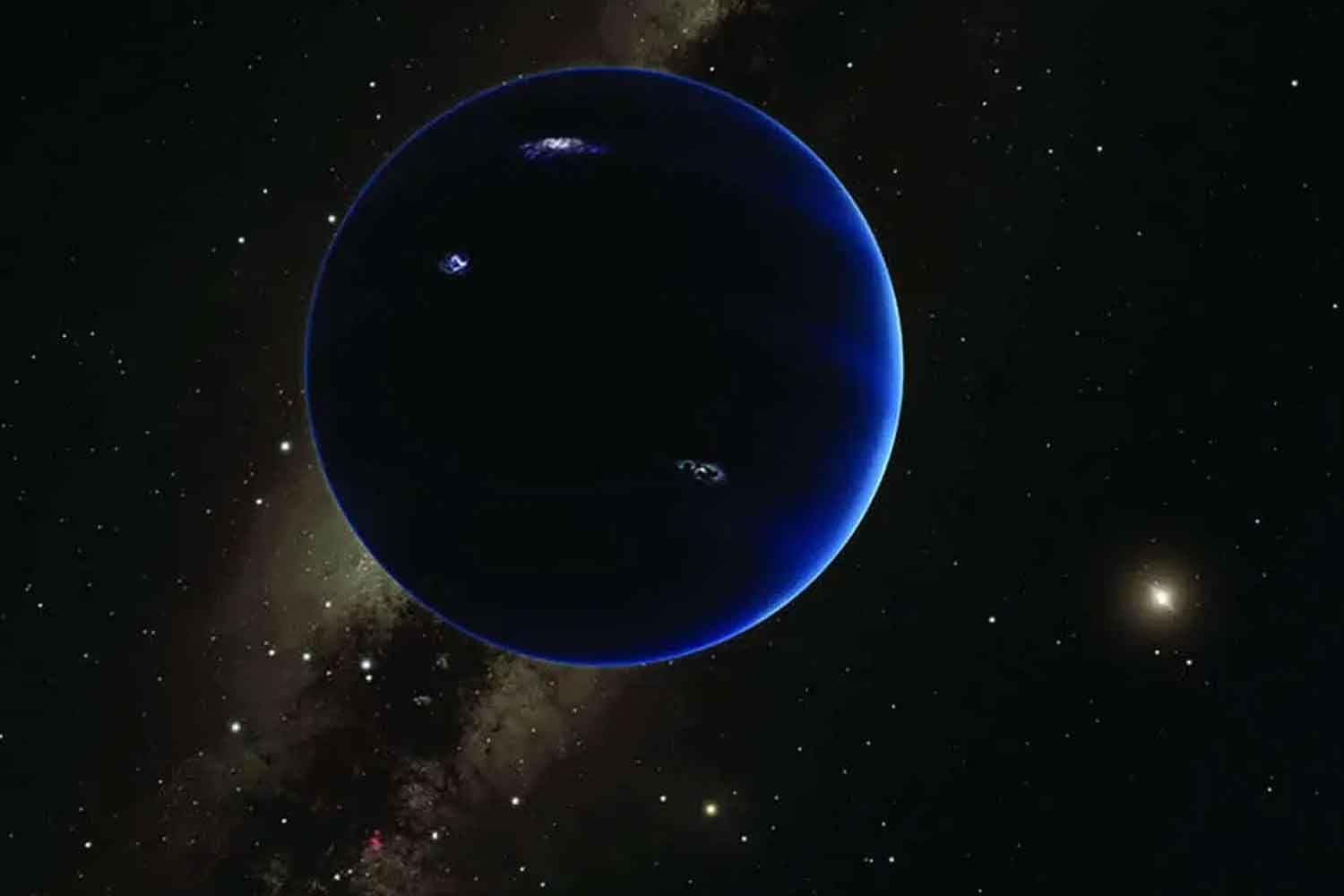
A Small and feeble bright point immortalized by telescopes in the deep sky of the south hemisphere could mark an epochal turning point: scientists speculate that it is the much discussed Planet ninethe enigmatic celestial body whose existence has been theorized for years, but never confirmed.
The weak object was sighted thanks to Blanco telescope of the Intemerican Observatory of Cerro Tololo, in Chile, during the project Dark Energy Survey (Des), a vast observation campaign that has mapped millions of galaxies, supernovae and other cosmic phenomena over the past few years.
An ideal candidate
The interest of astronomers was immediate. The dot, albeit faint and distant, shows orbital characteristics compatible with those expected for the Planet nineaccording to what suggested by the theoretical models. According to simulations, this hypothetical planet should have a mass between five and ten times the terrestrial one, and orbital around the sun at a distance equal to hundreds of astronomical units.
His presence was hypothesized to explain some abnormal deviations In the orbits of objects of the Kuiper belt, an area populated by frozen bodies beyond Neptune. The astronomers Mike Brown and Konstantin Batygin of Caltech had advanced this theory in 2016, claiming that an unknown planet could be the cause of these irregular gravitational movements.
Still early to confirm
Despite enthusiasm, scientists remain cautious. The identified glow is extremely fioco, and it could also be a particularly distant transnettunian object, or a body from the Oort cloud. To confirm the identity of the alleged Planet ninefurther monitoring and observations will be needed.
The tools used so far do not yet allow to determine with certainty or the massIn the’Complete orbit of the object. However, the fact that it was identified by an independent investigation and in a region consistent with the theoretical forecast makes this discovery promising. Astronomes are now crossing the data with those collected by other telescopes in the world to establish the trajectory of the object and determine their nature.
If it really is about, we would find ourselves in front of one of the most significant astronomical discoveries of the century.
