
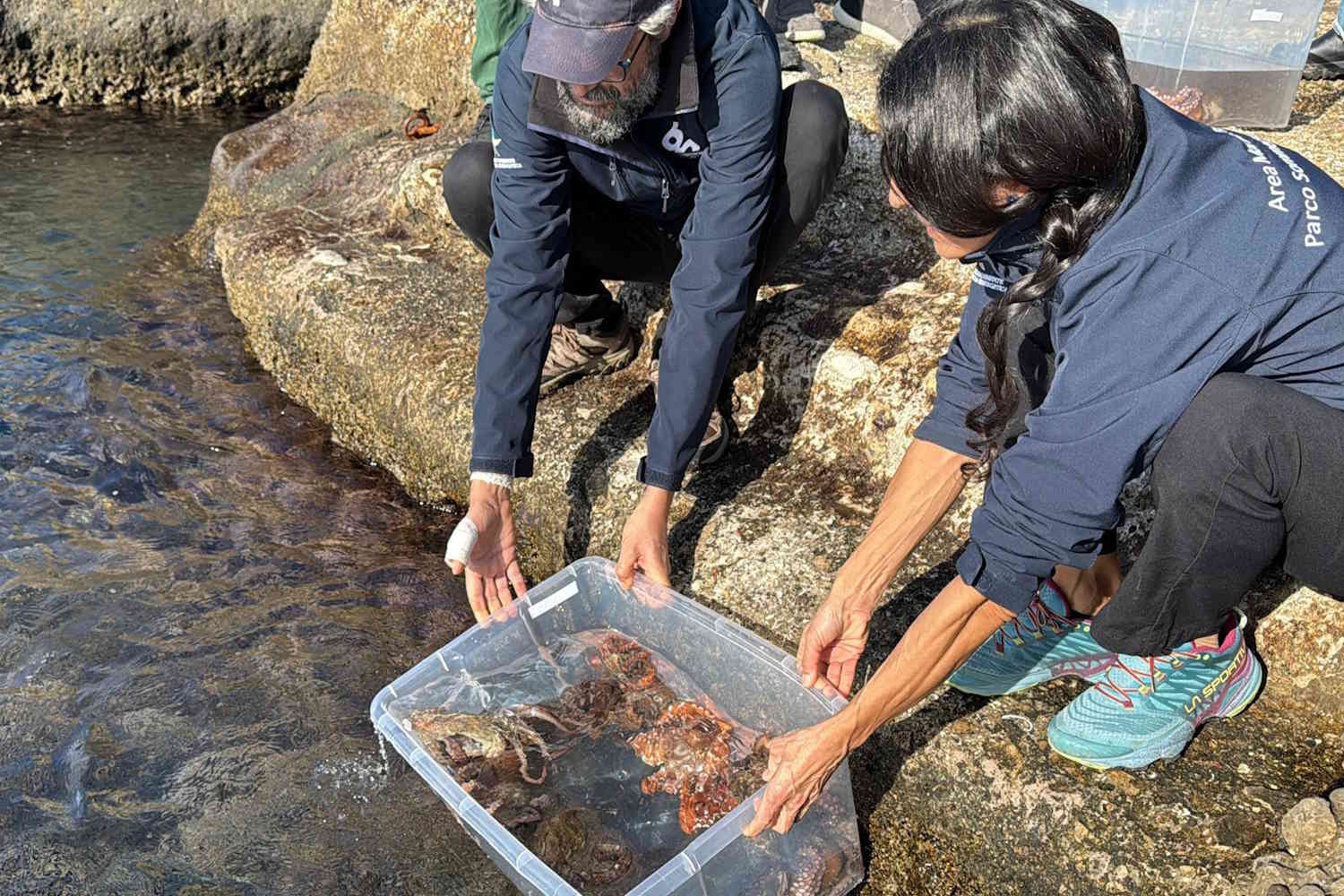
As many as 35 octopuses rescued from various fishmongers in Naples and released into the waters of the Marine Protected Area. We are in the magnificent Gaiola area and here the volunteers have returned to the sea small octopuses that barely reached 200-300 grams, definitely too small to end up on the fishmongers’ counters.
Therefore, removed from the market and released back into the wild in the waters of the Gaiola Marine Protected Area, a return to the sea which is equivalent, for these animals, to a second chance at life. In this specific case, then, these are still immature animals, which have not reached the age and size necessary to develop sexual organs and reproduce.
As with humans and land animals, marine organisms also need time to complete their life cycle. Fishing them too early means eliminating future spawners, compromising the very survival of the species. Furthermore, Christmas is one of the most critical periods for the sea. The increase in demand for fish and shellfish often ends up fueling illegal fishing activities, which spare neither marine protected areas, nor species at risk, nor undersized specimens.
Octopus, in particular, is one of the main victims of this system: in great demand on holiday tables, it is often fished without respecting biological and regulatory limits, with devastating effects on marine balances.
Because octopuses must be saved
Saving octopuses is not just an ethical issue, but an ecological one. The common octopus (Octopus vulgaris) is a key species of marine ecosystems: it regulates the populations of crustaceans and small molluscs, contributes to the balance of the food chain and is an indicator of the health of the sea.
Furthermore, octopuses are extraordinarily intelligent animals, equipped with complex cognitive abilities, memory, problem solving and advanced social behaviors. Removing them from the sea when they are still young does not only mean reducing a future resource, but impoverishing an ecosystem already under pressure.
That of Gaiola was not, therefore, a simple liberation, but a clear message: the sea is not an infinite pantry. By bringing 35 young octopuses back to life, we wanted to shine a spotlight on an often invisible crisis, remembering that every consumer choice has direct consequences on ecosystems.
Those octopuses will now be able to grow, reproduce and contribute to the biodiversity of the Mediterranean. A small gesture, sure. But it is also here that the possibility of a future in which the sea is respected, and not just exploited, passes through.
