
Show for the eyes and hearts from Webb spatial telescopewhich today gives us some images of the universe As we have never seen it, with small key galaxies for cosmic transformation in what we know today.
Using the data of the NASA James Webb spatial telescope (JWST), astronomers identified dozens of small galaxies who played a leading role in the cosmic transformation that brought the primordial universe into what we know today.
When it comes to producing ultraviolet light, these small galaxies are well above their abilities – explains Isak Wold, of NASA’s Goddard Space Flight Center – our analysis of these small but powerful galaxies is 10 times more sensitive Compared to previous studies and showed that they existed in sufficient numbers and had sufficient ultraviolet energy to guide this cosmic transformation
What we can see with such a powerful space telescope
What “sees” a space telescope is the light emitted by the starswhich however takes some time to get to us. Note the speed of light, astronomers are able to determine with a certain precision, the distance of the stars from which the light comes out.
The “instantaneous”, however, is the photograph of those stars as they were when the light was emitted, here’s because the more far the galaxy is, the more the photo is far over time.
The JWST really revolutionized the observation and study of the deep space, managing to dig galaxies before him unthinkable to find, the last one about a year ago, the Jades-Js-Z-14-0, The most distant galaxy currently knownat “Solo” two hundred and ninety million years after the big Bang.
In general, from its launch in 2021, the JWST has detected galaxies more and more distant over time: it can in fact make an approximate estimate of the distance traveled by the light from them to us, acquiring one rapid instantaneous of the galaxythrough a process called photometry. Then, to confirm the exact distance of a galaxy, the researchers use the spectroscopy To analyze all the components of the light emitted.
The origin of the universe (and why the Webb spatial telescope) was designed)
We know that, for most of its first billion years, the universe was immersed in one neutral gaseous hydrogen fog. Today, this gas is ionized, deprived of its electrons, and astronomers, which they call this transformation reionisationfor a long time they asked what types of objects were the main managers: large galaxies, small galaxies or supermaxicci black holes in active galaxies.
Just here “Born” Webb: the space telescope was in fact designed specifically for answer key questions about this important transition in the history of the cosmos.
Recent studies have shown that small star galaxies may have played a key role. Today these galaxies are rare, representing only about 1% of those around us. But they were abundant when the universe was about 800 million years old, the era in which, according to astronomers, reionisation was in full swing.
What the new study has now discovered (and how it was conducted)
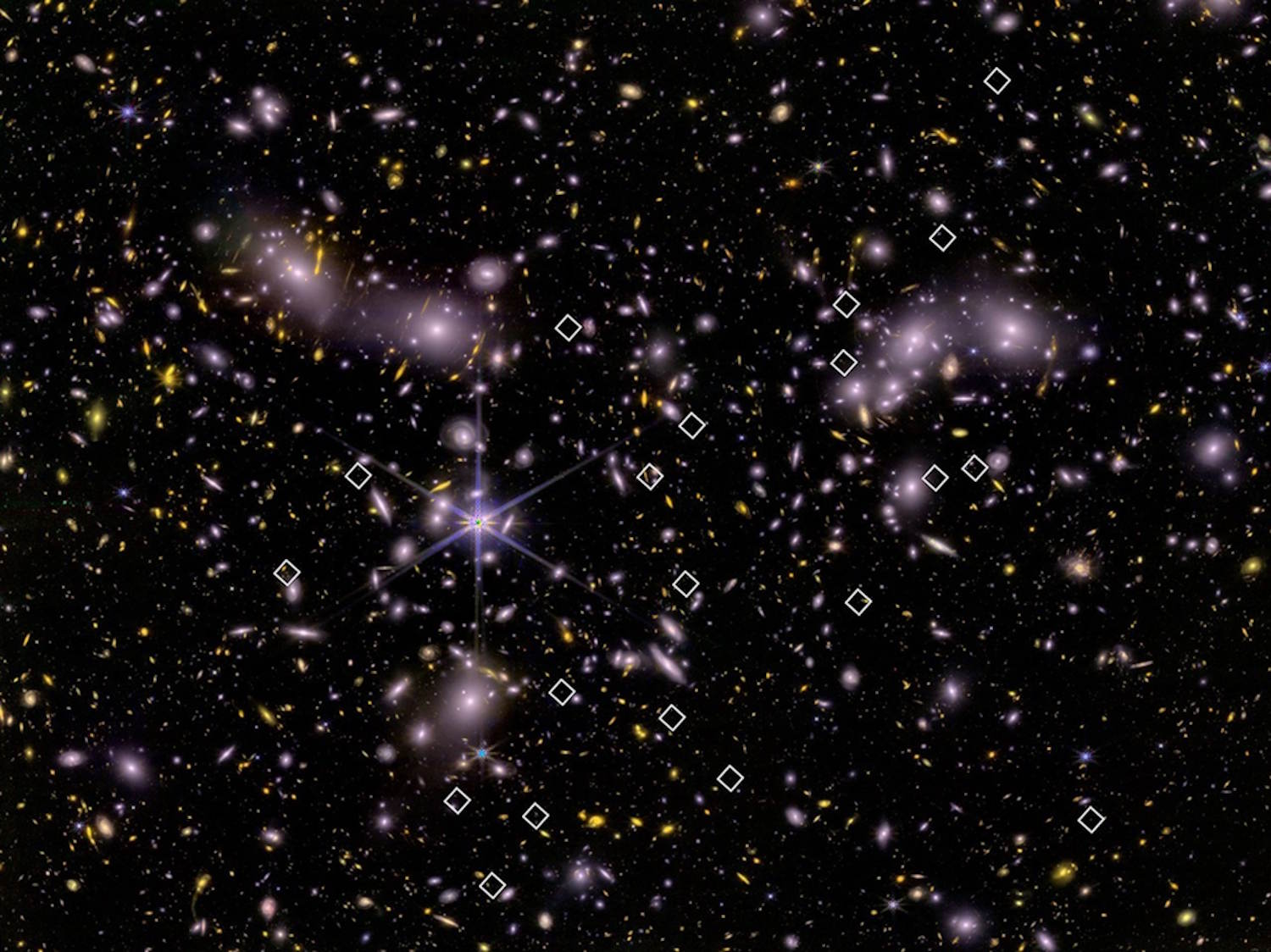
The team then sought small galaxies of the cosmic age they showed “Primordial” stellar signs of stellar formationcalls Starburst.
Small mass galaxies collect less hydrogen neutral around them, which facilitates the escape of ionizing ultraviolet light – explains James Rhoads, co -author of the discovery – in the same way, the episodes of Starburst not only produce abundant ultraviolet light, but also dig channels in interstellar matter of a galaxy that favor the escape of this light
The research made use of the existing images collected by the tool in particular NIRCAM (Near-Infrared Chamber), as well as new observations made with its instrument Nirspec (Near-Infrared Spectrograph), as part of the Uncovery observation program (Ultradeep Nirspec and Nircam Observations Before The Epoch of Reionization), led by Rachel Bezenson ofUniversity of Pittsburgh in Pennsylvania.
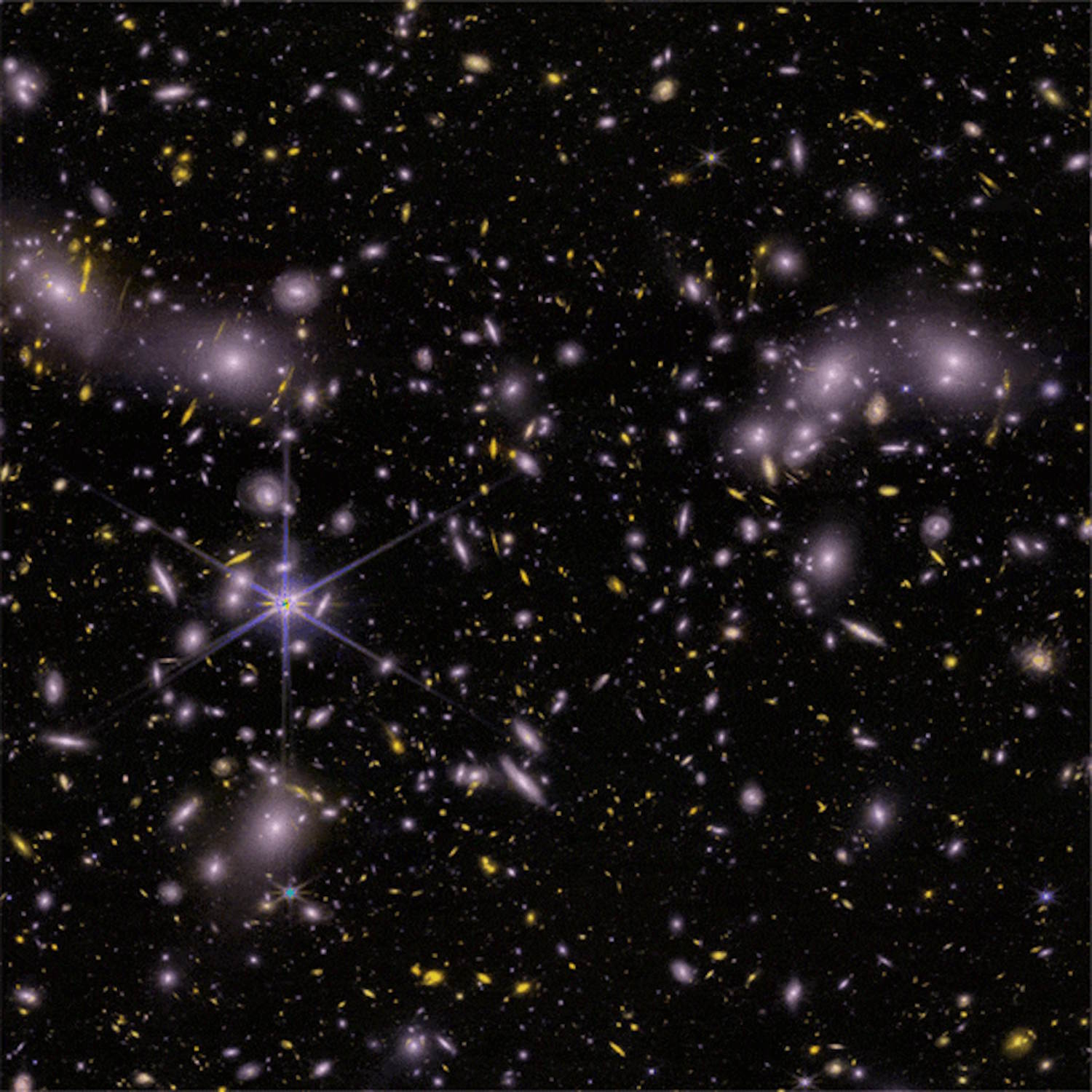
The project has mapped a gigantic cluster of galaxies known as Abell 2744nicknamed ‘Pandora’s cluster‘, located about 4 billion light years away in the southern constellation of the sculptor. The mass of this cluster forms a sort of “gravitational lens” which enlarges distant sources, further expanding the already considerable scope of the Webb telescope.
Astronomes have sought intense sources of a specific wavelength capable of revealing the presence of high energy processesin particular a green emission from oxygen atoms that have lost two electrons. Oxygen is a chemical element very electronegativethat is, with a strong tendency to attract electrons to itself. There is therefore aenormous energy To tear two more to his nucleus.
Originally emitted as light visible in the primordial cosmos, the green brightness of the oxygen doubly ionized “stretches” in the infrared while crossing the expanding universe and finally reached Webb’s tools.
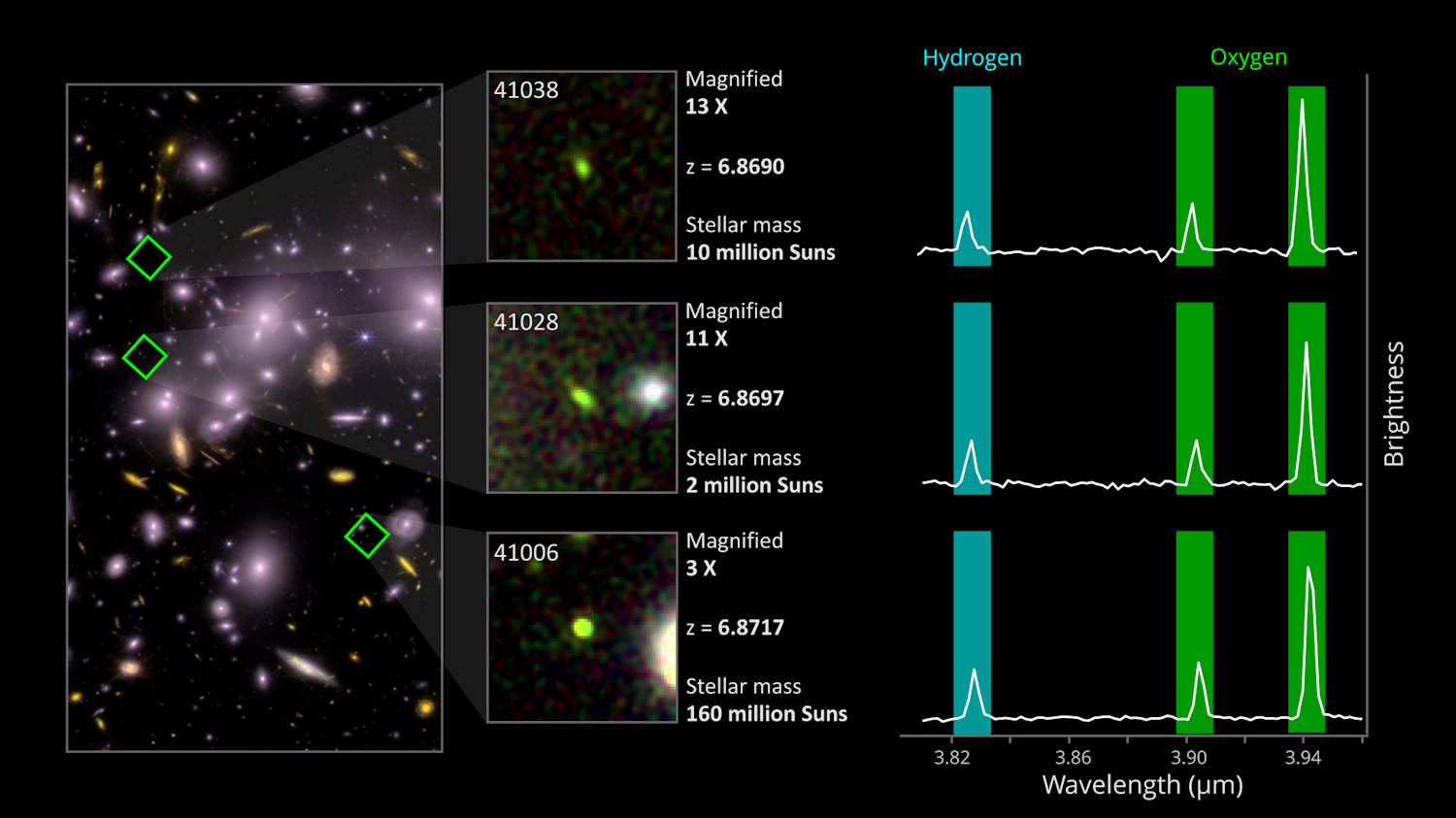
This technique revealed 83 small Starburst galaxies Just as they appeared when the cosmos had 800 million yearsor about 6% of his current age of 13.8 billion years. The team has selected 20 for a more in -depth analysis using Nirspec.
These galaxies are so small that, to build the star mass equivalent to our Milky Way, they would like it from 2,000 to 200,000 – explains on this Sangeeta Malhotra, who has collaborated in research – but we are able to detect them thanks to our innovative technique of selection of the champions combined with the gravitational lens
The discoveries were shown to the 246th conference of theAmerican Astronomical Society in Anchoragein Alaska last June 11, 2025.
Source: NASA
