
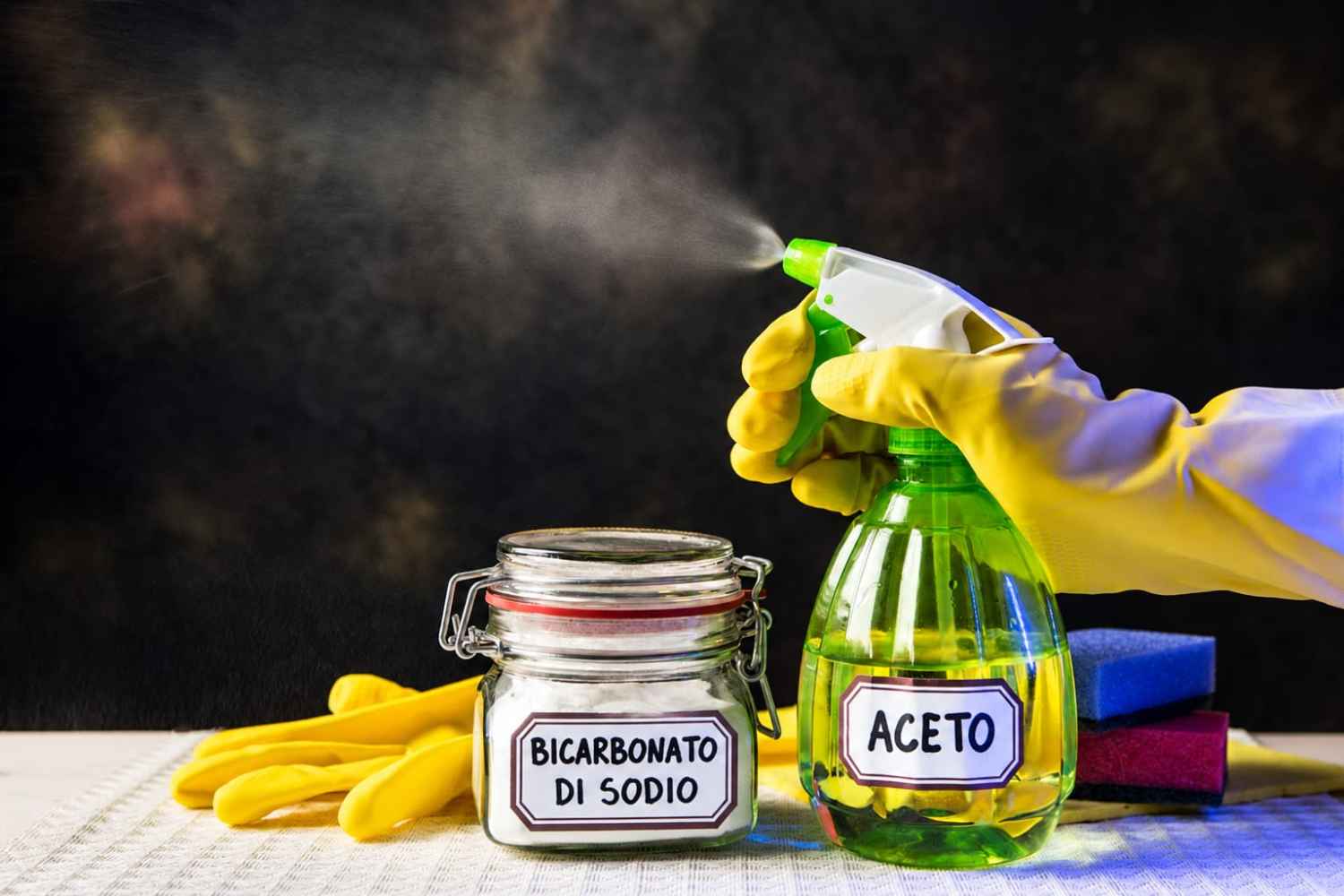
There is a scene that we have seen many times in videos dedicated to natural cleaning: you pour the vinegar on the bicarbonate of soda, a cloud of foam immediately starts and, for a few seconds, it seems like you are witnessing some sort of small domestic miracle.
The more it fizzes, the more spontaneously we think it’s working. And instead that spectacular foam is telling us a very different story: it is not the signal that we have created a very powerful detergent, but of the chemical reaction between two substances that are consuming each other.
It’s one of the most resistant false myths of so-called green cleaning, along with the idea that baking soda, vinegar and lemon are a sort of invincible team to use together for anything. In reality, to get the best from these ingredients you need to do exactly the opposite: know their properties and use them separately, always keeping in mind what they can really do.
And there is another equally important rule: do not exceed the quantities just because they are substances considered “natural”.
Baking soda and vinegar together
Let’s start with the most famous combination.
The reason why a large amount of foam immediately forms when they are mixed is a simple chemical reaction. Baking soda is a basic substance, while vinegar contains acetic acid, so it has acidic characteristics. When the two substances come into contact, they react with each other and produce, among other compounds, water, sodium acetate and carbon dioxide.
It is precisely the latter that is responsible for the characteristic effervescence that we observe: the bubbles that develop are in fact the gas released by the reaction. The foam, therefore, is not the dirt that is dissolving and does not indicate that we have obtained some sort of more powerful detergent. On the contrary, by mixing the two ingredients we cause the acidic and basic properties that we could have exploited separately to react with each other.
This does not mean that the mixture cannot have any effect during cleaning: the effervescence can contribute, in some situations, to mechanically moving residues and particles. But it is important not to confuse this effect with greater cleaning capacity and, above all, not to consider the amount of foam as an indicator of cleaning effectiveness.
The same goes for lemon juice and baking soda. Also in this case an acid reacts with a basic substance, producing carbon dioxide and therefore the characteristic effervescence. The result may be spectacular, but it does not mean that we have created a more powerful cleaner simply by putting the two ingredients together.
What is bicarbonate of soda used for?
We must not think that bicarbonate is useless, the problem is attributing properties to it that it does not have. We are talking about a very versatile substance that can have various domestic uses, but not a universal detergent capable of degreasing, eliminating limescale, sanitizing and softening laundry all together.
One of its simplest and most sensible uses is, for example, to help combat bad odors. It can also be used as a delicate abrasive agent in some cleaning operations, thanks to its consistency.
But if we have a surface encrusted with limestone in front of us, bicarbonate is not the most suitable substance: limestone is mainly made up of calcium carbonate and, to dissolve it, acidic substances are needed.
The rule “the more I put, the better it cleans” doesn’t apply either. A larger amount of bicarbonate does not turn it into a more effective limescale remover or degreaser, if we are using more than necessary, we are simply increasing the amount of substance that will have to be removed or it will end up in the wastewater.
Vinegar really works against limescale
This time we are not faced with a myth. In fact, vinegar contains acetic acid, an acidic substance capable of reacting with limescale deposits and which is also used in some specific products for limescale removal. Used alone, therefore, vinegar can be useful in some cleaning operations, especially when we need to eliminate mineral residues and limescale encrustations.
This does not mean, however, that it is a universal solution to be used without distinction on all surfaces. The same acidity that makes it effective against limescale can in fact make it unsuitable, or even risky, on some materials. This is the case, for example, of marble and other limestone, which can be damaged by acidic substances. Some metals and particular finishes can also be affected by exposure to vinegar.
This is why it is important not to transform vinegar into a “good for everything” product: even in green cleaning, knowing the properties of what we use and choosing the right product based on the surface is much more useful than relying on the rule according to which, being natural, it can be used anywhere.
And from an environmental point of view? Here you have to be careful because natural does not automatically mean ecological.
Acetic acid, especially at high concentrations, can be harmful to aquatic organisms. At the same time it is a biodegradable substance: it is therefore not correct to describe vinegar as a persistent pollutant, nor to consider it completely harmless regardless of the quantity used.
This is an important concept when we talk about sustainable cleaning. It’s not enough to take a substance from the kitchen and call it “green”, we need to consider what it does, how much we use, on which surfaces and where it ends up after use.
Quantity, in particular, matters. Even for a biodegradable ingredient, the most sustainable choice is not to use large doses “to be safe”, but to use the quantity actually necessary to obtain the desired result.
This is precisely where we need to scale back some of the recipes circulating online. Vinegar is often recommended as a natural softener in the washing machine or as a rinse aid in the dishwasher. But there is no point in turning it into a universal product for these appliances.
In particular, acidity may not be suitable for some materials, seals, finishes or components, and for many uses there are products formulated specifically for that function.
This does not mean that a small amount of vinegar used occasionally on a particular surface automatically causes damage. It simply means that “it’s natural” is not a sufficient guarantee to use it everywhere and continuously.
When to use baking soda and when to use vinegar
Ultimately, the rule is much simpler than the many recipes circulating on social media suggest. Bicarbonate can be useful when we want to neutralize odors or take advantage of its delicate abrasive action, while vinegar makes sense when we need the action of an acidic substance, for example to help remove limescale and some mineral deposits.
In this case, however, it is important to always evaluate the type of surface on which we use it and not to exceed the quantities, also avoiding turning it into a remedy to be poured regularly down the drain.
The best limescale remover
And if we want a descaler, what can we use? Here comes into play an ingredient less famous than vinegar, but very interesting for household cleaning: citric acid.
It is also an acid, so it can be used to combat limescale and mineral deposits. But it has characteristics that make it particularly interesting for some domestic applications, so much so that it is also used in detergent products and as a sequestering agent. Available data also indicates that it is easily biodegradable and has a low bioaccumulation potential.
It can be used, in the right dilutions and following the instructions relating to the surface or appliance, as a limescale remover and descaler, and is also used in some solutions for laundry and household appliance maintenance.
Even here, however, a fundamental rule applies: being a naturally derived product does not mean it can be used everywhere. Marble, limestone and other acid-sensitive surfaces should also be protected by citric acid.
In the end, in the most sustainable cleaning, the recipe with the most ingredients does not win, nor the one that produces the most foam. The conscious use of the right substance, in the necessary quantity and on the right surface, wins.
