
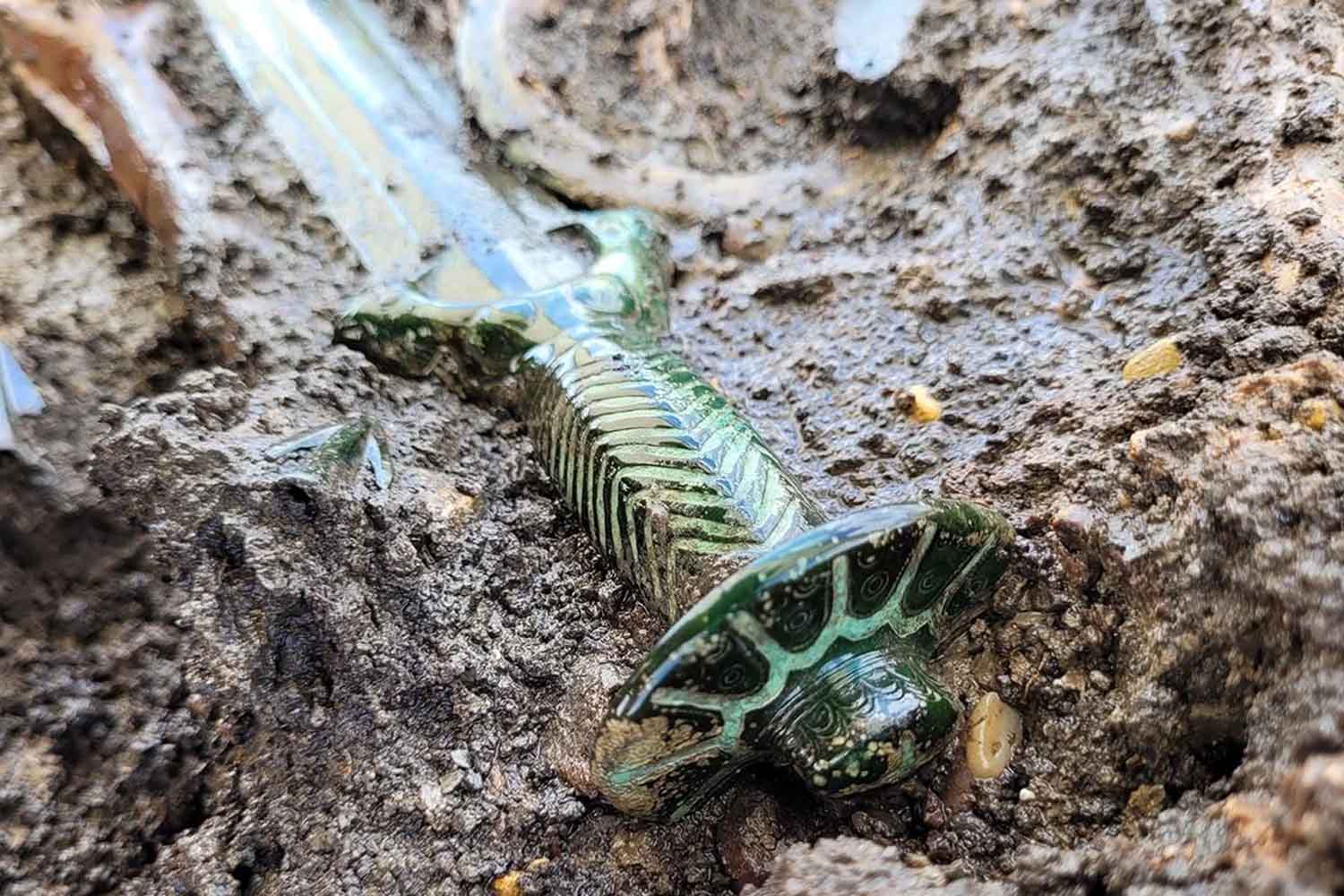
There are objects that pass through time. And then there are objects that challenge him. There Bronze Age octagonal sword found in 2023 in Nördlingen, in Bavariadefinitely belongs to the second category. More than 3,400 years old, a blade still almost sharp, visible geometric decorations, surfaces that still shine in some places. It is not just an archaeological find, but a story that has remained intact underground, which today science is learning to read line by line.
And no, it’s not “just” a sword. It is proof that already in the second millennium BC, in southern Germany, metal was being worked with a precision that still surprises us.
A weapon that becomes a source of knowledge
After being found during an archaeological excavation, the sword was sent to Berlin by Bayerisches Landesamt für Denkmalpflege to be studied with cutting-edge technologies. The analyzes were carried out at Helmholtz-Zentrum Berlin and the Bundesanstalt für Materialforschung und -prüfungusing the BESSY II synchrotron radiation source.
The experts used a 3D computed tomographythe X-ray diffraction to analyze the internal tensions of the metal and the X-ray fluorescence spectroscopy to take a look “inside” the sword without touching it or damaging it. And what they saw was fascinating.
The blade extends into a sort of metal tongue that enters the handle and is blocked with rivets. A complex, precise, thoughtful system. It is not an improvised object. It is the result of advanced technical knowledge. And the analysis of the residual stresses in the metal showed the traces of the processes: heating, casting, hammering, forging. Each phase left a microscopic imprint on the crystalline structure of bronze. It’s like reading the fingerprints of a craftsman who lived 3,400 years ago.
Copper wires, color contrasts and maybe even urine
The most surprising detail is the decorations. Deep geometric grooves are engraved on the knob and end plate. Inside those engravings there was a material other than bronze. At first it was thought to be tin, softer and easier to work with. But no.
The analyzes revealed threads of copper inserted and joined with extreme precision. Copper: More difficult to shape than tin. A choice that speaks of skill, but also of aesthetics.
The scholars also found traces of tin and in some places lead, probably residues of the alloy. And there is a hypothesis that is striking for its concreteness: to darken the copper and make it stand out even more, a chemical coating could have been used, perhaps with organic substances such as urine. Yes, exactly that one. Chemistry, even before it is called chemistry.
This Bronze Age octagonal sword it doesn’t seem designed for everyday use in battle. It is too refined, too refined, too symbolic. It probably belonged to a high-ranking figure, perhaps it was a ceremonial object, a sign of power and prestige. And while today we observe it with sophisticated instruments and synchrotron radiation, what emerges is something very simple: even then there existed an evolved, conscious material culture, capable of combining technique and aesthetic vision.
Research will continue in the coming months to understand where it was made, even if the southern German area is already considered one of the main centers of diffusion of this type of sword in the Bronze Age. Meanwhile, this blade which has remained almost intact underground for millennia reminds us of a very concrete thing: knowledge is not born yesterday. And attention to detail, to materials, to beauty, is an ancient form of intelligence.
