
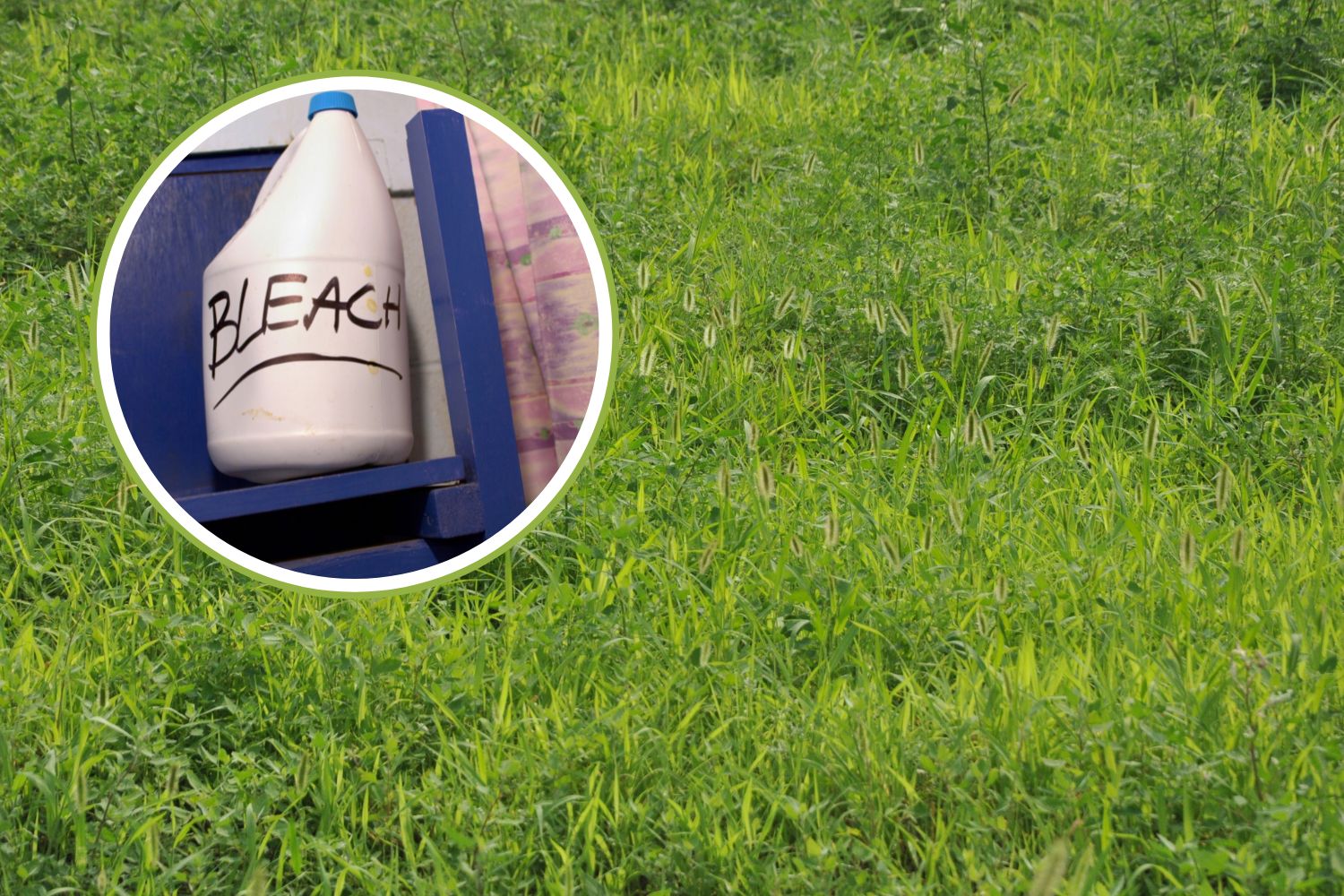
There are those who do it at dawn, to avoid prying eyes. There are those who instead claim it with pride, as if they had discovered the secret formula of eternal cleaning. We are talking about those who use bleach to “clean” the avenues from weeds, a practice as widespread as it is dangerous. Yet if you ask around, there is always someone ready to swear: “It works!”.
Of course it works, because bleach, by its nature, is lethal. On the other hand, it is designed to destroy microorganisms, bleaching, disinfecting. So certainly, if I had to pour it on a tuft of lion tooth, that would dry out within a few hours. But at what price? The problem is that bleach does not discount: where it passes, nothing grows.
One less grain, an extra dead soil
The scene is always the same: a watering can, some splashing here and there, a corner of the courtyard that in a few hours seems to have come out of a catalog of floors.
The bleach (which is chemically called sodium hypochlorite) is extremely corrosive. When he comes into contact with the earth, he kills everything he lives in the subsoil: mushrooms, bacteria, insects usthere. In practice, it eliminates that entire invisible community that works every day to keep the ground fertile. And it doesn’t stop there: penetrate deeply, it reaches up to the aquifers and contaminates. And if we really want to close in beauty, try to mix it with a little vinegar – yes, someone has done it – and you will get a nice toxic chlorine toxic gas. Other than urban agriculture.
An illegal herbicker
In Italy, as in most of Europe, the use of bleach as herdisan is not only not recommended, but really forbidden. The law is clear:, especially in public spaces or environmental risk (art. 228 of Legislative Decree 81/2008). And the bleach does not appear in the list of admitted phytosanitary products.
The health authorities, such as Anses in France, regularly warn against this type of domestic habits, since the risks can be very high: according to the data collected, More than 59% of cases of poisoning from domestic substances are linked to mixtures between bleach and acids. And often everything comes from an idea: “I just wanted to clean the courtyard …”
The cultural problem: “I have always done so”

The real obstacle, perhaps, is mental. There are rooted habits, handed down from generation to generation, which are difficult to eradicate, so patience, information and – why not – some alternatives that is effective but more respectful of the environment are needed.
Ecological alternatives (which really work)
Eliminating weeds without polluting is possible, only a pinch of goodwill is needed. Here are some solutions that do not provide for the use of toxic substances:
A healthier garden is possible
The truth is that natural methods require a little more time, and they certainly do not give the “wow” effect of the bleach, immediate and lethal. The great, however, is represented by the fact that unlike bleach, Natural methods preserve the ground, respect life can make our garden a small ecosystem, not a sterilized parking.
Using bleach to kill weeds is like washing dishes with muriatic acid: yes, fat goes away, but at what cost?
Green needs care, not of shortcuts.
