
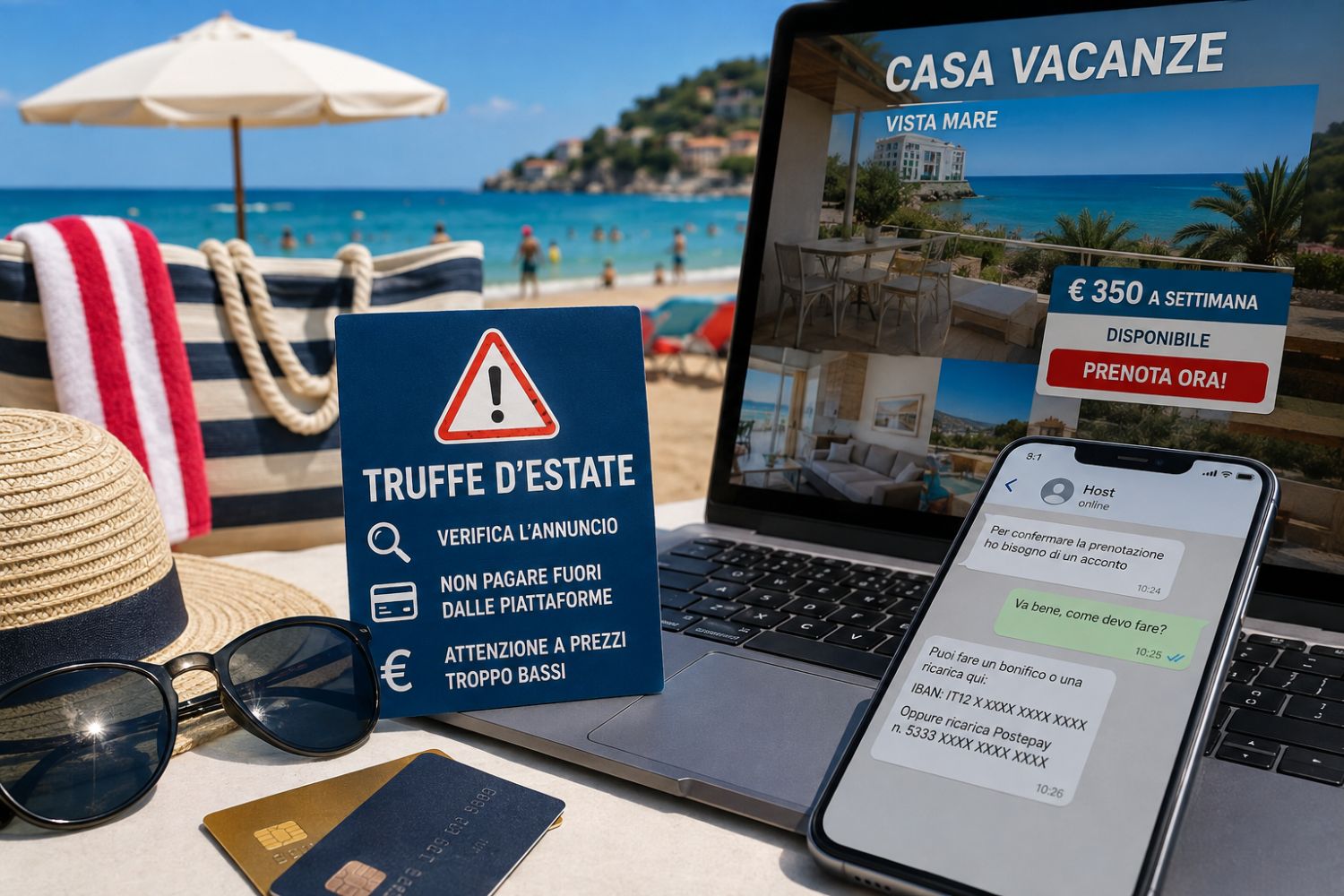
A residence that doesn’t exist, photos stolen from a real apartment, over 120 tourists left without accommodation in high season. It happened in Cesenatico a few days ago, and it was enough to bring back into the news a phenomenon which, behind the anecdote, hides figures that are anything but marginal. It’s happening in recent weeks, on Italian beaches but above all in the chats of those who are still looking for a house for August, where organized gangs operate who work almost exclusively online, supported by more artisanal street scammers. According to the Postal Police, those who fall into the net are not so much the elderly, as one might imagine, but rather young people between 18 and 24 years old: the speed with which they move between one announcement and another, combined with the lack of habit of checking each step, makes them the most exposed target to scams linked to bookings.
The holiday home that doesn’t exist
The mechanism is always the same: an advert on a social network or on a cloned portal, a price too good to be true, a request for a deposit via bank transfer or top-up before even having seen the structure in person. Then silence. In the case of the Residence Andrea in Cesenatico, reported by Sky TG24, the scammers had copied the images of a real apartment to build a credible advertisement: the toll, in addition to tourists without accommodation, is more than fifty complaints. The incident in Cesenatico certainly does not represent an isolated episode: for online bookings alone, there are over 1.7 million victims in Italy, as emerged from the awareness campaign conducted by the Postal Police.
A number that the annual report of the Postal and Cyber Security Police helps to better frame in the broader context of digital scams: in 2024, 18,714 cases were treated, up 15% on the 16,325 of the previous year, for a total of 181 million euros stolen from the victims, 32% more than the 137 million in 2023. The number of suspects, approximately 3,500, however, he did not move: a sign that the scammers are often always the same people, who are increasingly organised. This is also confirmed by the data released by the ANSA agency, which also reports a 20% growth in IT fraud in the strict sense, reaching 48 million euros. To complicate the picture, according to the Postal Police, generative artificial intelligence has been added in recent months: fake adverts, once recognizable by grammatical errors and grainy images, are now difficult to distinguish from real ones. “The recommendation is to make prudence a habit,” declared the director of the Postal Police Ivano Gabrielli, who indicates three recurring warning signs: price too low, host pushing to close quickly, request for payment outside the official platforms.
The dangers that await on the beach
In addition to online scams, we can still encounter other, older and equally profitable ones, including umbrellas and parking lots. Theft with the excuse of “keep an eye on my things” remains a classic, as do fake parking attendants who ask for a “protection fee” never authorized by anyone. On the roads leading to the sea, the mirror scam promptly returns: a sharp noise against the side, a car pulling alongside the victim, the request for 50 or 100 euros in cash to close the matter immediately without involving the insurance. It is to all intents and purposes a fraud crime, punished by article 640 of the Criminal Code, and the Carabinieri recommend only one counter-move: staying in the car, keeping the windows up and calling 112, because the mere prospect of a check by the police is almost always enough to make those who attempt the scam give up.
Then there are the more technological traps, such as fake Wi-Fi networks that imitate the name of a beach to intercept banking data, or QR codes replaced on menus and parking signs. And there is the summer variant of the fake nephew scam, which is not carried out on the beach but on the telephone: an apparently harmless phrase, “when are you coming to the seaside?”, is enough to make the victim believe he is talking to an acquaintance and to make him reveal on his own the names, places and dates that the scammer will use shortly afterwards to ask for the money.
